
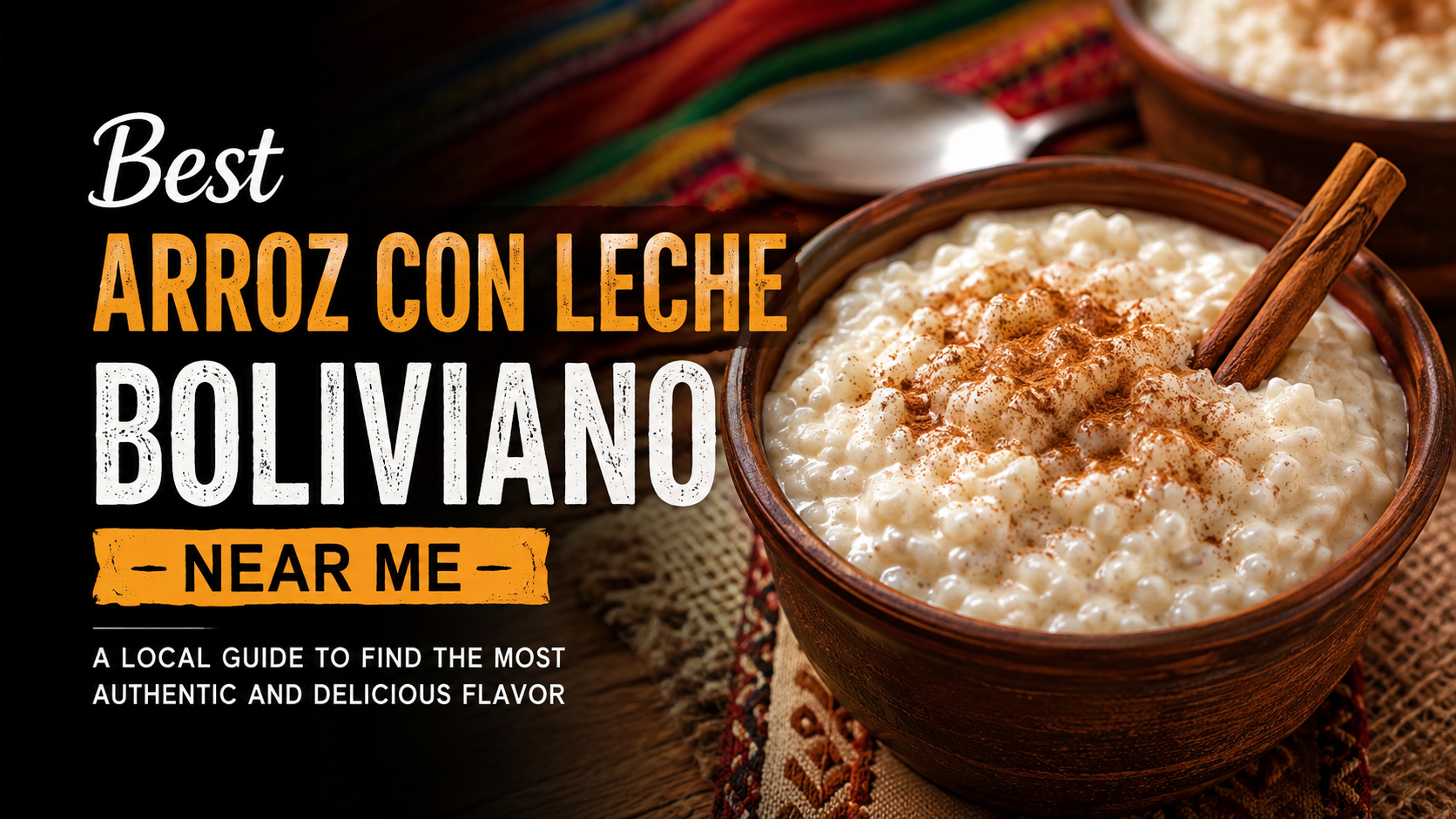

Searching for the best arroz con leche Boliviano near me usually means you are after something more memorable than an ordinary bowl of rice pudding. You want soft rice, creamy milk, warm cinnamon, gentle sweetness and the familiar comfort that makes arroz con leche such a loved dessert.
Bolivian arroz con leche is simple food, but simple does not mean boring. Families prepare it differently. Some prefer it light and milky, while others cook it until thick and rich. Condensed milk, evaporated milk, cinnamon, cloves and citrus peel can all appear depending on the family recipe. Bolivian recipe sources show just how much the preparation can vary while keeping the same comforting character.
If you are trying to find a good serving locally, knowing what makes the dessert special will help you choose the right restaurant, bakery or Latin American café.
What Is Bolivian Arroz con Leche?
Arroz con leche literally means “rice with milk.” At its heart, the dessert is made by slowly cooking rice with milk and sugar until the grains become tender and the mixture develops a creamy texture.
The Bolivian version does not follow one rigid formula. A traditional Bolivian Cookbook recipe, for example, uses rice, milk, evaporated milk, sugar, cloves and cinnamon. Another Bolivian recipe describes versions made with ordinary milk as relatively loose, while preparations containing condensed or evaporated milk can be noticeably thicker.
That variety is part of the appeal. Two Bolivian families may make arroz con leche differently, and both versions can feel authentic.
Some recipes are straightforward and lightly sweetened. Others are luxurious, with condensed milk producing a richer finish. Cinnamon is especially common, while cloves can provide a warm background aroma.
Read more: Best Humita en Chala Near Me: How to Find the Most Authentic Version
What Should It Taste Like?
A well-made bowl should taste creamy rather than simply sugary.
The rice needs to be completely tender but should still have enough structure to be noticeable. It should not resemble uncooked rice floating in sweet milk, nor should it become a solid mass.
Milk should provide most of the richness. Sugar belongs in the background rather than overpowering everything else.
Then come the spices.
Cinnamon gives arroz con leche its instantly recognizable warmth. Cloves are also found in Bolivian preparations and can add another layer of fragrance. A recipe published by Bolivian newspaper El Deber, for example, combines short-grain rice with evaporated milk, whole milk, cloves and cinnamon.
The best versions balance all of these elements instead of allowing one ingredient to dominate.
What Makes the Bolivian Style Different?
It is difficult to describe a single recipe as the only authentic Bolivian version because regional and family variations are common.
One preparation might contain mainly fresh milk and sugar. Another might combine regular, evaporated and condensed milk. Some recipes contain cloves, while others introduce lemon or lime peel for a fresher aroma.
A Bolivian recipe published by Opinión includes rice, sugar, milk, lemon peel and both stick and ground cinnamon. Another version uses evaporated milk and optionally adds raisins and citrus zest.
This means authenticity should not be judged by a single ingredient.
A better question is whether the dessert has been prepared carefully, slowly and with balanced flavours.
Finding the Best Arroz con Leche Boliviano Near Me
When searching online, start with “Bolivian arroz con leche near me” or “Bolivian restaurant near me.” If results are limited, broaden the search to Latin American restaurants, Bolivian bakeries, South American cafés and independent dessert shops.
Google Maps can be particularly useful because customer photographs may reveal dishes that are not listed clearly on a restaurant’s main website.
Do not rely only on the overall restaurant rating. Search within reviews for terms such as arroz con leche, rice pudding, Bolivian desserts, homemade desserts or postres bolivianos.
A restaurant may have excellent savoury food but buy its desserts from elsewhere. If arroz con leche is what you specifically want, reviews about that particular dish are more useful than a general star rating.
It is also worth calling ahead. Traditional desserts frequently rotate, and a small Bolivian restaurant may prepare arroz con leche only on particular days.
Check Whether It Is House-Made
One of the simplest questions to ask is:
“Is your arroz con leche made in-house?”
House-made does not automatically mean better, but it gives you useful information.
Arroz con leche benefits from careful cooking because its final texture depends on how the rice absorbs the liquid and how long it remains over the heat.
A freshly prepared batch may also have clearer cinnamon and milk flavours than a mass-produced dessert that has spent a long time refrigerated.
If the restaurant staff can explain how their arroz con leche is prepared — perhaps mentioning cinnamon sticks, evaporated milk, cloves or a family recipe — that is often a promising sign.
Look at the Texture
Appearance tells you quite a lot.
A good arroz con leche should normally look creamy and moist. The exact thickness depends on the recipe, so a slightly runny bowl is not necessarily poorly made.
In fact, Bolivian sources specifically note that some families prefer a more liquid version while others use condensed or evaporated milk to create something thicker.
What you want to avoid is an obviously dried-out serving.
Rice continues absorbing liquid as it rests. A Bolivian cooking article published by Opinión specifically warns against letting the dessert become too dry because the rice continues taking in milk after cooking.
A spoonful should therefore feel soft, creamy and cohesive.
Cinnamon Matters
Cinnamon is one of the defining aromas of arroz con leche.
In many recipes, a cinnamon stick cooks directly with the rice or milk, allowing its flavour to spread gradually throughout the dessert. Ground cinnamon can then be sprinkled over the finished portion.
That creates two different effects: a gentle fragrance throughout the pudding and a stronger aroma when the spoon reaches the cinnamon on top.
Several Bolivian preparations use precisely this combination of cinnamon during cooking and powdered cinnamon for serving.
If you love cinnamon, ask for an extra dusting. If you prefer a softer flavour, the dessert is still worth trying without much of the powdered topping.
Hot or Cold?
You may find Bolivian arroz con leche served warm, room temperature or chilled.
There is no need to assume that one temperature is universally correct. Bolivian food sources describe arroz con leche as a dessert that can be enjoyed hot or cold.
Warm arroz con leche tends to emphasize its soft texture, milkiness and spice aromas. It can be particularly satisfying in colder weather.
Cold arroz con leche becomes firmer and often tastes more refreshing. The cinnamon flavour may seem slightly more restrained, while the sweetness and creaminess become more noticeable.
Try both when you have the opportunity.
Traditional and Modern Versions
Traditional arroz con leche has relatively modest ingredients, but modern dessert businesses are increasingly experimenting with it.
In Cochabamba, for example, Opinión reported on an establishment serving arroz con leche with additions such as chocolate-hazelnut spread, chocolate chips and biscuits.
Those toppings can be enjoyable, but they create a noticeably different experience from the traditional dessert.
If it is your first time eating Bolivian arroz con leche, start with the simplest version available. Rice, milk, sugar and spices allow you to understand the dessert itself.
You can explore contemporary toppings later.
A Dessert With Family Connections
Part of the charm of arroz con leche is that it is not purely restaurant food.
It is strongly associated with home cooking, and recipes are frequently adapted from one family to another. That helps explain why arguments about whether it should be thick, thin, made with condensed milk or prepared only with regular milk rarely have a single answer.
The dessert also appears within Bolivian religious and family food traditions. Reporting from Bolivia has documented families serving arroz con leche as part of Good Friday meals, while another Bolivian publication includes it among foods associated with Holy Week.
This background gives the dish a significance that goes beyond its ingredients.
For many people, the appeal is as much about memory and familiarity as sweetness.
What to Order With It
Arroz con leche can easily be enjoyed by itself because it is already rich enough to finish a meal.
At a Bolivian restaurant, however, ordering it after a traditional savoury dish can give you a broader introduction to the country’s food.
If you are visiting mainly for dessert, coffee can work well alongside a creamy bowl. Unsweetened coffee offers some bitterness against the milk and sugar.
If the restaurant offers several traditional sweets, sharing portions can also be worthwhile. This gives you a chance to compare arroz con leche with other Bolivian desserts without turning the meal into an overly heavy experience.
Signs of a Good Bowl
When your order arrives, look for a few simple qualities.
The rice should be tender, with no hard centre.
The mixture should retain moisture rather than looking dry or rubbery.
The sweetness should complement the milk rather than overwhelm it.
The cinnamon should smell fragrant, especially if freshly sprinkled over the surface.
Any cloves or citrus notes should remain subtle.
Most importantly, the dessert should taste unified. You should not feel as though you are eating plain rice covered with sweet milk. Proper cooking allows the starch, milk, sugar and spices to come together into one creamy dessert.
What If I Cannot Find a Bolivian Restaurant?
Do not give up if searching for the best arroz con leche Boliviano near me produces few results.
Bolivian restaurants are not equally common in every city. Search for Bolivian bakery, South American restaurant, Latin American café, Bolivian food delivery and the Spanish phrase postres bolivianos.
Independent caterers can also be worth checking. In areas with smaller Bolivian communities, traditional food is sometimes sold through home-based catering businesses or weekend events rather than permanent restaurants.
Local Latin American grocery stores can be another useful source of information. Staff may know nearby Bolivian caterers, cafés or community businesses that are difficult to discover through a normal web search.
Social media pages can help too, particularly when small food businesses post weekly menus rather than maintaining full restaurant websites.
Always check opening hours, current menus and availability before travelling.
Can You Make It at Home?
If you cannot find a good local version, arroz con leche is very approachable at home.
A traditional-style preparation begins with rice, milk, sugar and cinnamon. Depending on the recipe, you can add evaporated milk, condensed milk, cloves or citrus peel.
For example, the Bolivian Cookbook version cooks cinnamon and cloves in water before adding rice, then later incorporates milk, evaporated milk and sugar.
Another Bolivian recipe uses evaporated and condensed milk for a thicker result.
The important part is patience. Cook gently and stir often enough to prevent the bottom from catching. Stop while the pudding still has some looseness because it will continue to thicken as it cools.
A little cinnamon over the finished bowl is usually all it needs.
Choosing Your Favourite
There is no universal winner in the search for the best arroz con leche Boliviano near me.
Some people want an intensely creamy bowl made with condensed milk. Others prefer a thinner, less sweet family-style recipe with cinnamon and cloves. Some enjoy it warm; others will only eat it chilled.
That variety is exactly why trying arroz con leche at more than one Bolivian restaurant can be rewarding.
Start by looking for a place that prepares it in-house. Check recent photographs and dessert-specific reviews, confirm availability, and order the classic version before experimenting with elaborate toppings.
The best bowl should feel uncomplicated: soft rice, creamy milk, restrained sweetness and the unmistakable aroma of warm spices.
When all of those things come together, arroz con leche shows why such a simple dessert has remained part of family tables for generations.
FAQs
What is Bolivian arroz con leche?
Bolivian arroz con leche is a sweet rice pudding made with cooked rice, milk, sugar and usually cinnamon. Depending on the household or recipe, it may also contain evaporated milk, condensed milk, cloves, raisins or citrus peel.
How can I find the best arroz con leche Boliviano near me?
Search Google Maps for Bolivian restaurants, Bolivian bakeries, Latin American cafés and South American restaurants. Check recent menu photographs and search customer reviews specifically for “arroz con leche.” Calling ahead is useful because traditional desserts may not be available every day.
Is Bolivian arroz con leche thick or runny?
It can be either. Bolivian family recipes vary considerably. Some versions made mainly with milk remain relatively loose, while recipes containing evaporated or condensed milk can produce a thicker, richer pudding.
Is cinnamon used in Bolivian arroz con leche?
Yes. Cinnamon is common in Bolivian preparations. Some recipes cook the rice with a cinnamon stick and then add ground cinnamon before serving.
Does Bolivian arroz con leche contain cloves?
Some versions do. Bolivian Cookbook and El Deber recipes both include cloves alongside cinnamon, although cloves are not required in every family recipe.
Is arroz con leche served hot or cold?
Both are common. Bolivian sources describe the dessert as something that can be eaten warm or chilled.
Does authentic arroz con leche contain condensed milk?
It can, but it does not have to. Some Bolivian versions rely on ordinary milk and sugar, while others use evaporated or condensed milk for extra richness and thickness.
What should good arroz con leche taste like?
A good serving should be creamy, gently sweet and fragrant with cinnamon. The rice should be completely tender, while any cloves or citrus should complement rather than dominate the milk.
Is arroz con leche a traditional Bolivian dessert?
It is widely prepared and eaten in Bolivia, including in family settings. Bolivian reporting also documents arroz con leche being served by some families as part of Good Friday and Holy Week food traditions.
What should I look for when ordering it at a restaurant?
Look for tender rice, plenty of moisture, balanced sweetness and a fresh cinnamon aroma. Asking whether the dessert is house-made and whether it is served warm or cold can also help you choose the version you prefer.
Can I make Bolivian arroz con leche at home?
Yes. The basic ingredients are inexpensive and the technique is straightforward. Rice, milk, sugar and cinnamon form the foundation, while evaporated milk, condensed milk, cloves or citrus peel can be added according to the style you prefer.
Why does arroz con leche become thicker after cooling?
Cooked rice continues absorbing some of the surrounding liquid after it leaves the heat. For that reason, it is better for the pudding to retain some moisture when cooking ends rather than becoming completely dry in the pot. A Bolivian cooking guide from Opinión gives the same warning.
What is the best way to search for Bolivian arroz con leche if there are no Bolivian restaurants nearby?
Expand your search to Latin American bakeries, South American cafés, Bolivian caterers, local food markets and community food businesses. Searching Spanish phrases such as “arroz con leche boliviano” and “postres bolivianos” alongside your city name can reveal options that an English-only search misses.
Sources
Bolivian Cookbook – Arroz con Leche — A Bolivian recipe using rice, milk, evaporated milk, cloves, cinnamon and sugar.https://boliviancookbook.com/dessert/arroz-con-leche/BoliviaBella – Arroz con Leche / Rice Pudding — Explains how Bolivian families prepare arroz con leche in different ways, including thinner versions with regular milk and thicker versions with condensed or evaporated milk.https://www.boliviabella.com/arroz-con-leche.htmlBoliviaBella – Bolivian Arroz con Leche — Gives a Bolivian preparation using evaporated milk, condensed milk and cinnamon.https://www.boliviabella.com/bolivian-arroz-con-leche-rice-with-milk.htmlChipa by the Dozen – Arroz con Leche Boliviano — Describes Bolivian rice pudding flavored with cinnamon and cloves and notes that it can be eaten hot or cold.https://chipabythedozen.com/es/arroz-con-leche-cremoso/Opinión Bolivia – Arroz con Leche — Bolivian recipe featuring rice, milk, sugar, lemon peel and cinnamon.https://www.opinion.com.bo/articulo/tendencias/arroz-con-leche/20110612185100661205.htmlOpinión Bolivia – Arroz con Leche Recipe — Includes whole milk, evaporated milk, condensed milk, cinnamon and optional raisins.https://www.opinion.com.bo/articulo/tendencias/arroz-con-leche/20160224194500672552.htmlOpinión Bolivia – Arroz con Leche Light — Provides another Bolivian variation using cinnamon and cloves.https://www.opinion.com.bo/articulo/tendencias/arroz-con-leche-light/20160323195700672781.htmlEl Deber – Good Friday Food Traditions in Bolivia — Documents arroz con leche as a dessert served among traditional Good Friday dishes in some Bolivian families.https://eldeber.com.bo/gente/que-comemos-en-viernes-santo_226289/Opinión Bolivia – La Vaca Premium — Reports on a Cochabamba business offering modern arroz con leche variations and toppings.https://www.opinion.com.bo/articulo/revista-asi/vaca-premium-revoluciona-forma-tomar-arroz-leche-cochabamba/20240811000044952507.html
Another Topic To Read: Best Empanadas de Cazón Near Me: How to Find a Great Local Spot