
Getting invited to an interview is encouraging, but it can also create a new problem: what exactly should you do before the meeting? Reading a few sample questions the night before rarely provides enough preparation.
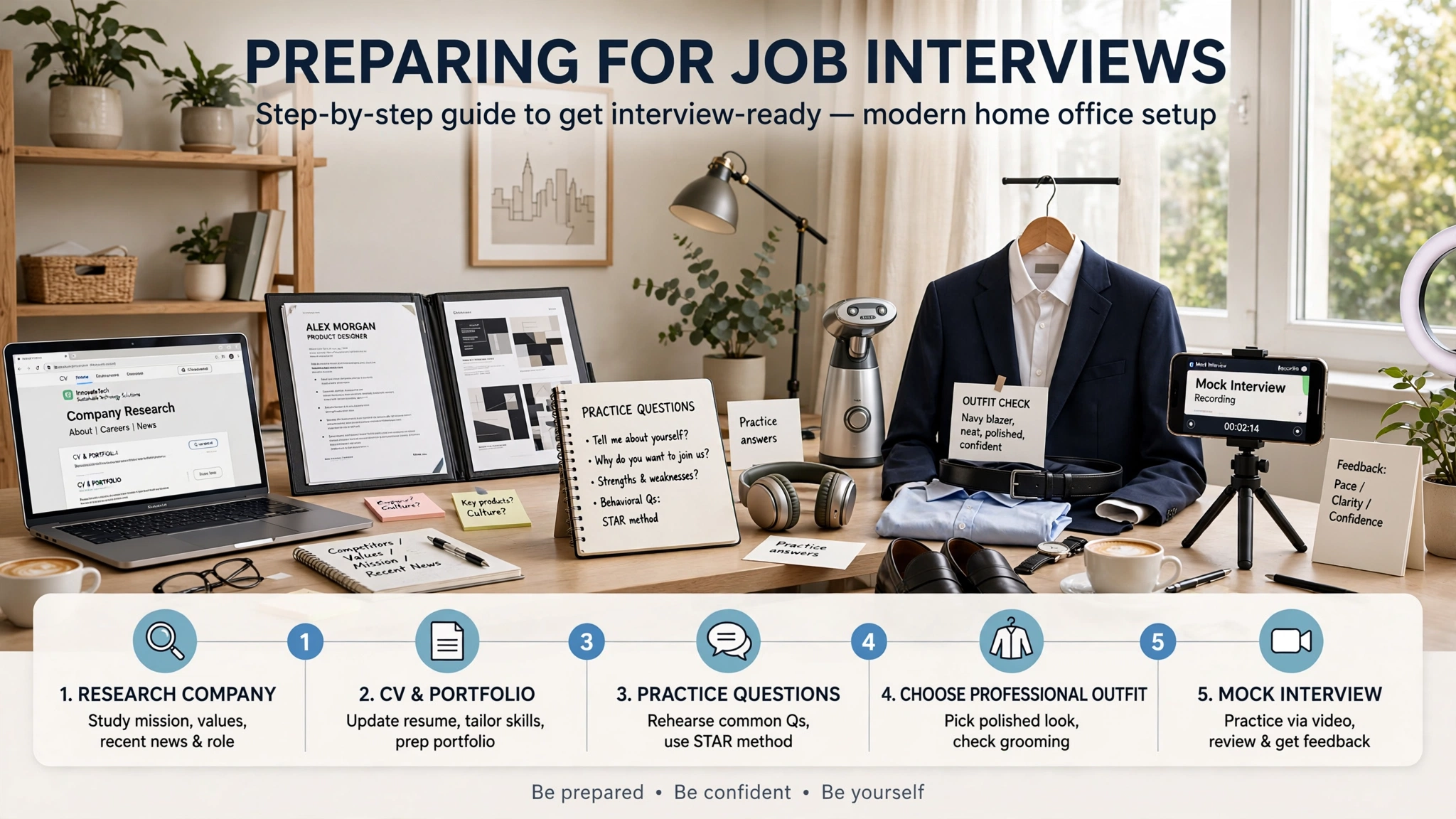
A better approach is preparing for job interviews step by step. That means understanding the role, researching the employer, identifying the experiences you want to discuss, practicing without memorizing scripts, and dealing with practical details before interview day.
The goal isn’t to predict every question. You can’t. Instead, you want to reach the interview knowing what the employer needs, what you can offer, and which examples best demonstrate your abilities. Career guidance from Harvard’s Mignone Center similarly emphasizes understanding both the organization and the position and being able to explain how your skills meet its needs.
Here’s how to prepare systematically.
Preparing for Job Interviews Step by Step: The 10-Step Process
Step 1: Read the Job Description Again—More Carefully
Your first preparation document should be the job posting itself.
Don’t simply reread it. Break it down into what the employer appears to care about most. Look for recurring responsibilities, required skills, preferred experience, software or tools, qualifications, and words describing how the person will work.
For example, suppose a marketing coordinator position repeatedly mentions campaign reporting, communication with multiple teams, spreadsheets, and deadlines. Those themes tell you something about the likely interview. You may need examples showing organization, communication, data handling, and your ability to manage competing priorities.
Create two simple columns:
- What the employer needs
- Evidence I can provide
Next to “manage multiple deadlines,” you might write about coordinating three university projects at once. Beside “customer communication,” you might note your retail, volunteer, freelance, or previous professional experience.
This turns a vague interview into a much more specific matching exercise.
Step 2: Research the Employer With a Purpose
Company research shouldn’t become an attempt to memorize the entire corporate website.
Focus on information that helps you understand the job and have an intelligent conversation. Review the organization’s official website, the page describing its products or services, its mission or values if relevant, and recent announcements that could affect the role.
You should be able to answer basic questions such as:
What does this organization actually do?
Understand its main product, service, audience, or purpose.
Why does this particular role exist?
Connect the responsibilities in the job description to the organization’s work.
Why are you interested?
Identify something more specific than “It looks like a good company.”
Recent interview guidance from Indeed likewise recommends researching the company and reviewing the job description so candidates can connect their background with the position.
Be careful with unofficial information. Employee reviews, social media discussions, and news coverage may provide useful context, but individual comments don’t necessarily represent everyone’s experience. Treat them as additional signals rather than unquestionable facts.
Step 3: Prepare Your Professional Story
Interviewers often ask some version of “Tell me about yourself.” The best response isn’t your complete life history or a sentence-by-sentence reading of your résumé.
Prepare a concise professional story covering three points:
- Where you are professionally now.
- The most relevant experience that brought you here.
- Why this opportunity makes sense as your next step.
For example:
A recent graduate applying for an operations role might explain that they studied business, became particularly interested in process improvement while organizing student events, completed an internship involving scheduling and reporting, and are now looking for an operations position where those skills are central.
Your answer should create context for the rest of the conversation.
Candidates changing careers can use the same structure. Focus less on explaining why you are “starting over” and more on showing how existing transferable skills connect to the new field.
Step 4: Build a Small Library of Strong Examples
Trying to invent examples while an interviewer waits is difficult. Prepare them in advance.
You don’t need a separate story for every possible question. A few flexible examples can often demonstrate several skills.
Think of situations involving:
- solving a difficult problem;
- working with a team;
- handling disagreement;
- managing pressure or deadlines;
- learning something quickly;
- making a mistake and correcting it;
- taking initiative;
- dealing with a customer, client, colleague, or stakeholder;
- achieving a meaningful result.
People with limited work experience can use examples from education, volunteering, internships, community projects, sports, freelance work, or other situations where they had genuine responsibilities.
Specific examples are generally stronger than broad claims. Saying “I’m a good problem solver” gives the interviewer little evidence. Describing how you identified a scheduling problem, reorganized the process, communicated the change, and avoided missed deadlines shows what problem solving looks like in practice.
Step 5: Structure Behavioral Answers With STAR
Behavioral interview questions usually ask for evidence from your past. You may hear phrases such as:
“Tell me about a time when…”
“Give me an example of…”
“Describe a situation where…”
A useful way to structure these answers is the STAR method:
- Situation: Give enough background to understand what was happening.
- Task: Explain what you needed to accomplish.
- Action: Describe what you personally did.
- Result: Explain what happened and, when relevant, what you learned.
The UK’s National Careers Service recommends STAR as a way to structure interview examples and defines it using these four components.
The “Action” portion usually deserves the most attention because that is where the interviewer learns how you think and behave.
Avoid turning STAR into a rigid script. It is a structure for organizing your thoughts, not wording that must be memorized.
Step 6: Practice Common Questions Without Memorizing Answers
Some interview questions appear in many industries. Preparing your thinking around them makes sense.
Examples include:
- Tell me about yourself.
- Why are you interested in this position?
- Why do you want to work here?
- What are your strongest relevant skills?
- What is an area you’re currently improving?
- Tell me about a difficult problem you solved.
- Describe a disagreement or conflict you handled.
- What achievement are you proud of?
- Why are you leaving your current position?
- What are you looking for in your next role?
Current guidance from the National Careers Service recommends planning answers around a small number of job-relevant examples rather than trying to prepare unrelated stories for every question.
Practice speaking your answers aloud. Something that looks concise on paper can sound unnatural or take far too long when spoken.
However, avoid memorizing complete paragraphs. Interviews are conversations. If you rely on an exact script, an unexpected follow-up question can make it harder to adapt.
Prepare ideas, evidence, and structure instead.
Step 7: Prepare for Questions Specific to the Role
General questions are only part of the interview.
A software developer could face coding or system-design questions. A designer may discuss a portfolio. A salesperson might be asked how they would approach a prospect. An accountant could be tested on technical knowledge. A customer service candidate may receive a difficult customer scenario.
Return to the job description and ask:
If I were hiring somebody for this position, what would I need them to prove?
Then prepare accordingly.
If the job requires a portfolio, presentation, technical assessment, writing sample, case interview, or other work demonstration, confirm the instructions carefully. Don’t assume the format based on experiences with another employer.
When technical preparation is needed, prioritize the skills explicitly connected to the role instead of trying to revise an entire profession in a few days.
Step 8: Prepare Questions for the Interviewer
An interview is also your opportunity to understand the position.
Prepare several questions, recognizing that some may be answered naturally during the conversation. Strong questions usually focus on the work, expectations, team, challenges, management, or selection process.
You could ask:
- What would success in this position look like during the first few months?
- What are the biggest challenges the person taking this role will inherit?
- How does this team normally work together?
- How is performance evaluated?
- What would a typical week in this role involve?
- What are the next stages of the hiring process?
Current interview guidance also recommends asking role-specific questions about responsibilities, success, challenges, and performance measurement.
Avoid asking questions whose answers are prominently displayed on the employer’s website unless you are seeking clarification or deeper context. Research should help your questions become more specific.
Step 9: Do a Realistic Practice Interview
Reading answers silently isn’t the same as answering questions under pressure.
Ask a friend, mentor, colleague, career adviser, or another suitable person to conduct a mock interview. Give them the job description and ask them to use a mixture of expected and unexpected questions.
If nobody is available, record yourself.
Listen for:
- answers that take too long to reach the point;
- repeated filler words;
- vague examples;
- excessive technical language;
- answers that don’t actually address the question;
- places where your strongest evidence appears too late.
Don’t try to eliminate every hesitation. Natural conversation includes pauses.
The purpose of practice is to become clearer and more comfortable, not to sound rehearsed.
Step 10: Remove Interview-Day Problems Before They Happen
Good preparation includes logistics.
For an in-person interview, confirm the time, location, travel route, expected journey time, building or reception instructions, and anything you were asked to bring.
For a video interview, confirm the platform and test the practical setup beforehand. Check your internet connection, camera, microphone, device power, background, and lighting. The National Careers Service recommends preparing common answers and your own questions before video interviews as well.
Keep useful documents nearby, such as your résumé, the job description, portfolio notes, and a short list of questions.
Choose interview clothing in advance. The most suitable level of formality varies by workplace, industry, role, and location, so there is no universal outfit that works everywhere. When uncertain, aim for clothing that is neat, professional, comfortable, and appropriate to the setting.
What to Do on the Day of the Interview
Preparation isn’t finished when you enter the room or join the call.
Listen to the complete question before answering. If you don’t understand it, asking for clarification is better than confidently answering the wrong question.
Keep your answers relevant. Extra detail doesn’t automatically make an answer stronger. Give enough context to make your example understandable, explain what you did, and then stop when you’ve made the point.
If you need a few seconds to think, take them.
And remember that you are gathering information too. Pay attention to how the interviewer describes responsibilities, expectations, management, workload, and the reason the position is open. An interview should help both sides decide whether the arrangement makes sense.
Common Job Interview Preparation Mistakes
Preparing Answers but Not Evidence
Candidates sometimes write polished statements about being organized, adaptable, or good communicators without preparing examples that demonstrate those qualities.
Replace adjectives with evidence whenever possible.
Memorizing Word-for-Word Scripts
Highly memorized responses can make it difficult to respond naturally when questions are phrased differently.
Know the points you want to communicate, but allow the wording to change.
Researching the Company but Ignoring the Role
Knowing when an organization was founded isn’t especially helpful if you haven’t worked out how your experience relates to the vacancy.
Spend preparation time in proportion to what will actually affect the interview.
Making Every Answer Too Long
Detailed isn’t the same as effective. If the interviewer needs more information, they can ask a follow-up question.
Practice making the main point early.
Giving Generic Reasons for Wanting the Job
“I’m looking for a new challenge” could describe almost any application.
Connect your motivation to actual responsibilities, relevant skills, career direction, or something specific you learned about the employer.
Speaking Negatively About Previous Employers
You may have legitimate reasons for leaving a difficult workplace, but lengthy criticism can distract from your candidacy.
Explain the situation factually when necessary, then shift toward what you are looking for next.
How Much Time Should You Spend Preparing?
There is no universal number of hours that guarantees adequate preparation.
A straightforward first-round conversation for a familiar type of job may require less preparation than a senior interview involving presentations, technical assessments, case studies, or several interviewers.
Instead of measuring preparation only by time, check whether you can confidently:
- explain why the position interests you;
- describe why your experience is relevant;
- discuss several specific examples;
- answer common questions without relying on a script;
- demonstrate any role-specific knowledge likely to be tested;
- ask useful questions;
- handle the interview logistics without uncertainty.
If one of those areas still feels weak, that tells you where your remaining preparation time should go.
Preparing When You Have Little or No Work Experience
Lack of formal employment doesn’t mean you have nothing to discuss.
Interviewers need examples showing how you approach responsibilities and problems. Those experiences can come from education, projects, internships, volunteering, clubs, family responsibilities, community work, or other genuine activities.
Suppose you are asked about teamwork but have never worked in an office. You could describe a group assignment where responsibilities were unclear, explain how you helped organize tasks, describe your contribution, and discuss the outcome.
Don’t apologize for being early in your career. Use the strongest relevant evidence you actually have.
Preparing for an Interview When Changing Careers
Career changers have a slightly different challenge: making the connection between past experience and future work obvious.
Identify transferable abilities such as project management, writing, customer communication, analysis, leadership, training, negotiation, budgeting, or problem solving.
Then prepare examples showing those skills in action.
You should also be ready to explain why you are changing direction. A strong answer focuses on the attraction of the new path and the connection between your existing strengths and the new role rather than simply describing dissatisfaction with your previous career.
What to Do After the Interview
As soon as practical, make a few private notes. Record questions you were asked, examples that worked well, answers you want to improve, and anything important you learned about the position.
A concise thank-you message is also appropriate in many professional hiring processes. CareerOneStop recommends sending a thank-you note promptly and suggests doing so within 24 hours; Harvard career guidance gives a similar window of roughly 24–48 hours.
Keep the message brief. Thank the interviewer for their time, mention something specific from the conversation if useful, and reiterate your interest when it is genuine.
If the interviewer gave you a timeline for the decision, respect it before following up about your application.
FAQs
1. What is the best way of preparing for job interviews step by step?
Start with the job description, research the employer, identify your most relevant skills, prepare several specific examples, practice common and role-specific questions, prepare questions for the interviewer, and confirm all practical arrangements. After the interview, record what you learned and follow up appropriately. This process is more useful than simply memorizing sample answers.
2. How early should I start preparing for a job interview?
Start once the interview is confirmed if possible. The amount of preparation needed depends on the role and interview format. A technical assessment, portfolio presentation, case interview, or senior-level meeting may require more preparation than an introductory screening call. Focus on completing the important preparation tasks rather than trying to reach an arbitrary number of hours.
3. How many interview answers should I prepare?
You don’t need to prepare a script for every imaginable question. Instead, develop a small set of strong examples covering areas such as teamwork, problem solving, initiative, challenges, mistakes, achievements, and communication. Several examples can often be adapted to different behavioral questions while remaining truthful and relevant.
4. What should I research about a company before an interview?
Understand what the organization does, its main products or services, the role you are interviewing for, and any recent developments that genuinely affect the position. Review the employer’s official website first. You can use news reports, professional profiles, and employee reviews for additional context, but distinguish verified company information from personal opinions.
5. Should I memorize answers to interview questions?
Usually, no. Memorizing full answers can make you sound rigid and makes it harder to adjust when a question is phrased unexpectedly. Prepare your key points, examples, and evidence instead. Practice saying them aloud in different ways so that your responses remain organized without becoming scripted.
6. What is the STAR method in interviews?
STAR stands for Situation, Task, Action, and Result. It provides a simple structure for answering questions about past experiences. Briefly explain the situation and your responsibility, spend most of the answer describing what you did, and finish with the outcome or lesson. It is particularly useful for behavioral questions asking you to describe a specific example.
7. What should I bring to a job interview?
For an in-person interview, useful items may include copies of your résumé, relevant portfolio materials, identification if required, a notebook, and any documents the employer specifically requested. Requirements vary, so follow the interview instructions you were given. For a virtual interview, have digital copies of essential documents accessible without cluttering your screen.
Conclusion
Effective interview preparation isn’t about finding perfect answers to every possible question. It is about reducing uncertainty and making your strongest relevant evidence easier to communicate.
By preparing for job interviews step by step, you can move from understanding the employer’s needs to selecting examples, practicing clear responses, preparing intelligent questions, and managing interview-day details. The process won’t guarantee a particular hiring decision—many factors remain outside a candidate’s control—but it can help you enter the conversation informed, organized, and ready to explain what you genuinely bring to the role.
The best final test is simple: you should be able to explain what the employer needs, why the role interests you, and what real experiences show that you could do the work.
Read also Common Mistakes on UK Staycation Planning to Avoid