
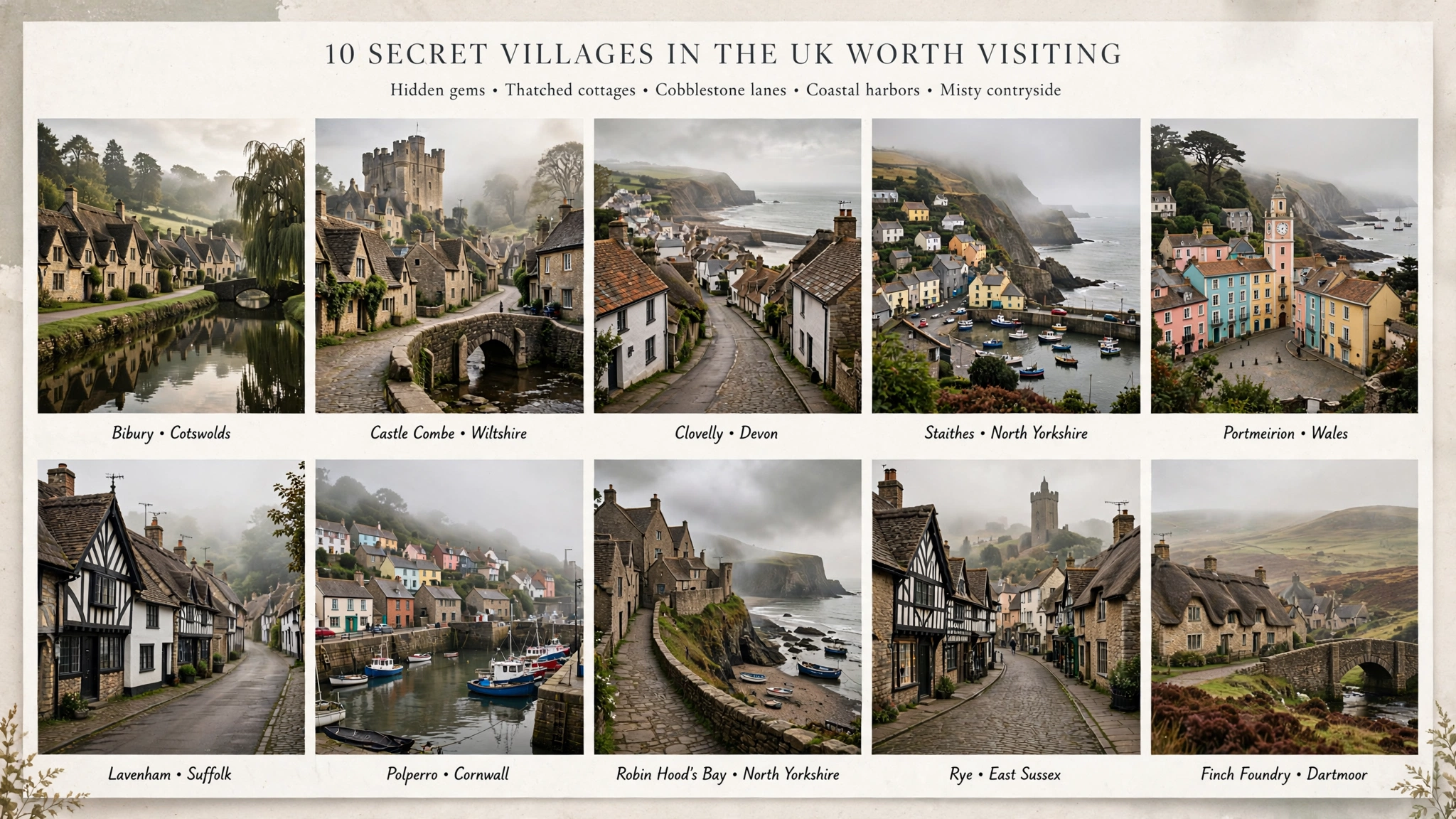

Britain’s best-known villages rarely stay quiet for long. Places that once felt like discoveries can now have busy car parks, packed cafés and queues for the same photograph.
Fortunately, there are still corners of England, Scotland, Wales and Northern Ireland where the pace feels slower. Some are old fishing settlements squeezed between cliffs and sea; others are stone villages surrounded by hills, rivers or farmland.
Calling them “secret” does not mean nobody knows about them. A few are well known locally, and some appear on television or in guidebooks. What they offer is something more valuable: a chance to experience a smaller, quieter side of the UK away from the obvious city-break and sightseeing routes.
Here are ten secret villages in the UK worth putting on your travel list.
1. Crovie, Aberdeenshire
Crovie is the sort of place that makes you wonder how a village was built there at all.
The settlement occupies a remarkably narrow strip of land between the sea and the cliffs on the Aberdeenshire coast. Instead of a normal village street, there is essentially a line of traditional houses facing a pedestrian path beside the water. VisitAberdeenshire describes Crovie as particularly good for walking, wildlife watching and photography.
Its history is tied closely to fishing. The village dates from the 18th century and is one of the smallest of the old cliff-foot fishing settlements along this part of Scotland.
There is very little to distract you here, which is precisely the point. Walk slowly along the waterfront, watch seabirds over the bay and look across towards neighbouring Gardenstown.
Best for: photographers, coastal walkers and travellers who enjoy genuinely small places.
Good to know: Crovie’s unusual setting means vehicle access is extremely limited. Treat the village as somebody’s home rather than an attraction, keep noise down and avoid blocking paths or house entrances.
2. Culross, Fife
Culross may only be around 25 miles from Edinburgh, but its narrow streets feel considerably further removed from city life. VisitScotland describes it as Scotland’s most complete surviving example of a 17th- and 18th-century burgh.
The appeal is architectural rather than dramatic. Cobbled lanes climb between old houses, while the ochre-coloured Culross Palace gives the village an unmistakable historic character.
Television viewers may recognise parts of Culross from Outlander, but there is plenty to see without any interest in filming locations. The palace, gardens, old buildings and views towards the Firth of Forth make it easy to spend several hours here.
What works particularly well is the scale. You do not need an itinerary. Park, walk and follow whichever street looks interesting.
Best for: history, architecture and an easy day trip from central Scotland.
Don’t miss: the older streets around Culross Palace before exploring the waterfront.
3. Solva, Pembrokeshire
Solva appears almost suddenly as the road drops into a deep valley on the Pembrokeshire coast.
The village is divided into Upper and Lower Solva, with the lower section leading towards a naturally sheltered harbour. Visit Pembrokeshire explains that the valley was shaped by meltwater at the end of the last Ice Age before flooding created the harbour seen today.
This is not a museum-piece village. It has cafés, pubs, galleries, small shops and working harbour activity, which gives it considerably more life than some beauty spots.
Walk towards the harbour and then pick up part of the Pembrokeshire Coast Path for higher views over the water and surrounding coastline. The village also works well as a base for exploring the St Davids Peninsula.
Best for: coastal walking, independent shops and a relaxed weekend near the sea.
Good to know: parking close to the harbour is limited, especially at popular times. Arriving earlier in the day usually makes the experience more enjoyable.
4. Beddgelert, Gwynedd
Mountains rise almost immediately around Beddgelert, making this North Wales village feel much more remote than its popularity with walkers might suggest.
It sits inside Eryri National Park, surrounded by rivers, woodland and mountain routes. Visit Wales describes Beddgelert as one of Eryri’s most attractive villages, while the National Park highlights walking routes linking the area with nearby Rhyd Ddu.
The village itself is compact. Stone buildings gather around the rivers Glaslyn and Colwyn, and a riverside walk leads towards Gelert’s Grave, associated with the famous Welsh legend of Prince Llywelyn and his faithful hound.
The story is part folklore rather than a reason to rush through the village ticking off a landmark. Beddgelert is better enjoyed slowly: walk beside the river, stop for lunch and then head into the surrounding countryside.
It also has the advantage of useful visitor facilities, accommodation and places to eat while retaining a strong village atmosphere.
Best for: walkers, couples and anyone wanting a village base in the mountains.
Best time: late spring or early autumn if you want good walking conditions without relying on the busiest summer period.
5. Cushendun, County Antrim
Cushendun deserves more attention from travellers driving Northern Ireland’s Causeway Coastal Route.
The village sits at the mouth of the River Dun in the Glens of Antrim, with a beach, small harbour, woodland and whitewashed buildings. The National Trust describes it as a conservation village with a distinctive architectural history.
Its appearance is not accidental. Parts of the village were designed in the early 20th century with Cornish architectural influences, including work associated with architect Clough Williams-Ellis. Cushendun was later designated a Conservation Area in 1980.
There is enough here for a leisurely half-day: walk beside the harbour, cross through the village, explore the beach and continue towards the surrounding landscape.
Discover Northern Ireland also highlights scenic paths running through the village and along the beachfront.
Best for: Causeway Coast road trips and travellers who want somewhere calmer between major attractions.
Don’t miss: the short walk through the village towards the coast rather than simply stopping for photographs beside the road.
6. Staithes, North Yorkshire
Staithes looks as though its houses were poured into a narrow gap between the cliffs.
Steep lanes descend towards a small harbour, passing tightly packed cottages that recall the village’s long relationship with the sea. According to the North York Moors National Park Authority, Staithes became one of the largest fishing ports in north-east England during the 19th century, when more than 300 fishermen worked from the village.
That history still shapes the place. The harbour, old fishermen’s cottages and narrow passages make walking more rewarding than driving, while Staithes Museum explores local fishing heritage and the village’s past.
Artists have also long been drawn to this stretch of coast, and it remains a good village for anyone who prefers sketchbooks, galleries and weather-beaten harbour walls to amusement arcades.
For a longer visit, continue onto the surrounding coast or follow one of the area’s walking routes.
Best for: maritime history, coastal photography and atmospheric winter or shoulder-season trips.
Good to know: expect steep streets. Comfortable shoes are far more useful here than trying to park close to the harbour.
7. Penberth Cove, Cornwall
Cornwall still has places where the landscape feels more important than the tourism industry, and Penberth Cove is one of them.
Located in West Cornwall between the better-known areas around Porthcurno and Mousehole, Penberth is a tiny fishing settlement descending through a wooded valley towards the sea.
Visit Cornwall notes that fishing boats continue to use the cove and that its traditional capstan survives from the days when boats were hauled from the water. The village has also appeared as a filming location for Poldark.
The surrounding landscape is just as important as the buildings. The West Penwith coast here combines high cliffs, small valleys and sections of the South West Coast Path. Visit Cornwall recommends a roughly three-mile walk linking Porthcurno and Penberth for coastal views and access to the tiny harbour.
Do not arrive expecting shops and a long list of attractions. Penberth works because very little has been added.
Best for: walkers and people looking for a quieter Cornish coast.
Good to know: keep the village peaceful and follow local parking restrictions. Small communities can be badly affected when visitors leave cars in passing places or residents’ access points.
8. Branscombe, Devon
Branscombe stretches through a green valley towards the Jurassic Coast in East Devon.
Rather than having one compact centre, the village unfolds gradually between historic buildings, cottages and countryside before eventually reaching the sea. Visit Devon describes Branscombe as one of Devon’s oldest villages and highlights its thatched cottages and position on the coast.
Its real strength is the combination of village and landscape.
You can spend time around the historic centre before following footpaths towards Branscombe Beach or joining the South West Coast Path. A circular route between Beer and Branscombe combines village scenery with cliffs and countryside.
If you want something shorter, the Branscombe Undercliff walk explores the unusual landslip landscape beside the Jurassic Coast.
Best for: a full day combining an English village with serious coastal walking.
Best time: spring is particularly pleasant for longer walks, while autumn brings quieter lanes and softer coastal light.
9. Biddestone, Wiltshire
Travellers heading for the Cotswolds often concentrate on famous names such as Castle Combe. Biddestone offers a quieter alternative nearby.
Visit Wiltshire highlights its traditional stone cottages, village green, historic church and buildings dating back several centuries. The settlement itself has much older roots, extending back to Saxon times.
There is no major attraction demanding an admission ticket. Instead, the pleasure comes from walking around the village, noticing details in the old buildings and then continuing into the surrounding Wiltshire countryside.
That lack of an obvious tourist circuit is precisely why Biddestone belongs on a list of secret villages in the UK. You can spend an hour here or use it as one stop on a slower tour of the smaller Wiltshire villages.
Nearby places such as Slaughterford, Grittleton and North Wraxall can easily turn the visit into a full day away from the busiest Cotswolds routes. Visit Wiltshire specifically recommends these smaller settlements as alternatives to Castle Combe.
Best for: traditional English village scenery without planning an attraction-heavy day.
Travel tip: combine several nearby villages rather than racing between the most photographed Cotswolds locations.
10. Dent, Cumbria
Dent sits in Dentdale at the western edge of the Yorkshire Dales National Park, despite technically being in Cumbria.
Its narrow cobbled street, whitewashed houses and old church give it a different appearance from the honey-coloured villages further south. The Yorkshire Dales National Park Authority describes Dent as one of the loveliest villages in the Dales and notes its connections with geologist Adam Sedgwick, who was born locally.
The surrounding valley is the reason to stay longer than an hour. Walking routes lead through fields and hills around Dentdale, making the village a useful base for anyone who wants countryside without the heavier visitor traffic associated with better-known Lake District centres.
There are cafés, pubs and local facilities within walking distance, but the overall pace remains distinctly rural.
One useful detail for rail travellers: Dent railway station is about five miles from Dent village, despite sharing its name, and the final approach is steep. The National Park Authority specifically advises visitors about the distance.
Best for: walkers, traditional pubs and a quieter alternative to the Lake District.
When to Visit
For most of these villages, April to June and September to early October offer a good balance between daylight, walking conditions and avoiding peak holiday crowds.
July and August can still be enjoyable, but small coastal villages have limited roads and parking. Arriving early or staying overnight changes the experience considerably.
Winter should not automatically be ruled out. Places such as Staithes, Culross and Cushendun can be particularly atmospheric outside the main season, although daylight is shorter and some independent businesses operate reduced hours.
Always check official visitor information, weather conditions and opening times before making a long journey.
Visit Responsibly
The places in this guide are attractive partly because they remain living communities rather than purpose-built visitor attractions.
That distinction matters.
Use designated parking instead of squeezing onto residential streets. Take litter home when bins are full. Keep gateways and access roads clear. Stick to marked paths across farmland, especially where livestock are present.
Buying a coffee, lunch, local produce or artwork is another simple way to make a visit worthwhile for the community rather than treating the village purely as a backdrop for photographs.
In very small settlements such as Crovie and Penberth, privacy matters too. A beautiful cottage may look like part of the scenery, but it is still somebody’s front door.
Final Thoughts
The most memorable villages in Britain are not always the ones appearing at the top of every travel search.
Sometimes it is a single lane beside the North Sea in Crovie, a cobbled street in Dent, fishing boats at Penberth or the evening light over Solva Harbour that stays with you.
These secret villages in the UK worth visiting offer history, architecture and dramatic countryside without requiring an endless sightseeing checklist. Some deserve an afternoon; others make excellent bases for several days of walking and exploring.
The best approach is simple: choose fewer places, stay longer and leave enough time to wander without constantly checking the map.
FAQs
What are the best secret villages in the UK to visit?
Crovie in Aberdeenshire, Solva in Pembrokeshire, Cushendun in County Antrim, Penberth Cove in Cornwall and Dent in Cumbria are excellent choices if you want smaller settlements surrounded by strong coastal or countryside scenery. Which is “best” depends on whether you prefer walking, history, architecture or the sea.
What is the prettiest hidden village in England?
There is no objective winner, but Staithes has one of the most dramatic settings, with tightly packed cottages descending towards a harbour between high cliffs. Biddestone is a better option for travellers looking for traditional Cotswold-style stone architecture without concentrating only on the best-known villages.
Which secret UK villages are best by the sea?
Crovie, Solva, Cushendun, Staithes, Penberth Cove and Branscombe all have strong coastal settings. Crovie and Penberth feel especially small, while Solva and Staithes provide more visitor facilities.
Where can I find quiet villages in Scotland?
Crovie on the Aberdeenshire coast is one of the most distinctive choices. Culross in Fife is easier to reach and offers considerably more historic architecture, although it can attract visitors because of its heritage and television connections.
What are the best hidden villages in Wales?
Solva is ideal for the Pembrokeshire coast, while Beddgelert is better for mountains, woodland and walking in Eryri National Park.
Are there secret villages in Northern Ireland worth visiting?
Yes. Cushendun in County Antrim is particularly worthwhile. It combines a beach, harbour, distinctive architecture and walks through the Glens of Antrim, making it a natural stop on the Causeway Coastal Route.
Do I need a car to visit these villages?
A car makes reaching several of them easier, especially the more rural locations, but not every village requires one. Rail, bus and walking connections vary considerably, so public-transport travellers should check current routes before travelling. Be particularly careful with Dent: its railway station is roughly five miles from the actual village.
What is the best time of year to explore UK villages?
Late spring and early autumn are excellent for many travellers because days remain useful for walking while the busiest school-holiday period can often be avoided. Coastal conditions can change quickly at any time of year, so weather forecasts should always be checked before longer walks.
Are these villages suitable for families?
Many are, although terrain varies. Beddgelert has family-friendly activities and walks in and around the village, while Solva provides cafés, shops and easy access to its harbour. Villages such as Crovie and Staithes have steeper approaches and may require more care with young children or pushchairs.
How can tourists help protect small UK villages?
Use official parking, respect residents’ property, avoid blocking narrow lanes, follow countryside paths, take rubbish with you and spend money with independent local businesses. Visiting outside the busiest hours can also reduce pressure on communities with limited infrastructure.
Sources
- VisitAberdeenshire and VisitScotland for Crovie and Culross.
- Visit Pembrokeshire and Visit Wales/Eryri National Park for Solva and Beddgelert.
- National Trust and Discover Northern Ireland for Cushendun.
- North York Moors National Park for Staithes.
- Visit Cornwall for Penberth Cove and the West Penwith coast.
- Visit Devon for Branscombe and nearby walking routes.
- Visit Wiltshire for Biddestone and the smaller Wiltshire Cotswolds villages.
- Yorkshire Dales National Park Authority for Dent and Dentdale.
Read also: Best Credit Cards UK: A Simple Guide to Choosing the Right Credit Card