
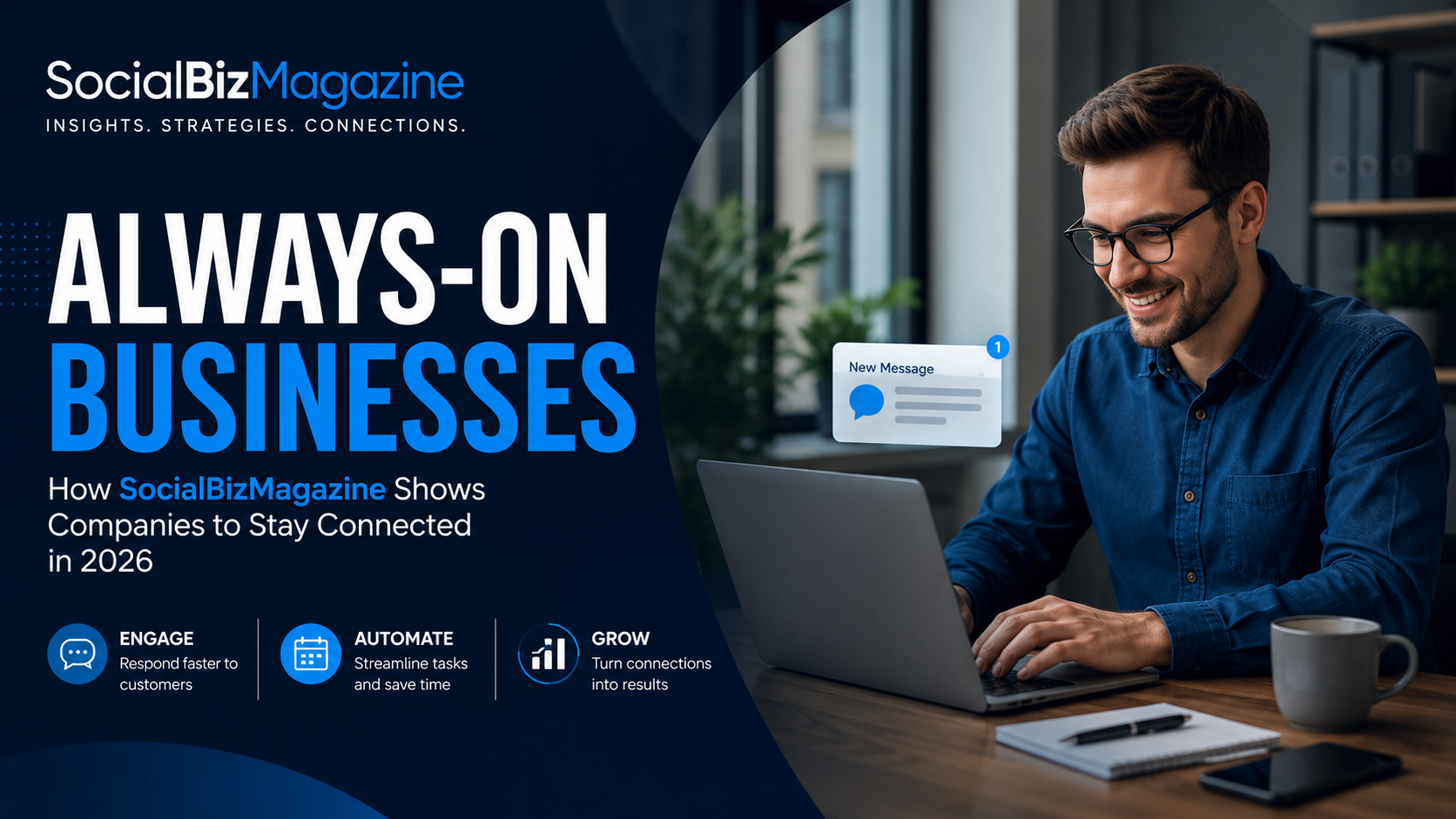

The phrase “always businesses socialbizmagazine” looks incomplete when read as ordinary English. Search results indicate that it refers to a SocialBizMagazine article titled Always-On Businesses: How SocialBizMagazine Shows Companies to Stay Connected in 2026. The page describes businesses that maintain an active, organized presence across social channels through regular publishing, audience monitoring, customer responses, and limited automation.
That doesn’t mean a company must post every hour or employ a team around the clock. A workable always-on strategy is less about constant activity and more about dependable availability. Customers should be able to find current information, receive a response within a stated period, and see that the business is paying attention.
This guide explains the original page, separates verified information from unsupported claims, and shows how a small or growing business can build a sustainable system without turning social media into a 24-hour burden.
What Does “Always Businesses SocialBizMagazine” Refer To?
“Always businesses” is not a widely established name for a formal business model. In this context, the words appear to be a search-oriented variation of always-on businesses.
The relevant SocialBizMagazine page defines an always-on business as one that remains active on social channels by publishing content, answering comments, monitoring mentions, and using customer interactions as a source of business information. It recommends content calendars, clearly assigned responsibilities, shared inboxes, automation, response standards, and performance tracking.
SocialBizMagazine itself describes its website as a publication covering business news, entertainment, lifestyle, and travel. Its About page lists several contributors, although the always-on article carries a different byline: Byndaris Zolvak.
The safest interpretation of the keyword is therefore:
An inquiry about SocialBizMagazine’s explanation of businesses that maintain a consistent social media and customer-communication presence.
It should not be confused with “social business,” a separate term often used for financially sustainable organizations created primarily to address social or environmental problems.
What an Always-On Business Actually Looks Like

An always-on business creates continuity between marketing, customer service, sales, and public communication. Its channels don’t appear abandoned between campaigns, and customers aren’t left wondering whether anyone is listening.
In practice, the system has three connected parts.
Consistent Publishing
The business shares useful information according to a manageable schedule. That might mean three thoughtful posts each week rather than several weak posts every day.
A neighborhood restaurant could publish its changing menu, opening hours, booking information, and occasional behind-the-scenes content. A software company might share product guidance, maintenance notices, customer education, and answers to recurring questions.
The U.S. Small Business Administration advises businesses to treat social media as a dialogue and to concentrate resources on the channels most appropriate for their audience instead of attempting to manage every available platform.
Active Monitoring
Publishing is only half the work. Someone must also check comments, direct messages, reviews, tags, and important mentions.
Monitoring helps a company notice questions, complaints, misinformation, buying signals, and recurring customer difficulties. It doesn’t require reacting to every casual mention. It requires a method for identifying interactions that deserve attention.
Reliable Responses
An always-on company sets realistic response expectations and follows them. A small firm may promise replies during weekday business hours rather than pretending to offer 24/7 support.
Reliability matters more than unrealistic speed. A customer who sees “Messages are answered Monday to Friday within one business day” has useful information. A customer who receives an automated “We’ll respond shortly” message and then hears nothing for three days does not.
More article….. How to Start a Limited Company in the UK
What the SocialBizMagazine Article Recommends
The SocialBizMagazine page presents an always-on presence as a combination of tools, people, and processes. Its main recommendations include:
- Auditing existing social channels
- Selecting scheduling, inbox, monitoring, and analytics tools
- Assigning content, response, and coordination responsibilities
- Building a repeatable weekly publishing pattern
- Establishing response and escalation rules
- Testing the approach and reviewing performance data
The article also recommends combining automation with human judgment. Routine messages may be categorized or acknowledged automatically, while sensitive, unusual, or emotionally charged conversations should be handled by a person.
That general framework is sensible. Scheduling and unified inbox functions are real capabilities offered by major platform tools. Meta, for example, documents that Meta Business Suite can schedule Facebook and Instagram posts, manage content, and support inbox automations across eligible connected accounts.
However, not every statement on the SocialBizMagazine page carries the same level of evidence.
Confirmed Information Versus Unverified Claims
| Statement | Assessment |
|---|---|
| A SocialBizMagazine page about always-on businesses exists | Confirmed |
| The page recommends scheduling, monitoring, role assignment, automation, and measurement | Confirmed |
| Scheduling and inbox-management features exist on major social platforms | Confirmed through official platform documentation |
| “Always businesses” is a recognized formal business category | Not established |
| A featured retailer increased online sales by 20% | Not independently verifiable from the page |
| A software company reduced onboarding calls by 30% | Not independently verifiable from the page |
| Daily posting will automatically improve sales | Unsupported as a universal claim |
| Faster responses always reduce customer churn | Plausible in some situations but not guaranteed |
The article refers to a retailer, a business-to-business software company, and a restaurant as examples. It gives precise results for two of them, but it does not identify the companies, link to source material, describe the measurement method, or explain what other factors may have influenced the outcomes.
Those examples may illustrate the author’s point, but their percentages should not be repeated as established case-study evidence without further documentation.
Why an Always-On Presence Can Be Useful
The strongest reason to adopt this model is not that constant posting guarantees growth. It’s that a dependable system reduces avoidable communication gaps.
Customers Receive Current Information
Opening hours, stock availability, event details, service interruptions, and policy changes can quickly become outdated. A maintained digital presence gives customers a better chance of finding accurate information before calling or visiting.
Questions Become Easier to Manage
Repeated questions reveal where customers are confused. A business can turn those questions into saved replies, help pages, videos, product instructions, or clearer website copy.
For example, if a delivery company receives daily messages about service areas, it could publish a location guide and add a direct link to its profile. Social media then becomes a feedback channel rather than an isolated promotional feed.
Content Becomes More Organized
A calendar allows teams to prepare useful material before it is needed. It also reduces the pressure to invent a post at the last minute.
The goal isn’t to remove spontaneity. It’s to reserve spontaneous publishing for genuine opportunities while routine information is planned in advance.
Responsibility Becomes Clear
Many social accounts fail because everyone assumes somebody else is checking them. An always-on system identifies who publishes, who responds, who approves sensitive messages, and who takes over when the usual account manager is unavailable.
How to Build a Sustainable Always-On System
1. Define One Business Goal
Start with a purpose that can guide decisions. Examples include reducing repetitive support questions, increasing qualified enquiries, keeping local customers informed, or improving event attendance.
Avoid a vague objective such as “be more active.” Activity is not a business result.
The SBA similarly recommends beginning with a limited set of goals, such as strengthening customer relationships, driving website visits, building an email list, or establishing expertise.
2. Select Only the Necessary Channels
Choose platforms based on customer behavior and the type of information you produce well.
A visually oriented retailer might prioritize Instagram. A professional consultancy may find LinkedIn more relevant. A local service provider could place greater emphasis on business listings, reviews, and one social platform.
Maintaining two strong channels is usually better than opening six accounts that appear neglected.
3. Set a Publishing Rhythm
Build a schedule your team can continue during busy periods. A simple weekly pattern could include:
- One educational post
- One product or service update
- One customer question or conversation prompt
- One operational notice when needed
There is no universal posting frequency. Review performance and workload, then adjust. More content is useful only when it remains relevant and manageable.
4. Create Response Standards
Specify which messages need a response, who handles them, and when they must be escalated.
A basic policy might separate messages into four groups:
- General questions
- Sales enquiries
- Service complaints
- Legal, safety, privacy, or media issues
The first two can often follow standard procedures. The last two may require immediate involvement from a manager or specialist.
5. Automate Low-Risk Tasks
Automation can schedule approved content, acknowledge incoming messages, apply labels, route enquiries, or provide opening hours.
It should not make promises, settle disputes, interpret complex complaints, or imitate a human during sensitive conversations. Automated replies should be transparent and should tell the customer what happens next.
6. Protect Account Access
An always-on presence increases the number of people, devices, and tools that may have account access. That makes security part of the operating model rather than an optional technical concern.
Use individual accounts where possible, remove access when employees or contractors leave, review connected applications, and enable multi-factor authentication. NIST explains that MFA adds another verification barrier beyond a password and can make account takeover more difficult when credentials are compromised.
7. Review a Small Set of Metrics
Useful measurements include:
- Median response time
- Percentage of messages answered
- Number of issues resolved
- Qualified enquiries generated
- Clicks to important service pages
- Conversions attributable to tracked links
- Posts that produce meaningful questions or saves
- Time spent managing each channel
Follower count and impressions can provide context, but they shouldn’t be treated as proof of revenue or customer satisfaction.
Legal and Trust Considerations
An active publishing schedule creates more opportunities to make mistakes. Every post still needs to follow advertising, consumer-protection, privacy, intellectual-property, and industry-specific requirements.
Businesses working with influencers, affiliates, employees, or sponsored reviewers should make material relationships clear. The U.S. Federal Trade Commission states that endorsements must be honest and not misleading and provides specific guidance on social media disclosures, reviews, and testimonials. Requirements differ by jurisdiction, so companies operating globally should check the rules that apply to their markets.
Avoid creating or encouraging fake reviews, hiding legitimate negative feedback, or presenting employee endorsements as independent customer opinions. It’s also wise to obtain appropriate permission before reposting customer images, messages, or personal stories.
Limitations of the Always-On Model
An always-on approach can become counterproductive when it is interpreted as nonstop production.
It Can Exhaust Small Teams
A company with limited staff may struggle to maintain multiple feeds, answer messages, produce videos, and monitor mentions. The solution is narrower coverage, not more pressure.
Automation Can Damage Customer Trust
A cheerful automated reply can feel dismissive when someone is reporting a serious problem. Templates should help people respond consistently, not prevent them from responding thoughtfully.
Social Platforms Are Not Owned Assets
Algorithms, features, policies, and account access can change. Businesses should not depend entirely on a social profile for customer relationships.
A website, email list, customer database, and documented support process give the company channels it can manage more directly.
Visibility Does Not Equal Profitability
A post may receive attention without generating useful enquiries or purchases. Costs also matter: staff time, creative production, software subscriptions, moderation, advertising, and training.
Measure the value of the system against the resources required to maintain it.
Who Is Most Likely to Benefit?

An always-on system is particularly useful for businesses that receive frequent questions, publish changing information, manage bookings, sell online, operate in competitive local markets, or provide services where trust develops over time.
It may be less important for a specialist company with a small number of long-term clients and little public-facing activity. Even then, basic monitoring and accurate profile information remain useful.
The model should fit the business. The business should not be redesigned merely to feed social platforms.
Common Mistakes to Avoid
One common mistake is confusing consistency with volume. Posting several times a day is not automatically better than publishing one genuinely useful update.
Another is automating before defining the process. A tool cannot decide which complaints require escalation unless the business has already created clear rules.
Businesses also weaken results when they track only visible engagement. Likes may be encouraging, but enquiries, resolved questions, bookings, sign-ups, and purchases are closer to business outcomes.
Finally, avoid making claims that the company cannot support. Frequent publishing increases exposure, so inaccurate prices, outdated offers, invented testimonials, and exaggerated product statements can spread quickly.
FAQs
What is always businesses socialbizmagazine?
It is an awkward search phrase associated with a SocialBizMagazine page about “always-on businesses.” The page describes companies that maintain consistent social media activity through planned content, audience monitoring, customer responses, automation, assigned responsibilities, and performance measurement. The phrase itself does not appear to name a formally recognized business category.
Is SocialBizMagazine a social media management platform?
No evidence reviewed for this article indicates that SocialBizMagazine is a social media management software product. The website presents itself as an online publication covering business, lifestyle, entertainment, and travel topics. Its always-on business page provides general advice rather than access to a documented management platform.
Does an always-on business need 24/7 employees?
Not necessarily. A small business can be always-on in a practical sense by keeping information current, scheduling content, monitoring important messages, publishing response hours, and assigning backup responsibilities. Around-the-clock staffing is appropriate only when customer needs, service commitments, risk levels, and available resources justify it.
How often should an always-on business post?
There is no reliable frequency that suits every company. The right schedule depends on the platform, audience, content quality, team capacity, and business objective. Begin with a rhythm you can maintain, then evaluate whether the posts create useful conversations, website visits, enquiries, or customer-service improvements.
Can social media automation replace employees?
Automation can handle scheduling, acknowledgements, categorization, routing, and simple information requests. It should not replace human judgment in complaints, negotiations, safety issues, privacy matters, or emotionally sensitive conversations. A strong system automates repetitive steps while making it easy for a person to take control.
Which metrics should a small business track?
Start with response time, messages answered, issues resolved, qualified enquiries, tracked website visits, conversions, and time spent managing the channel. Add platform-level engagement metrics for context, but do not assume that reach or follower growth automatically represents revenue.
Are the case-study percentages in the SocialBizMagazine article verified?
The page states that one retailer achieved a 20% online-sales increase and one software company reduced onboarding calls by 30%. However, it does not identify the businesses, link to supporting evidence, or explain the methodology. Those figures should therefore be treated as unverified examples rather than independently confirmed results.
Conclusion
The always businesses socialbizmagazine keyword points to an article about building a dependable, always-on business presence. Its central idea is useful: organize publishing, monitoring, customer responses, automation, responsibilities, and measurement so that communication doesn’t depend on last-minute effort.
The concept becomes less useful when it is treated as a demand for constant posting or immediate availability. A sustainable system sets realistic service hours, focuses on relevant channels, protects account access, uses automation carefully, and measures outcomes beyond likes and impressions.
SocialBizMagazine offers a workable starting framework, but its precise case-study results lack enough supporting detail to be treated as verified evidence. Readers should adopt the operational principles that fit their needs while testing results against their own customer behavior, workload, and business goals.
Read also: Tools for Business Bank Accounts UK: A Simple Guide