
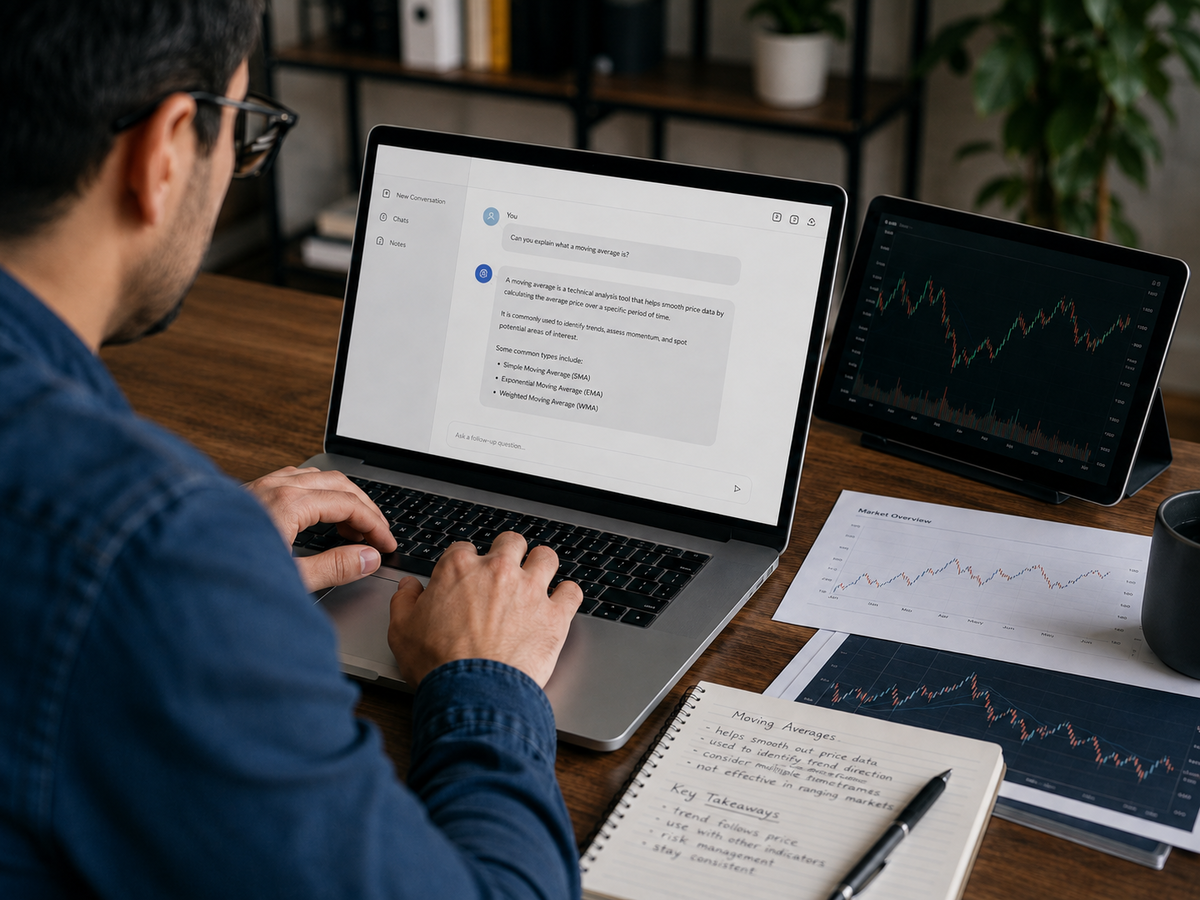

AI can explain trading terminology, summarise books and break down market concepts in seconds. But financial markets are not a quiz with one correct answer, and faster access to information does not automatically create better judgement.
Ask an AI assistant what a short position is and you can have an explanation before most finance websites have finished loading.
Ask it why the pound moved at 2.17pm on a particular Tuesday and things become more complicated.
It will probably still have an answer.
That is both the appeal and the problem.
Artificial intelligence has made financial information extraordinarily easy to access. Concepts that once required a textbook, a patient lecturer or several browser tabs can now be explained conversationally in seconds.
For someone trying to understand financial markets, that is a genuine improvement.
What AI has not done is remove the difference between understanding an explanation and understanding a market.
AI Is Very Good at the First Five Minutes
Financial markets come with an irritating amount of vocabulary.
Spreads, margin, leverage, liquidity, support, resistance, lots, pips, volatility and dozens of other terms tend to appear before a beginner has even decided what they want to learn.
AI is extremely useful here.
A reader can ask for a simple definition, request a more detailed version and then follow up on whatever remains confusing.
Something like the difference between long and short positions, for example, is largely conceptual. One expresses an expectation that a market will rise; the other involves exposure to a potential fall, although the exact mechanics depend on the financial instrument involved.
An AI assistant can explain that distinction quickly.
It can also produce examples, compare terminology and translate technical language into something much less intimidating.
This is where the technology is at its best: helping people cross the distance between “I have never heard of this” and “I understand what those words mean.”
The trouble starts when understanding the words begins to feel like understanding what happens next.
Markets Are Not Closed-Book Exams
Traditional education often rewards finding the right answer.
Markets are less accommodating.
Two people can have access to exactly the same inflation report, company announcement or central-bank statement and reach completely different conclusions about its implications.
Worse, both conclusions can be reasonable.
Prices are being influenced by what investors expected before the information appeared, how positions were already distributed, what is happening elsewhere in the market and what participants believe comes next.
That makes questions such as “Will this stock rise?” fundamentally different from “What is a dividend?”
One is asking for information.
The other is asking for the future.
AI can make the second type of answer look remarkably similar to the first.
The grammar is equally polished. The bullet points are equally tidy. The confidence can sound exactly the same.
Reality has not signed the same formatting agreement.
A Plausible Explanation Can Still Be Wrong
One of the peculiar characteristics of generative AI is that it is designed to produce useful, coherent responses.
Coherence is not the same thing as truth.
An incorrect answer does not necessarily arrive looking confused. It can contain detail, structure and enough technical language to sound thoroughly researched.
That matters in almost any subject, but the consequences become more significant when the answer could influence a financial decision.
A sensible use of AI therefore requires a slightly different habit from conventional search.
Do not only ask:
“Does this explanation make sense?”
Also ask:
“Where did this information come from?”
A market definition can be checked against an established source.
A claim about an interest-rate decision can be checked against the central bank.
A company figure can be checked against its published accounts.
A historical price can be checked against market data.
The easier AI makes it to obtain an answer, the more valuable verification becomes.
Speed has reduced the cost of asking questions.
It has not reduced the cost of being confidently wrong.
Reading Still Does Something Summaries Cannot
AI summaries have created an odd question for books.
Why spend ten hours reading something that can apparently be reduced to twelve bullet points?
Because the bullet points were never the entire point.
A good financial book does more than transfer conclusions. It shows how somebody arrived at them.
The useful parts are often the examples, failed assumptions, historical episodes and arguments that sit between the headline lessons.
That is particularly important in trading, where context changes the meaning of a rule.
“Cut losses” sounds straightforward.
Knowing whether a position has invalidated an idea, encountered normal market noise or was poorly constructed from the beginning requires considerably more judgement.
Well-chosen trading books can expose readers to market history, psychology, risk management and the experiences of people who have spent years dealing with uncertainty.
AI can make those books easier to study.
It can explain a difficult paragraph, test the reader with questions or compare two ideas.
What it should not do is convince us that reading the summary produces the same understanding as working through the reasoning.
There is a difference between possessing a conclusion and knowing why you believe it.
Knowing the Theory Is Not the Same as Making the Decision
Learning becomes even more complicated when an actual decision has to be made.
Consider somebody who has spent several weeks learning technical analysis.
They understand support and resistance. They know what a stop-loss is. They have memorised several chart patterns and can explain position sizing.
Then a price begins moving quickly.
Suddenly the theoretical problem becomes a behavioural one.
Do they enter because the setup fits their rules, or because they are afraid of missing the move?
If the market moves against them, do they follow the plan?
If the first trade works, do they immediately take a larger position because confidence has arrived suspiciously early?
No chatbot can experience those decisions on the user’s behalf.
This is why practice remains an important part of learning.
A trading simulator can provide a controlled environment for becoming familiar with orders, charts and strategy testing without putting actual capital at risk.
Even simulation has limits.
Virtual money does not create the same emotional consequences as real money. Historical testing does not guarantee that the same conditions will return. Execution in a simulated environment may also differ from a live market.
But that is precisely the lesson.
Market knowledge is not a collection of answers that eventually becomes complete.
It is a process of testing what you think you know.
AI Can Accelerate the Feedback Loop
None of this means AI has little value for someone learning about markets.
Used properly, it may be one of the most useful educational tools to appear in years.
The difference is in the job we give it.
AI can help someone:
- explain unfamiliar terminology;
- create questions to test their knowledge;
- compare different analytical approaches;
- identify gaps in an argument;
- turn notes into a study plan;
- explain why two sources appear to disagree;
- generate scenarios for further research;
- review a trading journal for recurring patterns.
Those are learning tasks.
They use AI to help the person think.
A very different relationship develops when the user expects the technology to remove the thinking entirely.
“Explain why bond yields affect currencies” is an educational question.
“Tell me exactly what to buy tomorrow” is an attempt to outsource a decision whose outcome remains uncertain.
The distinction sounds obvious when written down.
Convenience has a remarkable ability to make obvious distinctions less obvious in practice.
Financial AI Is Moving Beyond the Chat Window
This question is becoming more important because AI itself is changing.
The next generation of systems will not necessarily wait for a person to ask individual questions. Agentic tools are being designed to operate towards goals, analyse information across multiple services and potentially take actions on a user’s behalf.
UK regulators are already examining what this could mean for retail financial services.
That raises a much larger question than whether a chatbot can define leverage correctly.
What happens when people move from asking AI for information to allowing AI to participate in financial decisions?
For regulated firms, that brings questions about responsibility, suitability, consumer protection and the boundary between general information and financial advice.
For ordinary users, the basic discipline remains surprisingly traditional.
Understand what the tool is doing.
Understand what information it is using.
Understand what it cannot know.
And retain responsibility for decisions whose consequences belong to you.
Automation can remove effort.
It cannot remove risk simply because the interface looks intelligent.
The Best AI User May Be the One Who Knows Enough to Disagree
There is a temptation to think that increasingly capable AI makes subject knowledge less important.
The opposite may prove true.
Someone who knows nothing about financial markets has little basis for recognising when an answer contains a subtle mistake.
Someone who understands the fundamentals can use the same technology much more effectively.
They can challenge an assumption.
They can request evidence.
They can spot terminology being used incorrectly.
They can recognise when a precise forecast has been built on uncertain information.
Most importantly, they can disagree.
That may become one of the more valuable forms of financial literacy in the AI era.
The objective is not to compete with a machine at remembering definitions or summarising reports. Machines will win that contest rather comfortably.
The objective is to know enough to judge what deserves to be trusted, what needs checking and what remains genuinely unknowable.
AI can make the route to financial knowledge shorter.
It cannot remove the difficult bit at the end.
You still have to think.
Read also: Why do small business pay tax in uk