
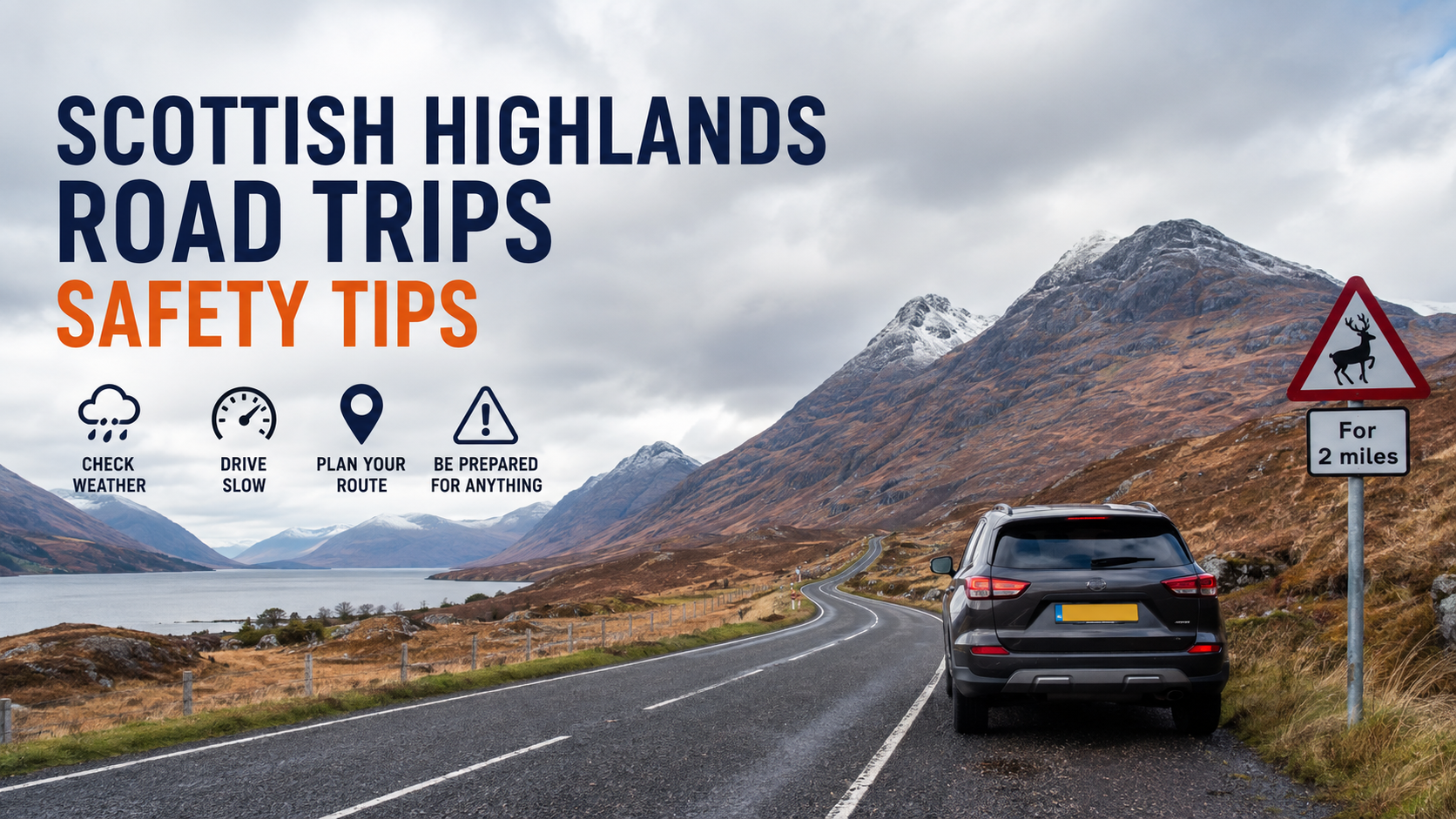

A Highland road trip can take you past sea lochs, mountain passes, isolated beaches and villages that feel far removed from everyday traffic. Those landscapes are part of the attraction, but they also bring narrow roads, sudden weather changes, limited services and driving situations that may be unfamiliar to visitors.
These Scottish Highlands road trips safety tips explain how to prepare your vehicle, use passing places correctly, choose a sensible speed and respond to wildlife, poor visibility or a breakdown. The aim isn’t to make Highland driving sound intimidating. Most journeys are straightforward when you slow down, plan realistic distances and treat rural roads as working routes rather than scenic attractions built solely for tourists.
Why Highland Driving Requires a Different Approach
The Highlands contain major roads such as the A9 and A82, but many scenic routes narrow considerably once you leave the main network. Single-track sections, blind bends, steep gradients and unfenced land can all appear during the same day’s drive.
Navigation apps may show that two places are relatively close while failing to convey how slowly traffic moves through bends, passing places or busy viewpoints. Build spare time into every journey. A relaxed itinerary is safer than one that requires you to rush to accommodation, a restaurant reservation or the last ferry.
Plan the Journey Before Starting the Engine
Check weather and road conditions together
Look at both the Met Office forecast and Traffic Scotland before setting out. The Met Office publishes regional forecasts and weather warnings, while Traffic Scotland reports incidents, closures, roadworks and police travel advice affecting Scotland’s trunk-road network. Conditions on smaller local roads may require additional checks with councils, ferry operators or accommodation providers.
Check again during the day whenever you stop somewhere safe. A dry morning in Inverness doesn’t guarantee similar conditions on a west-coast pass several hours later. Forecasts can also differ between low-level settlements and exposed mountain areas, so use the most local forecast available.
Inspect the vehicle
Before leaving, confirm that the tyres are correctly inflated and have adequate tread. Check the lights, windscreen washers, wipers, coolant and fuel or battery level. Learn how to switch on the fog lights, hazard lights and windscreen demister before you need them.
In a hire car, adjust the mirrors and seat while parked, identify the fuel type and locate the spare wheel or puncture kit. Save the rental company’s breakdown number offline. A ten-minute familiarisation period is especially worthwhile when the vehicle has unfamiliar controls or a manual gearbox.
Plan shorter daily distances
Avoid building an itinerary around continuous driving. Frequent stops reduce fatigue and give you time to enjoy the scenery without looking away from the road.
Use proper car parks, lay-bys and marked viewpoints for breaks. Never stop suddenly because a photograph appears unexpectedly. Continue until you find somewhere that allows the vehicle to leave the carriageway completely.
Scottish Highlands Road Trips Safety Tips for Single-Track Roads
Single-track roads are wide enough for only one moving vehicle in many places. Passing places allow vehicles travelling in opposite directions to get around each other and let faster traffic overtake.
When an oncoming vehicle approaches, pull into a passing place on your left. When the available passing place is on your right, stop opposite it and allow the other vehicle to enter. The Highway Code also advises giving way to vehicles coming uphill whenever possible and reversing to a passing place when necessary.
Look well ahead so that you can identify the nearest passing place before meeting another vehicle. Arriving slowly gives both drivers time to communicate and avoids hurried reversing. Keep enough distance from the vehicle ahead to leave passing places available rather than forming a convoy.
Passing places are part of the road, not parking bays. Don’t use one for photographs, picnics, overnight stops or waiting for another member of your group. Blocking it can force traffic to reverse around bends or create a queue on a road with no room to turn.
Check your mirrors regularly. When several vehicles gather behind you, use the next suitable passing place or lay-by to let them through. This applies even when you believe you’re travelling at a reasonable speed; local drivers may know the road and may be travelling for work or an appointment. Official North Coast 500 guidance specifically asks slower vehicles to allow following traffic to overtake safely.
Treat the Speed Limit as a Maximum, Not a Target
For cars, the national limit on a single carriageway is generally 60 mph unless signs set a different limit. That figure does not mean 60 mph is safe on every Highland road. GOV.UK states clearly that a speed limit is the maximum permitted speed, not a recommended speed for all conditions.
Choose a speed that allows you to stop within the distance you can see to be clear. Slow down before blind bends, narrow bridges, summits and dips. Expect pedestrians, cyclists, motorcyclists and horse riders, especially on scenic roads where there may be no pavement or separate cycle lane.
When overtaking vulnerable road users, wait for a genuinely clear view and leave generous space. On a narrow road, patience is safer than attempting to squeeze through.
Prepare for Rapidly Changing Weather
Rain can reduce visibility, increase stopping distances and hide potholes or standing water. Use dipped headlights when visibility deteriorates, increase the gap from the vehicle ahead and avoid sudden steering or braking.
In strong winds, exposed roads can be difficult for campervans, motorhomes and vehicles carrying roof boxes or bicycles. Slow down before open stretches and when passing gaps in walls, woodland or buildings, where crosswinds may strike suddenly.
Snow and ice require a more cautious decision: the safest option may be postponing the journey. Traffic Scotland recommends gentle acceleration and braking in wintry conditions and advises drivers to reduce speed, particularly on bends. Official disruption guidance also tells travellers to carry warm clothing, food and water, maintain sufficient fuel and respect road-closure signs.
Don’t drive into floodwater simply because another vehicle has crossed. The depth, current and condition of the road beneath it may be impossible to judge. Follow closure signs and choose another route.
Watch for Deer, Sheep and Other Animals
Deer are particularly difficult to see around dawn and dusk. Reduce speed when animal-warning signs appear and scan both verges rather than concentrating only on the centre of the road. If one deer crosses, be prepared for another to follow. Official guidance recommends staying especially alert during low-light periods when deer activity may coincide with traffic.
Sheep, cattle and horses may also be on or beside unfenced rural roads. Approach slowly and give them time to move. Don’t sound the horn aggressively, rev the engine or attempt to force your way through a herd.
Stop and Park Without Creating a Hazard
A beautiful view doesn’t make the roadside a safe parking area. Park only where your vehicle fits completely off the carriageway and doesn’t block gates, passing places, field entrances or access for emergency vehicles.
Before opening a door, check for cyclists and traffic approaching from behind. Keep children and pets under control, particularly beside narrow roads where there may be no verge.
Motorised vehicles aren’t covered by Scotland’s outdoor-access rights in the same way as people camping on foot. Campervan and motorhome users should use legal overnight parking, designated stopovers or campsites and comply with local signs or restrictions.
Manage Fuel, Navigation and Driver Fatigue
Fuel stations and electric chargers can be farther apart in remote areas than visitors expect. Refill or recharge before reaching a critically low level, especially in the evening or outside the busiest travel season. Opening hours and charger availability should be checked directly rather than assumed.
Download maps for offline use and carry a charging cable or power bank. VisitScotland’s guidance for remote northern routes recommends offline maps because connectivity cannot be relied upon throughout a journey.
Keep navigation instructions audible and place the phone where it doesn’t obstruct your view. Never hold or operate it while driving. When the route appears wrong, continue to a safe stopping point instead of braking abruptly or reversing in the road.
Fatigue can build quickly on winding routes because the driver is constantly steering, scanning bends and watching for passing places. Change drivers when possible and take a proper break before concentration starts to fade.
Advice for Overseas Drivers and Hire-Car Users
Scotland drives on the left. International visitors should pay particular attention when leaving car parks, petrol stations and single-track roads, because these are common moments for old habits to return. Traffic Scotland advises drivers to consciously keep left when joining or turning onto a new road.
Check that your licence is valid for driving in Great Britain before booking a vehicle. Eligibility varies according to the licence-issuing country and the driver’s residency status, so use the official GOV.UK licence checker rather than relying on general travel forums.
Scotland’s drink-driving limit is lower than the limit in England and Wales. The practical safety rule is simpler than calculating units: don’t drink when you’ll be driving, and remember that alcohol consumed the previous evening may still affect you the following morning.
Extra Care for Campervans and Motorhomes
Only hire a vehicle you can confidently steer, position and reverse. A large motorhome may feel manageable on a motorway but considerably more demanding on a steep single-track road.
Practise reversing before starting the scenic part of the journey. Keep well inside your side of the road on bends, remembering that mirrors and rear bodywork may be wider than the cab.
Don’t drive in a close convoy with other campervans. North Coast 500 guidance recommends leaving at least one passing place between vehicles so oncoming traffic has room to move through the group.
Check route-specific warnings before committing to a mountain pass or minor coastal road. Vehicle length, weight, height and rental-company restrictions may make an alternative route more appropriate.
What to Do During a Breakdown or Collision
Move the vehicle to a place of relative safety when possible, switch on the hazard lights and keep passengers away from moving traffic. On an ordinary road, a warning triangle may be used at least 45 metres behind the vehicle when it is safe to place one. Never use a warning triangle on a motorway.
Call your breakdown provider and describe your location as precisely as possible. A road number, nearby junction, village, direction of travel or map coordinates can be more useful than the name of a distant attraction.
Call 999 or 112 when someone is injured, the vehicle is in a dangerous position, the road is obstructed or there is another immediate threat. Don’t move an injured person unless they face greater danger by remaining where they are.
Carry a small emergency kit containing warm clothing, water, food, a torch, a reflective garment, basic first-aid supplies and a phone-charging option. These items matter throughout the year, not only during winter.
Quick Pre-Departure Safety Checklist
Before each day’s drive:
- Check local weather, warnings, road closures and ferry updates.
- Confirm fuel or battery range.
- Download the route for offline use.
- Secure luggage, bicycles and roof-mounted equipment.
- Clean the lights, mirrors and windows.
- Carry water, warm layers and emergency supplies.
- Tell someone your intended route when travelling into a remote area.
- Leave enough time to reach your destination before becoming tired.
Common Mistakes to Avoid
The most frequent problems usually begin with rushing: driving too fast into blind bends, refusing to let following traffic pass, stopping in passing places or continuing after weather conditions have become uncomfortable.
Another mistake is blindly following satellite navigation onto a road that doesn’t suit the driver or vehicle. Navigation software is a planning aid, not a substitute for road signs, closure notices or judgement. When a route looks unsuitable, turn around at a safe location or choose the longer main-road alternative.
FAQs
What are the most important Scottish Highlands road trips safety tips?
Plan modest daily distances, check weather and road conditions, slow down on rural roads and learn how passing places work before encountering them. Carry offline navigation and emergency supplies, let faster traffic pass and never stop in a passing place for photographs or breaks.
Are Scottish Highland roads dangerous for tourists?
They aren’t inherently dangerous, but unfamiliar features can catch visitors by surprise. Narrow lanes, blind bends, changing weather, animals and long distances between services demand more concentration than ordinary urban driving. Tourists who reduce their speed and plan conservatively should find most routes manageable.
Who has priority on a single-track road in Scotland?
There isn’t a universal rule giving one direction permanent priority. Drivers should use the closest passing place sensibly, pull into spaces on their left or wait opposite spaces on their right. The Highway Code recommends giving way to uphill traffic whenever possible.
Can I park in a passing place to take photographs?
No. Passing places must remain available for moving traffic. Parking in one may force other vehicles to reverse or prevent emergency and local traffic from getting through. Continue to a marked viewpoint, lay-by or car park where the vehicle can leave the road safely.
Do I need a four-wheel-drive vehicle in the Highlands?
A four-wheel-drive vehicle isn’t normally required for established public roads in ordinary conditions. A suitable, roadworthy car is usually enough. During snow, ice or severe weather, four-wheel drive doesn’t remove the need for appropriate tyres, lower speeds or a decision to postpone travel.
Is the North Coast 500 suitable for a first road trip?
It can be, provided the driver is comfortable with rural roads and doesn’t try to complete the route too quickly. The official visitor guidance recommends allowing at least five to seven days, fuelling regularly, carrying offline maps and preparing for changing weather.
Is mobile reception reliable throughout the Scottish Highlands?
Reception varies by location and network, so it shouldn’t be your only navigation or emergency plan. Download maps, accommodation details and important phone numbers in advance. Keep the phone charged and carry a power bank, particularly when travelling between remote settlements.
Conclusion
Safe Highland driving is less about specialist skill than patience, preparation and sound judgement. Check conditions, keep your itinerary flexible, use passing places correctly and resist the temptation to rush between scenic stops.
The most useful Scottish Highlands road trips safety tips all lead to the same principle: drive for the road you can see, not for the speed limit or the arrival time displayed on a screen. Giving yourself more time makes the journey safer and leaves more room to appreciate the landscape.
Read also Avoiding Online Scams UK Rules and Protections: A Simple Guide