
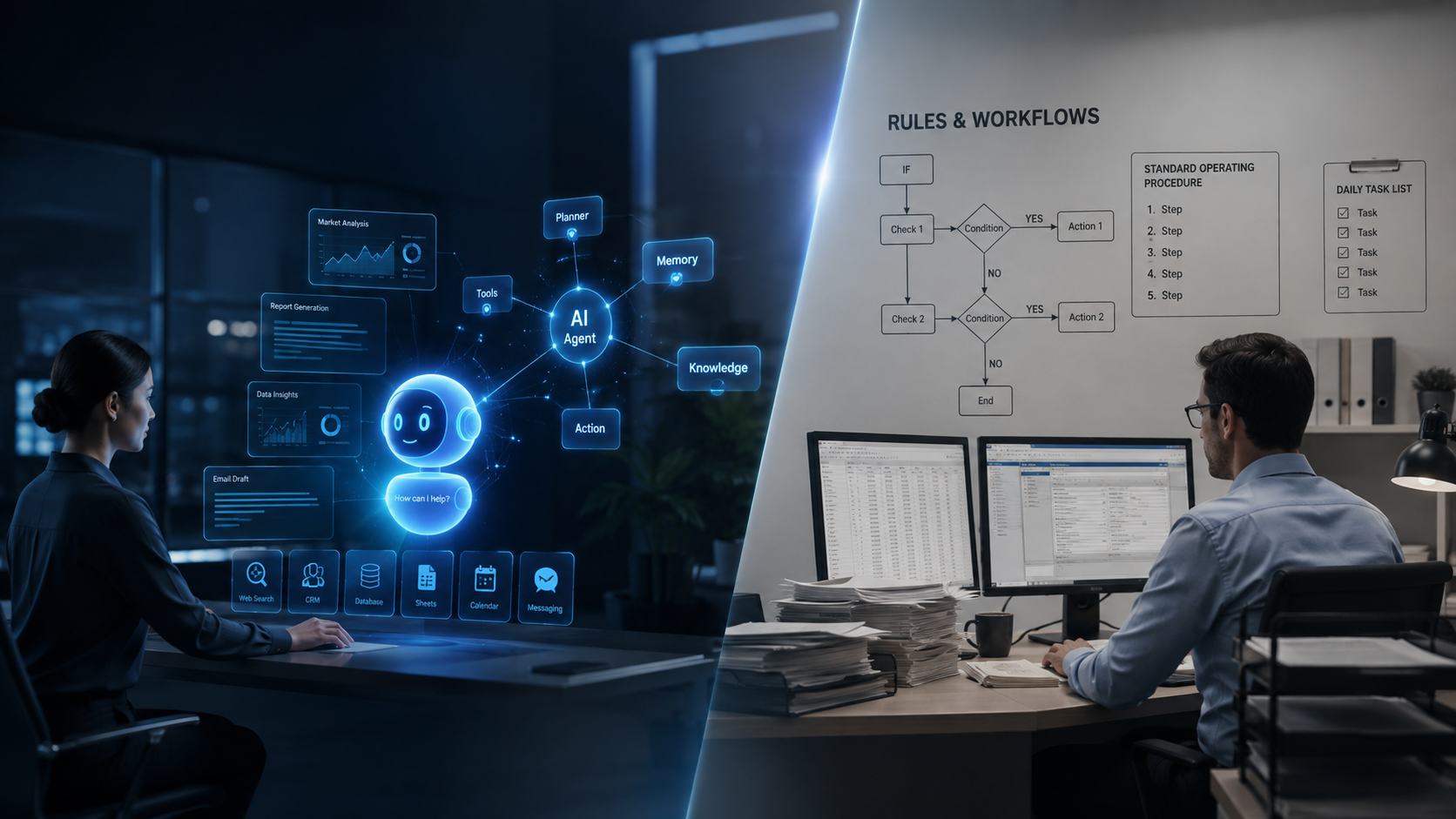

AI agents are changing how companies think about automation, but they are not a universal replacement for traditional software. An AI agent can interpret a goal, decide what steps to take, use connected tools, and adjust its actions as conditions change. Traditional alternatives—including deterministic code, rule-based workflows, robotic process automation (RPA), and simpler AI applications—usually follow paths defined in advance. The important question is therefore not whether AI agents are more advanced. It is whether a task actually benefits from autonomy, reasoning, and flexibility enough to justify the added cost, complexity, and risk.
What Are AI Agents?
An AI agent is software designed to pursue a goal rather than merely return a single response. Modern agents can use language models to interpret instructions, select tools, retrieve information, make decisions, and take actions in external systems. Depending on their design, they may also maintain state across several steps and change their approach when an initial attempt fails.
This makes an agent different from a basic chatbot. A conventional chatbot mainly responds to messages. An agent can potentially act on them. For example, instead of only explaining how to resolve a customer problem, an appropriately configured agent might inspect account information, search a knowledge base, choose the relevant procedure, call an approved business tool, and return the result. Microsoft describes autonomy as one of the defining distinctions between assistants and agents.
Anthropic makes another useful distinction: a workflow follows predefined code paths, while an agent allows the model to dynamically direct parts of the process and decide how tools should be used.
What Counts as a Traditional Alternative?
The phrase AI agents vs traditional alternatives covers several different technologies rather than one direct competitor.
Traditional options include:
- Deterministic software: ordinary programs that execute explicitly written logic.
- Rule-based workflows: processes built around conditions such as “if X happens, perform Y.”
- RPA: software robots that imitate repetitive actions people perform in digital applications.
- API and integration automation: predefined connections that move data or trigger actions between systems.
- Single-model AI applications: an LLM receives an input and generates an answer without autonomously managing a long sequence of actions.
RPA, for example, is particularly associated with repetitive, rule-based work such as data entry and interactions between existing business applications.
These approaches may appear less sophisticated than autonomous agents, but predictability is often an advantage rather than a weakness.
AI Agents vs Traditional Automation: Key Differences
| Area | AI Agents | Traditional Alternatives |
|---|---|---|
| Execution | Can dynamically choose steps | Usually follows predefined steps |
| Best suited to | Ambiguous, variable or open-ended tasks | Stable, predictable processes |
| Tool use | Model can decide which tool to use | Tool calls are normally specified in advance |
| Flexibility | High | Usually lower |
| Predictability | Can vary between runs | Generally high |
| Cost and latency | Often higher because models may run repeatedly | Often lower for routine operations |
| Governance needs | Requires strong permissions, monitoring and guardrails | Usually easier to constrain |
| Error handling | Can potentially reason about unexpected situations | Normally follows programmed exception paths |
The central trade-off is flexibility versus control. Anthropic recommends using the simplest architecture that solves the problem, noting that agentic systems can exchange higher cost and latency for better performance on tasks that genuinely need additional reasoning. Microsoft similarly recommends workflows for well-defined steps and agents for open-ended tasks requiring autonomous planning or tool use.
“If you can write a function to handle the task, do that instead of using an AI agent.” — Microsoft Agent Framework documentation.
Where AI Agents Have an Advantage
Handling Ambiguous Tasks
Traditional automation needs developers to anticipate conditions and encode them. That works extremely well when the environment is stable.
Agents become more useful when the correct next step cannot always be predicted beforehand. A model can interpret context, choose among available tools, examine a result, and then determine what to do next. This model-directed execution is one of the clearest architectural differences between an agent and a fixed workflow.
Working Across Several Steps and Systems
Agents can be designed to combine reasoning with actions across connected services. A business process might require retrieving information, interpreting unstructured text, deciding which system to query, and selecting a follow-up action. Such tasks become difficult to represent as an ever-expanding collection of static branches.
Adapting When Conditions Change
A predefined workflow generally reacts only to exceptions its designers anticipated. An agent can potentially reconsider its plan when a tool produces unexpected information.
That flexibility is useful in tasks such as research, troubleshooting, complex customer-service triage, coding, or other work where the path to a solution varies from case to case. It also creates new reliability concerns because the execution path is no longer completely predetermined.
Where Traditional Alternatives Are Better
High-Volume Repetitive Tasks
If a company needs to copy structured information between known systems thousands of times using the same procedure, an autonomous agent may add little value.
RPA and conventional programs are specifically suited to repeatable, rule-based activities. Once the required logic is understood, deterministic execution can avoid repeatedly paying for model inference or asking a model to make decisions that do not require judgment.
Processes Requiring Strict Predictability
Some operations need an exact sequence every time. Financial controls, permissions, validation rules and other sensitive steps may require hard constraints rather than model discretion.
That does not necessarily exclude AI. A stronger design can put an AI agent around selected reasoning tasks while keeping critical checks in deterministic code. OpenAI examples of production-oriented agent workflows similarly combine model reasoning with typed outputs, deterministic guardrails, tracing and evaluation instead of allowing the model unrestricted control.
Simple Problems
Not every application needs an agent.
A single LLM call combined with retrieval, examples, or conventional programming may solve many tasks with less engineering complexity. Anthropic specifically advises teams to consider simpler approaches before adopting full agentic systems.
The Strongest Architecture May Be Hybrid
The most useful comparison is not necessarily AI agents versus automation. Increasingly, the two can complement one another.
An agent can handle the uncertain portion of a process while deterministic software performs the predictable work. For example, a model might interpret an unusual request and choose the correct business operation, while ordinary code validates required fields, checks authorization and executes the final API request.
Platforms from Microsoft and UiPath increasingly describe architectures that combine agents with workflows, robots, conventional business logic and human oversight rather than replacing every component with autonomous AI.
This division of labor gives companies access to model-based reasoning without sacrificing control over operations that should remain fixed.
How to Choose Between AI Agents and Traditional Alternatives
Start with the nature of the task rather than the technology.
An AI agent is a stronger candidate when the work is open-ended, requires interpretation, involves changing paths, or needs the system to choose tools dynamically. A traditional workflow is usually preferable when the steps are already known, output needs to be consistent, and ordinary code can express the required logic clearly.
Risk also matters. Agents capable of taking actions need carefully scoped permissions, security controls, transparency and meaningful human control. Anthropic’s work on trustworthy agents emphasizes human control, alignment with user expectations, security, transparency and privacy as central considerations for systems given greater autonomy.
The question therefore becomes: Where is intelligent judgment actually valuable?
Use models there. Keep predictable operations predictable.
FAQs
Are AI agents better than traditional automation?
Not universally. AI agents are better suited to tasks requiring flexible decision-making, changing execution paths and autonomous tool use. Traditional automation is generally more appropriate when a process has stable, predefined steps.
What is the difference between an AI agent and RPA?
RPA primarily automates repetitive, rule-based interactions with digital systems. An AI agent can use a model to interpret goals, make decisions and dynamically select actions or tools. The technologies can also be combined.
Can AI agents replace traditional software?
They are unlikely to eliminate the need for deterministic software. Fixed code remains better for many predictable computations, validations and business rules, while agents can be added where reasoning and flexibility provide measurable value. Microsoft explicitly recommends using ordinary functions when a function is sufficient.
Are AI agents more expensive to run?
They can be. Agentic systems may require repeated model calls, tool interactions and iterative reasoning, which can increase cost and latency compared with simpler workflows. The exact difference depends on the architecture, model, tools and workload.
What businesses should use AI agents?
Organizations should consider agents for processes where employees currently make contextual decisions, interpret variable inputs or navigate different tools depending on circumstances. Stable repetitive operations may remain better candidates for traditional automation or RPA.
Can AI agents and traditional automation work together?
Yes. Hybrid architectures can use agents for judgment and conventional workflows, APIs or robots for predictable execution. Current enterprise agent frameworks increasingly support this combination.
Conclusion
The debate around AI agents vs traditional alternatives is not about choosing the newest technology. It is about matching the architecture to the problem.
Agents offer an important capability that conventional automation lacks: they can interpret goals and dynamically decide how to pursue them. But that autonomy also adds cost, variability, security considerations and operational complexity. Traditional software, workflows and RPA remain the better tools for many repeatable processes.
For most organizations, the practical future is likely to be hybrid: deterministic automation for what machines can predict, AI agents for the parts that genuinely require judgment.
Read Also Best Ideas for Beginner Home Workouts: A Simple Way to Start