
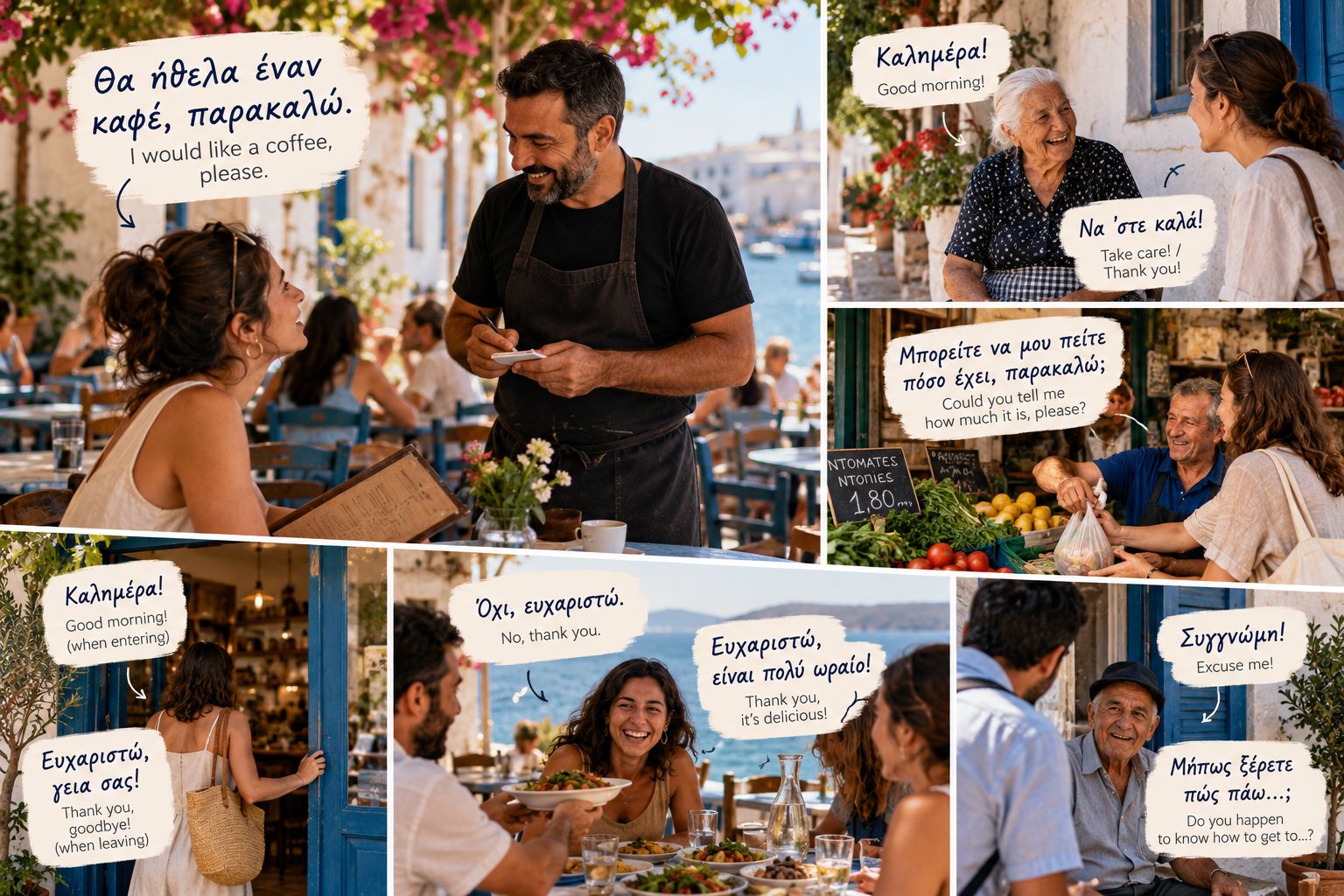

You can learn παρακαλώ from a phrasebook. You can learn ευχαριστώ from an app. But knowing when to use them, how warmly to say them, what someone might say back, and why Greeks often turn a simple thank-you into a wish — that is where the language becomes real. Greek polite phrases are not stiff or formal. They are small ways of making everyday life softer: at the café, in the taxi, after a lesson, in a message, at the bakery, or when someone helps you find the right street. And if you want to sound warmer, not just correct, these are the phrases to start with. Disclosure: This article was created in partnership with Greek-Out to help beginner learners understand useful Greek phrases and how Greek-Out teaches real-life conversation.
Polite Greek Is About More Than Saying the Right Word
Most beginners do not want to sound rude.
They want to say the right thing, at the right moment, in a way that feels respectful and natural.
But direct translation does not always work.
You can know the translation and still not know the feeling.
That is where real Greek begins.
Greek politeness is often warm, expressive, and relational. It depends on tone, timing, context, and the person in front of you.
A polite phrase can help you:
- order without sounding abrupt
- thank someone warmly
- apologise or get attention
- respond when someone apologises
- end a short interaction naturally
- sound more human in everyday Greek
That is why learning Greek with context matters. Greek-Out teaches Greek through real-life phrases, cultural context, and conversation — because knowing the word is only the beginning.
The First Word Everyone Learns: Παρακαλώ
Παρακαλώ
Parakaló
Please / you’re welcome
This is one of the most useful Greek polite phrases.
And yes, it does two jobs.
It can mean please when you ask for something:
Ένα νερό, παρακαλώ.
Éna neró, parakaló.
A water, please.
And it can mean you’re welcome when someone thanks you:
A: Ευχαριστώ.
Efcharistó.
Thank you.
B: Παρακαλώ.
Parakaló.
You’re welcome.
Greek likes to keep beginners alert.
| Greek | Meaning | Situation |
| Ένα νερό, παρακαλώ | A water, please | Ordering |
| Παρακαλώ | You’re welcome | Responding to thanks |
| Μπορείτε να βοηθήσετε, παρακαλώ; | Can you help, please? | Asking politely |
The secret is context.
Before a request, παρακαλώ usually means please.
After ευχαριστώ, it usually means you’re welcome.
Small word. Big responsibility.
Thank You in Greek: Ευχαριστώ and Ευχαριστώ Πολύ
The standard way to say thank you in Greek is:
Ευχαριστώ
Efcharistó
Thank you
A warmer version is:
Ευχαριστώ πολύ
Efcharistó polí
Thank you very much
Use these everywhere:
- at the bakery
- after a taxi ride
- after a lesson
- at a taverna
- when someone gives directions
- when someone explains something slowly because your Greek brain requested mercy
Ευχαριστώ is safe and standard.
Ευχαριστώ πολύ feels warmer and more natural in many everyday situations.
Pronunciation note:
ευχαριστώ sounds roughly like:
ef-ha-ri-STO
The stress falls near the end, on στώ.
Do not wait until it sounds perfect.
Say it anyway.
That is how the word becomes yours.
For a deeper guide, read our article on how to say thank you in Greek.
Συγγνώμη and Με Συγχωρείτε: Sorry, Excuse Me, and Pardon Me
Greek has a very useful word for both sorry and excuse me:
Συγγνώμη
Signómi
Sorry / excuse me
Use it when:
- you bump into someone
- you need to pass through a crowd
- you want to get someone’s attention
- you did not understand
- you need to interrupt politely
Example:
Συγγνώμη, μιλάτε αγγλικά;
Signómi, miláte angliká?
Excuse me, do you speak English?
A slightly more formal version is:
Με συγχωρείτε
Me sinchoríte
Excuse me / pardon me
| Situation | Better Phrase |
| Getting someone’s attention | Συγγνώμη |
| Apologising lightly | Συγγνώμη |
| More formal interruption | Με συγχωρείτε |
| Passing through a crowd | Συγγνώμη |
You do not need to overthink this as a beginner.
Συγγνώμη will help you in many everyday moments.
And if you say it with a kind tone, you are already doing well.
Να Είσαι Καλά: When Thank You Becomes a Wish
Now we arrive at a very Greek kind of politeness.
Να είσαι καλά
Na íse kalá
Be well / thanks / that’s kind of you
This is used when speaking to one person informally.
The more polite or plural version is:
Να είστε καλά
Na íste kalá
Be well / thank you
Use να είστε καλά when speaking to more than one person, or politely to someone you do not know well.
This phrase is not just a direct translation of “thank you.”
It literally wishes the other person well.
Example:
Ευχαριστώ πολύ. Να είσαι καλά.
Efcharistó polí. Na íse kalá.
Thank you very much. Be well.
In Greek, gratitude often comes with a little wish attached.
You do not only say thank you.
You send something good back.
That is why this phrase feels warm, human, and very Greek.
These are the kinds of phrases that make much more sense when a teacher explains the feeling behind them.
Καλή Συνέχεια: The Polite Goodbye That Sounds Very Greek
One of the most useful everyday polite phrases in Greek is:
Καλή συνέχεια
Kalí sinécheia
Have a good continuation / have a good rest of your day
This phrase does not translate perfectly into English.
Literally, it means something like good continuation.
Which sounds slightly strange in English.
But in Greek, it feels completely natural.
You can use καλή συνέχεια when leaving:
- a shop
- a café
- a kiosk
- a bakery
- a lesson
- a phone call
- a short everyday interaction
Example:
Ευχαριστώ πολύ. Καλή συνέχεια!
Efcharistó polí. Kalí sinécheia!
Thank you very much. Have a good rest of your day!
It is warm without being dramatic.
Polite without being stiff.
Very useful without requiring a full grammar degree.
A phrase list can tell you what καλή συνέχεια means.
A teacher can show you why it feels so Greek.
Polite Request Starters: Μπορείτε and Θα Ήθελα
If you want to sound polite in Greek, learn these two starters.
Μπορείτε…;
Μπορείτε…;
Boríte…?
Can you…? / Could you…?
Use this when asking for help.
Examples:
Μπορείτε να με βοηθήσετε;
Boríte na me voithísete?
Can you help me?
Μπορείτε να το πείτε πιο αργά;
Boríte na to píte pio argá?
Can you say it more slowly?
That second one is gold for beginners.
Keep it close.
Θα ήθελα…
Θα ήθελα…
Tha íthela…
I would like…
Use this when ordering or asking for something.
Examples:
Θα ήθελα έναν καφέ, παρακαλώ.
Tha íthela énan kafé, parakaló.
I would like a coffee, please.
Θα ήθελα ένα νερό, παρακαλώ.
Tha íthela éna neró, parakaló.
I would like a water, please.
These phrases work in cafés, bakeries, tavernas, hotels, taxis, lessons, and shops.
You do not need complicated Greek to sound polite.
You need a good starter phrase.
And the courage to use it before your brain starts translating everything word by word.
Δεν Πειράζει: The Greek Way to Say “It’s Okay”
Politeness is not only about asking and thanking.
It is also about responding kindly.
Δεν πειράζει
Den pirázi
It’s okay / no worries / never mind
Use this when someone apologises or when something small goes wrong.
Example:
A: Συγγνώμη.
Signómi.
Sorry.
B: Δεν πειράζει.
Den pirázi.
It’s okay.
This phrase helps soften awkward moments.
Someone makes a small mistake.
Someone is late.
Someone bumps into you.
Someone apologises.
You can say:
Δεν πειράζει.
No drama.
No coldness.
Just a gentle “it’s okay.”
Very useful. Very human.
Quick Cheat Sheet: Greek Polite Phrases for Beginners
Here is the useful version in one place.
| What You Want to Say | Greek | Transliteration | Best For |
| Please | Παρακαλώ | Parakaló | Requests |
| You’re welcome | Παρακαλώ | Parakaló | Replying to thanks |
| Thank you | Ευχαριστώ | Efcharistó | Everyday thanks |
| Thank you very much | Ευχαριστώ πολύ | Efcharistó polí | Warmer thanks |
| Sorry / excuse me | Συγγνώμη | Signómi | Apologies / attention |
| Excuse me, formal | Με συγχωρείτε | Me sinchoríte | Formal politeness |
| Be well / thanks | Να είσαι καλά | Na íse kalá | Warm informal thanks |
| Be well, polite/plural | Να είστε καλά | Na íste kalá | Polite or plural |
| Have a good rest of your day | Καλή συνέχεια | Kalí sinécheia | Leaving |
| I would like | Θα ήθελα | Tha íthela | Ordering politely |
| Could you…? | Μπορείτε…; | Boríte…? | Asking politely |
| It’s okay | Δεν πειράζει | Den pirázi | Reassurance |
If you are a beginner, start with five:
Παρακαλώ
Ευχαριστώ πολύ
Συγγνώμη
Θα ήθελα…
Καλή συνέχεια
That is already enough to make many everyday Greek interactions warmer.
Why These Phrases Are Hard to Learn From an App Alone
Phrase apps can help.
They are useful for memorising words. They can give you translations. They can help you recognise a phrase when you see it.
But polite Greek is not only about memorisation.
Apps often do not show you:
- when a phrase is formal or informal
- how warm a phrase feels
- what tone to use
- how Greeks might respond
- how to pronounce the phrase clearly
- when a literal translation does not tell the whole story
For example, an app can tell you:
Να είσαι καλά = be well
But a teacher can explain why it can feel like a warm thank-you.
An app can tell you:
Καλή συνέχεια = good continuation
But a teacher can show you when Greeks actually say it, and why it sounds natural when leaving a shop, class, café, or call.
That is the difference between correct Greek and real Greek.
And that is where Greek-Out lessons can help: real phrases, real situations, pronunciation support, and a teacher who can tell you, “Yes, this is correct — but here is how Greeks actually say it.”
A Mini Real-Life Conversation Using Polite Greek
Here is a simple everyday exchange.
Nothing advanced.
Just useful Greek used well.
A: Καλημέρα. Θα ήθελα έναν καφέ, παρακαλώ.
Kaliméra. Tha íthela énan kafé, parakaló.
Good morning. I would like a coffee, please.
B: Βεβαίως.
Veveós.
Of course.
A: Ευχαριστώ πολύ.
Efcharistó polí.
Thank you very much.
B: Παρακαλώ.
Parakaló.
You’re welcome.
A: Καλή συνέχεια!
Kalí sinécheia!
Have a good rest of your day!
See?
This is not advanced Greek.
It is simple Greek used well.
That is the point.
For more everyday conversation practice, read our guide to small talk in Greek or continue with basic Greek phrases.
FAQ: Greek Polite Phrases
What are common Greek polite phrases?
Common Greek polite phrases include παρακαλώ for please or you’re welcome, ευχαριστώ for thank you, συγγνώμη for sorry or excuse me, να είσαι καλά for a warm thank-you, and καλή συνέχεια for have a good rest of your day.
How do you say please in Greek?
Please in Greek is:
Παρακαλώ
Parakaló
The same word can also mean you’re welcome, depending on context.
How do you say thank you in Greek?
Thank you in Greek is:
Ευχαριστώ
Efcharistó
A warmer version is:
Ευχαριστώ πολύ
Efcharistó polí
Thank you very much.
How do you say sorry in Greek?
Sorry in Greek is:
Συγγνώμη
Signómi
It can also mean excuse me when you are trying to get someone’s attention.
What does να είσαι καλά mean?
Να είσαι καλά literally means be well.
Greeks often use it as a warm way to say thank you or respond kindly in everyday conversation.
What does καλή συνέχεια mean?
Καλή συνέχεια means have a good continuation or more naturally, have a good rest of your day.
It is a common polite phrase used when leaving shops, cafés, lessons, calls, or everyday interactions.
Can I learn polite Greek phrases online?
Yes. Online Greek lessons can help you learn polite phrases, pronunciation, tone, and when to use each expression naturally in real conversations.
Final Thought: Polite Greek Is Where Real Conversation Begins
You do not need to speak perfect Greek to make a conversation warmer.
Sometimes, the difference is one παρακαλώ, one ευχαριστώ πολύ, one συγγνώμη, or one perfectly timed καλή συνέχεια.
That is where real Greek begins.
Not in sounding flawless.
In sounding human.
Want to sound warmer, not just correct? Book a free trial lesson with Greek-Out and learn the Greek people actually use.
You can also explore Greek lessons online if you want structured support with conversation, pronunciation, tone, and everyday Greek.