
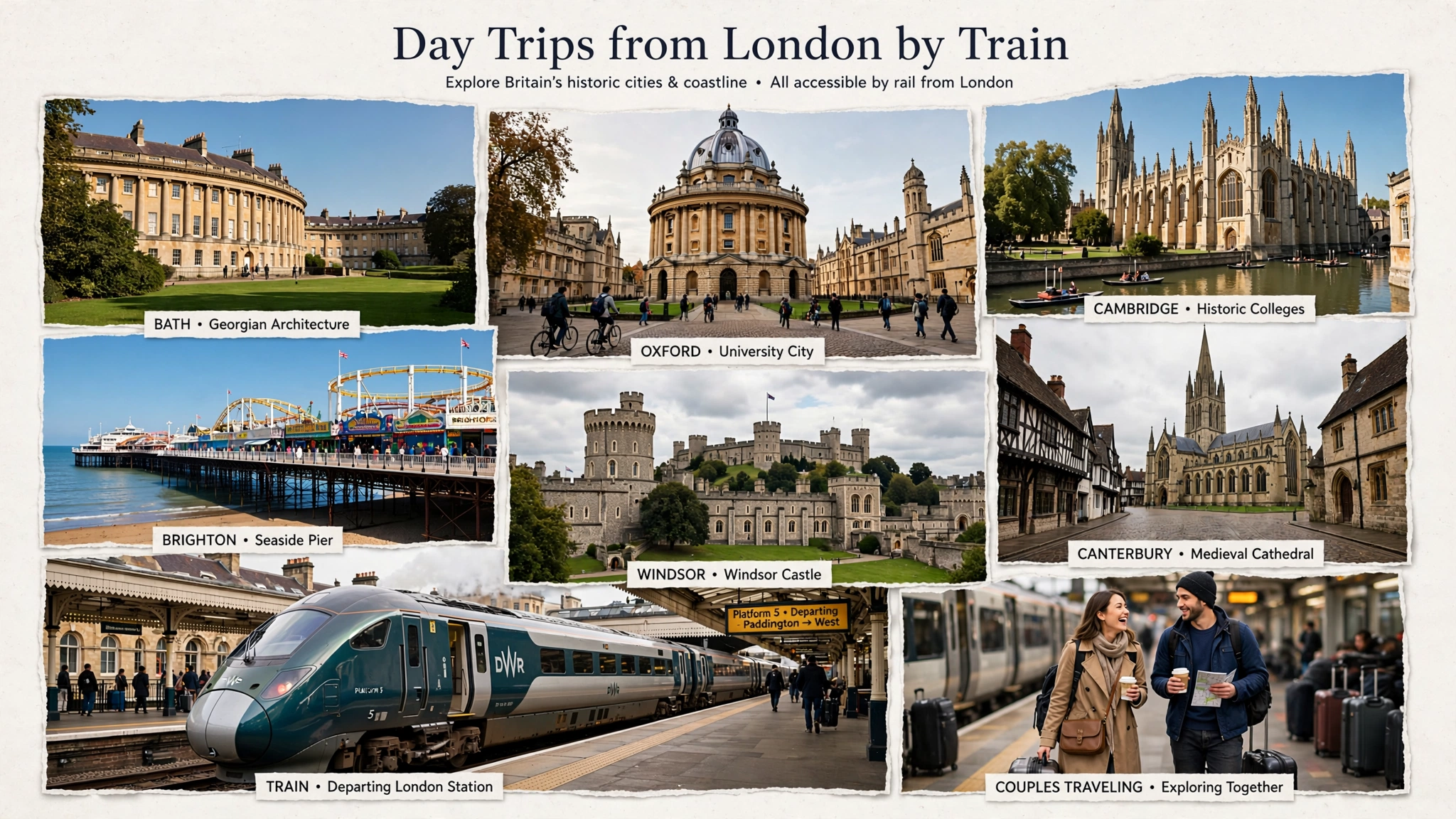

London has enough museums, restaurants and neighbourhoods to fill months of weekends, but some of England’s most interesting towns and landscapes sit surprisingly close to the capital. You do not need a car, an overnight hotel or a complicated itinerary to reach them.
The best day trips from London by train include much more than the familiar choices of Brighton, Oxford and Cambridge. Within roughly 45 to 90 minutes, you can walk through medieval streets, explore a Norman castle, hike across chalk downs, wander beside the sea or step straight from a railway station into the New Forest.
The journey times below are approximate. Timetables and routes can change, particularly at weekends, so it is worth checking the relevant train operator before leaving.
1. Rye
Train: London St Pancras to Rye via Ashford International
Journey time: Just over 1 hour on well-timed connections
Best for: Medieval streets, history, photography and coastal walks
Rye feels unusually far removed from London despite being reachable in a little over an hour. Southeastern’s high-speed service connects St Pancras with Ashford International in around 38 minutes, while Rye is roughly another 20 minutes from Ashford by train.
The pleasure of Rye is largely in walking. Its compact old centre is filled with steep lanes, old inns and weathered buildings rather than major modern attractions. Mermaid Street is the best-known example, and official local tourism information describes Rye as one of England’s best-preserved medieval towns.
Walk up to St Mary’s Church, explore the streets around the Citadel and allow time for the independent shops and cafés. If you want a longer day outdoors, the surrounding area also connects with Rye Harbour Nature Reserve and routes towards Camber.
Rye works particularly well if you prefer a day that is not organised around ticking off attractions. Arrive reasonably early, walk without a strict route, have lunch in the old town and leave the afternoon open for either the harbour or another circuit through the quieter streets.
2. Arundel
Train: London Victoria to Arundel
Journey time: Around 1 hour 30 minutes
Best for: Castles, architecture, gardens and riverside walks
Arundel makes an unusually complete day trip because its castle, cathedral, historic centre and riverside all fit into a walkable area. Southern operates regular direct services from London Victoria, and the railway station is around a 15-minute walk from the centre. Typical London–Arundel journeys take roughly an hour and a half.
Arundel Castle and Gardens dominates the town. Its origins go back to the Norman period, while today’s visitor experience combines historic rooms, fortified architecture and extensive gardens. The official visitor site also places the castle within easy reach of Arundel’s galleries, shops, restaurants and town centre.
Do not rush straight back to the station after visiting the castle. Walk along the River Arun, explore the lanes below the cathedral and stop for coffee away from the busiest streets. The compact layout means you can see a substantial amount without spending half the day moving between attractions.
Arundel is especially good in spring and summer when more of the castle grounds can be enjoyed, although opening dates and access to individual areas should be checked before travelling.
3. Brockenhurst
Train: London Waterloo to Brockenhurst
Journey time: About 90 minutes
Best for: Walking, cycling, woodland and a car-free New Forest day
For a countryside trip without hiring a car, Brockenhurst is one of the strongest choices from London. The New Forest National Park Authority says Brockenhurst station sits in the heart of the New Forest and can be reached from London Waterloo in around 90 minutes.
This is not a destination where you need a long sightseeing list. The appeal is being able to step off a train and spend the day walking through woodland, heath and open forest. Brockenhurst itself has shops, tearooms, pubs and restaurants, while free-roaming ponies, donkeys and cattle are a normal part of the surrounding landscape.
Several walking and cycling routes can be started around the village. The National Park Authority specifically promotes Brockenhurst as a base for exploring the forest without a car, including rail-linked trails and the Old Railway cycle route.
Bring shoes suitable for uneven or muddy ground and avoid planning the day too tightly. A simple combination of a forest walk, village lunch and another shorter trail in the afternoon makes a much better Brockenhurst trip than trying to cover a large portion of the national park.
4. Deal
Train: London St Pancras International to Deal
Journey time: Under 1 hour 30 minutes on suitable high-speed services
Best for: Seaside walks, independent shops and a quieter Kent coast
Deal offers the pleasures of a Kent seaside town without quite the same atmosphere as the better-known resort destinations. Southeastern advertises high-speed journeys from London St Pancras to Deal in under an hour and a half.
Start with the seafront. Deal Pier stretches more than 300 metres into the English Channel, giving wide views back towards the waterfront and along the Kent coast. It remains a working angling pier as well as a place for visitors to walk out over the water.
Behind the promenade, Deal has a compact centre with independent shops, cafés and historic streets. The town’s long pebbled waterfront gives it a calmer character than places built around amusement attractions. Official White Cliffs Country tourism information highlights the promenade, pier, historic buildings and views towards the Goodwin Sands.
If the weather is good, leave enough time simply to walk. A long promenade stroll followed by the pier, lunch and the town centre fills a day comfortably without requiring local buses or taxis.
5. Faversham
Train: London St Pancras International to Faversham
Journey time: About 1 hour 5–10 minutes
Best for: Markets, brewing history, old streets and creek-side walks
Faversham tends to receive less attention than Canterbury or Whitstable, which is precisely why it works well for travellers looking for somewhere different. Southeastern puts the high-speed journey from St Pancras at roughly 1 hour 5 to 10 minutes.
The town has a strong trading and brewing identity. Visit Kent describes Faversham Market as around 900 years old and highlights Shepherd Neame, based in the town, as Britain’s oldest brewer.
From the historic centre, continue towards Faversham Creek and Standard Quay. The quay mixes old maritime surroundings with small local businesses, food and antiques, and provides a pleasant contrast to the market streets.
Faversham is at its best when the market is operating, so checking market days before choosing your date can make the trip more rewarding. Even without it, the old centre, creek and pubs make this an easy destination for travellers who prefer atmosphere to headline attractions.
6. Great Missenden
Train: London Marylebone to Great Missenden
Journey time: Around 45 minutes
Best for: Roald Dahl, families, literature and Chiltern walks
One of the easiest unusual day trips from London is Great Missenden in Buckinghamshire. The direct Chiltern Railways service from London Marylebone takes approximately 45 minutes, and the village centre is easily reached on foot from the station.
Its strongest connection is with Roald Dahl, who lived and wrote in Great Missenden for 36 years. The Roald Dahl Museum and Story Centre occupies buildings on the High Street and includes interactive galleries, activities and original material from the writer’s archive.
The museum makes Great Missenden particularly appealing for families, but there is enough beyond it to avoid treating the village as a single-attraction trip. Local walking activities lead through the village and surrounding countryside, which sits within the Chiltern Hills.
A good plan is to visit the museum in the morning, eat on or near the High Street and spend part of the afternoon walking. Because the train journey is short, there is little pressure to catch an extremely early service from London.
7. Ely
Train: London King’s Cross to Ely
Journey time: Around 1 hour 13 minutes
Best for: Cathedral architecture, history and a relaxed riverside
Cambridge gets most of the attention in this direction, but travelling a little farther brings you to Ely, one of England’s smallest cathedral cities.
Great Northern lists London King’s Cross to Ely journeys at around 1 hour 13–14 minutes, with direct services available.
The city’s defining landmark is Ely Cathedral, whose scale feels particularly dramatic because Ely is otherwise so compact. Nearby you can also visit Oliver Cromwell’s House and explore the streets around the cathedral precinct. Visit Ely operates its tourist information centre from Oliver Cromwell’s House on St Mary’s Street.
One of the best reasons to choose Ely over a busier city break is its pace. After visiting the cathedral area, walk towards the River Great Ouse for a slower afternoon beside the water before returning through the centre.
Ely suits travellers interested in architecture and history but who do not want an itinerary crowded with major attractions. Everything important is close enough together that the day can remain unhurried.
8. Lewes
Train: London Victoria to Lewes
Journey time: About 1 hour 9 minutes
Best for: Norman history, old streets, independent shops and South Downs views
Lewes is close enough to Brighton that many visitors pass it by, but it has a completely different character. Southern lists the typical direct journey from London Victoria at approximately 1 hour 9 minutes.
The centre climbs over a series of old streets beneath Lewes Castle, which was begun soon after the Norman Conquest. Climbing the castle’s towers gives broad views across the town and surrounding Sussex countryside.
Lewes also has the remains of St Pancras Priory, founded between 1078 and 1082, as well as Anne of Cleves House and a strong collection of independent shops, pubs and cafés. Several of its principal historic sites are close enough to combine on foot.
If you prefer walking to museums, Lewes is also a useful starting point for routes that climb onto the South Downs. Visit Lewes publishes a selection of local walks, many of which include stretches of the Downs.
The hills make Lewes slightly more tiring to explore than its compact map suggests, so comfortable footwear is worthwhile.
9. Sandwich
Train: London St Pancras International to Sandwich
Journey time: Around 1 hour 30–40 minutes
Best for: Medieval streets, slow travel and Kentish history
Despite sharing its name with one of the world’s most familiar foods, Sandwich is one of the more overlooked historic day trips from London.
Current Southeastern journey listings include direct St Pancras–Sandwich services of around an hour and a half, although exact journey times vary by departure.
White Cliffs Country describes Sandwich as the most complete medieval town in England, and that historical character is the main reason to come. Rather than moving between large attractions, spend time walking the narrow streets, looking at old buildings and stopping at independent shops and cafés.
Sandwich also works well for travellers who have already visited Canterbury and want another Kentish town with substantial history but considerably less foot traffic.
Do not confuse the destination with a conventional seaside trip. The historic centre is the focus here, making Sandwich better for architecture, quiet wandering and lunch than for a day on the beach.
10. Wye
Train: London St Pancras to Wye via Ashford International
Journey time: Roughly 1 hour with a well-timed connection
Best for: Hiking, chalk downs and big countryside views
Wye is perhaps the most outdoors-focused trip on this list. The village sits beneath the Kent Downs and is easily combined with Southeastern’s high-speed route: London St Pancras to Ashford takes about 38 minutes, while Ashford to Wye takes only around six or seven minutes by train. Allow additional time for the connection.
The main reason to visit is the Wye Downs. A rail-linked circular walk climbs from the historic village onto the North Downs Way and passes the Devil’s Kneading Trough, a dramatic dry chalk valley.
The Devil’s Kneading Trough was formed by natural processes around the end of the last Ice Age, and the surrounding reserve is known for chalk grassland, biodiversity and long views across the Weald. On a clear day, viewpoints can reach towards Rye, Romney Marsh and the coast around Hastings and Dungeness.
This is a day trip where preparation matters. Wear proper walking shoes, take water and check the weather. In poor conditions, steep chalk and grassy paths can be less pleasant than the same route on a dry day.
Choosing Your Trip
The right destination depends more on the kind of day you want than on journey time.
For history and architecture, start with Arundel, Rye, Ely or Lewes. For the coast, Deal offers one of the easiest alternatives to the usual Brighton trip. Great Missenden is particularly convenient for families and literary interests, while Brockenhurst and Wye are the strongest options when the priority is walking and nature.
If you want somewhere easy to explore without much planning, Faversham and Sandwich are excellent choices. Both reward slow wandering rather than a rigid sightseeing schedule.
Train Tips
Buying a ticket in advance can help on routes where Advance fares are offered, while Off-Peak or Super Off-Peak fares may be useful if you have some flexibility over travel times. Individual ticket restrictions vary, so always check what trains your fare permits before travelling.
A Railcard can also reduce the cost of many eligible National Rail fares. Southeastern, for example, notes that qualifying Railcard holders can generally receive a one-third discount on standard fares.
For destinations such as Rye and Wye, pay particular attention to connections at Ashford International. A journey that looks short on paper can become considerably longer if there is a lengthy wait between trains.
Weekend engineering work is another reason to check the journey planner shortly before departure. Direct trains may occasionally be diverted, replaced or take longer than the normal advertised journey time.
FAQs
What are the best unique day trips from London by train?
Rye, Arundel, Brockenhurst, Deal, Faversham, Great Missenden, Ely, Lewes, Sandwich and Wye are all good alternatives to the most common London day trips. They cover historic towns, seaside destinations, countryside walks and family attractions, with most journeys taking around 45 to 90 minutes.
What is the easiest day trip from London by train?
Great Missenden is particularly easy because direct trains from London Marylebone take about 45 minutes and the village can be explored on foot. Lewes and Faversham are also straightforward because their centres are close to the station.
Where can I go from London by train for the countryside?
Brockenhurst is one of the best choices because the station is in the New Forest, about 90 minutes from London Waterloo. Wye is another strong option, particularly for walkers who want to climb onto the Kent Downs.
What is a good seaside day trip from London that is not Brighton?
Deal is an excellent alternative. High-speed trains connect it with St Pancras, and the town has a long promenade, a pebbled beach, historic streets and a pier extending more than 300 metres into the Channel.
Can I visit the New Forest from London without a car?
Yes. Brockenhurst has direct rail connections from London Waterloo and sits in the heart of the New Forest. Walking and cycling routes can be reached from or near the village, making it practical for a car-free day.
Is Rye possible as a day trip from London?
Yes. High-speed trains connect St Pancras with Ashford International in around 38 minutes, followed by a roughly 20-minute journey to Rye. With a sensible connection, the full trip can take just over an hour.
Which London day trip is best for history?
Arundel is particularly strong because you can combine Arundel Castle with the historic town and cathedral. Lewes offers a Norman castle, medieval streets and priory ruins, while Ely is the better choice if cathedral architecture is your main interest.
Which day trips from London are good without a car?
All the destinations in this guide can be reached by train, but Rye, Arundel, Deal, Faversham, Great Missenden, Ely and Lewes are especially convenient because their main sights can largely be reached on foot. Brockenhurst and Wye are also suitable without a car if your main aim is walking.
How far should I travel for a day trip from London?
For an easy day, a train journey of up to about 90 minutes each way usually leaves enough time for sightseeing and a relaxed meal. Trips approaching two hours can still work, but they require an earlier start and make delays more significant.
Do I need to book train tickets in advance?
Not always. Many routes allow tickets to be bought on the day, but booking ahead can provide access to cheaper Advance fares where available. If you use an Off-Peak, Super Off-Peak or Railcard-discounted ticket, check its restrictions carefully before boarding.
Final Thoughts
The most memorable day trips from London by train are not necessarily the famous ones. A medieval morning in Rye, a forest walk from Brockenhurst or an afternoon beside Deal Pier can feel much more distinct from London than another trip to a large, busy tourist city.
For a first choice, Rye is hard to beat for atmosphere, Arundel for history, Brockenhurst for nature and Deal for the coast. If you have already covered the usual destinations, Faversham, Sandwich and Wye show just how much variety is available within a relatively short train ride of the capital.
Whichever destination you choose, check the latest timetable and attraction opening information before travelling. A little planning is usually all that is needed to turn a free day in London into a completely different part of England.
Read more: Affordable Things to Do in London With Family: Budget-Friendly Ideas for 2026