
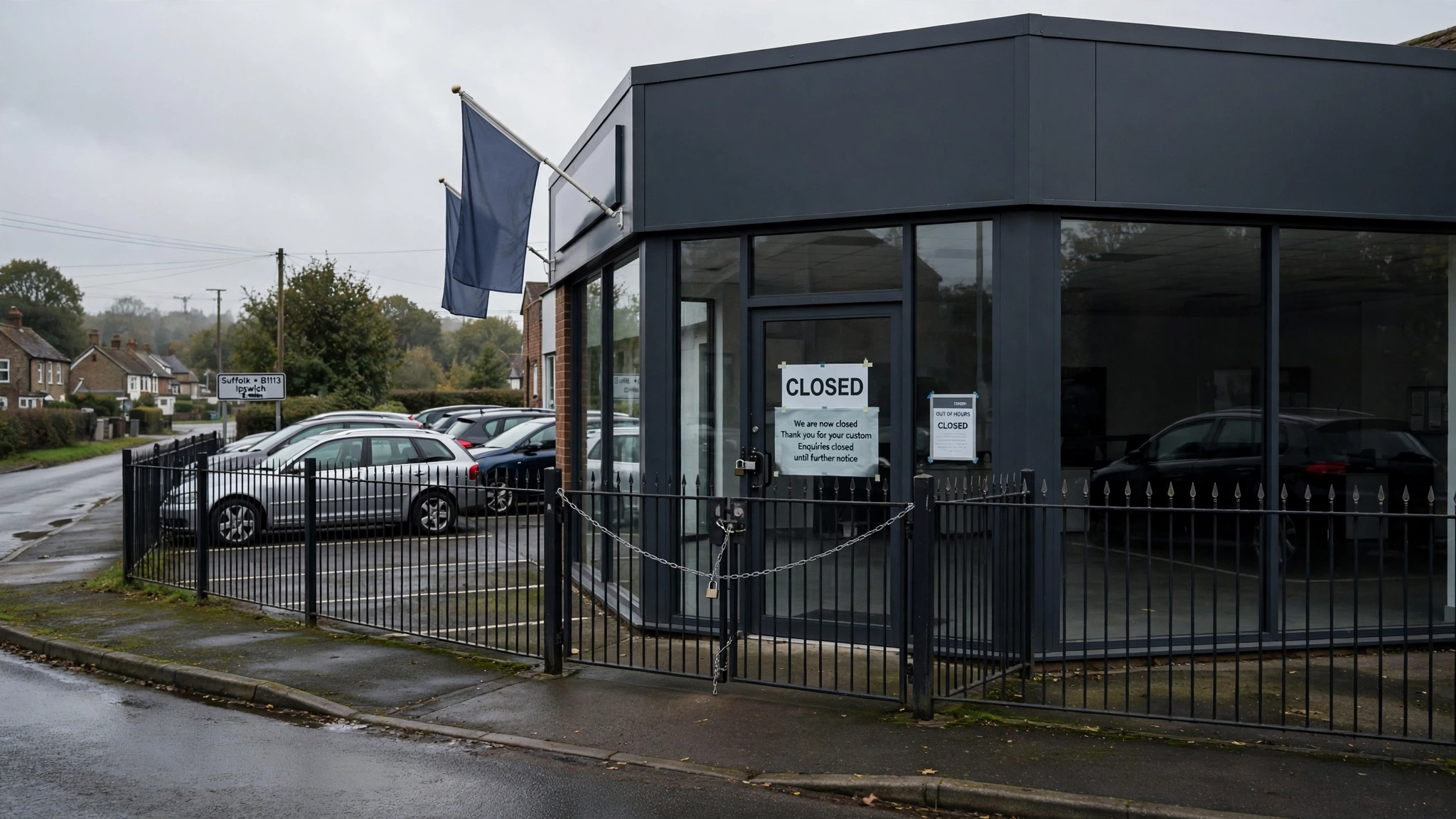

The closure of Car Station Suffolk Ltd has become one of the most talked-about business stories in Suffolk’s automotive sector. The independent used car dealership, based in Halesworth, entered creditors’ voluntary liquidation after trading for less than two years, leaving behind debts totaling £50,673.30 owed to 17 creditors. Official insolvency records also indicate that the company had no assets available for distribution, making it unlikely that unsecured creditors will recover the money they are owed.
While headlines have widely described the situation as a “Suffolk car dealership goes bust” story, the legal process involved is creditors’ voluntary liquidation. Although the phrase “goes bust” is commonly used in everyday language, voluntary liquidation is a formal insolvency procedure that allows an insolvent company to close its affairs under the supervision of a licensed insolvency practitioner.
The news has raised questions among customers, suppliers, and local residents. Many want to know what led to the company’s closure, what happens next, and whether anyone who purchased a vehicle from the dealership should be concerned. Although official documents reveal the company’s financial position, they do not point to a single reason for its failure. Like many business closures, the story is more complex than a simple headline suggests.
This article explores the confirmed facts surrounding the dealership’s collapse, explains what creditors’ voluntary liquidation means, and looks at what the closure could mean for customers and the wider used car market.
A Short-Lived Business
Car Station Suffolk Ltd was established as an independent used vehicle dealership serving customers in Halesworth and the surrounding Suffolk area. The company aimed to provide a range of pre-owned cars while competing in a market filled with both large dealership groups and smaller independent traders.
According to public records, the business was incorporated on 2 June 2024. Like many newly formed companies, it entered the market with the goal of building a customer base and growing through vehicle sales.
Independent dealerships play an important role in local communities. They often offer competitive prices, flexible customer service, and a more personal buying experience than larger national retailers. However, they also face significant financial pressures. Rising operating costs, changing consumer demand, higher borrowing expenses, and fluctuating used vehicle prices can all affect profitability.
For Car Station Suffolk Ltd, the period between incorporation and liquidation lasted less than two years. Although the company initially appeared to be another new entrant in the local motor trade, its trading life proved to be remarkably short.
The Company Entered Creditors’ Voluntary Liquidation
The turning point came when the directors decided the business could no longer continue trading.
Instead of remaining in operation while unable to meet its financial obligations, the company entered creditors’ voluntary liquidation (CVL). This is one of the most common insolvency procedures used by limited companies in the United Kingdom.
Under a CVL, company directors acknowledge that the business cannot pay its debts and appoint a licensed insolvency practitioner to oversee the winding-up process. From that point onward, the liquidator becomes responsible for dealing with the company’s financial affairs, investigating its assets and liabilities, and distributing any available funds to creditors.
In this case, Richard Cacho of RCM Advisory Limited was appointed as the liquidator to manage the process.
Although many media reports use phrases such as “went bust” or “collapsed,” the official Companies House records describe the legal position as creditors’ voluntary liquidation.
The Financial Picture
One of the most significant aspects of the liquidation was the company’s financial position at the time proceedings began.
Documents filed during the insolvency process show that the dealership owed £50,673.30 to 17 creditors.
For a small independent business, this represented a considerable financial burden.
More importantly, the Statement of Affairs filed by the company indicated that no assets were available for realization. In simple terms, there were no remaining business assets expected to generate money for unsecured creditors once liquidation costs had been met.
This greatly reduces the likelihood that suppliers and other unsecured creditors will recover what they are owed.
The figures reported in the insolvency documents provide a snapshot of the company’s financial condition at the point liquidation commenced.
| Financial Summary | Details |
|---|---|
| Company | Car Station Suffolk Ltd |
| Location | Halesworth, Suffolk |
| Incorporated | 2 June 2024 |
| Liquidation Type | Creditors’ Voluntary Liquidation |
| Total Debt | £50,673.30 |
| Creditors | 17 |
| Reported Assets | None Available |
While larger corporate failures often involve debts running into millions of pounds, the absence of assets makes this case particularly difficult for those owed money.
What Is Creditors’ Voluntary Liquidation?
Many people associate the phrase “going bust” with bankruptcy, but companies and individuals follow different insolvency procedures.
A creditors’ voluntary liquidation is a formal legal process used when a limited company is unable to pay its debts and there is no realistic prospect of recovery.
Rather than continuing to trade while insolvent, the directors voluntarily place the business into liquidation.
Once the process begins, an insolvency practitioner assumes control of the company.
Their responsibilities include:
- Collecting company records.
- Identifying any remaining assets.
- Investigating the company’s financial affairs.
- Selling assets where possible.
- Reviewing creditor claims.
- Distributing any available funds according to insolvency law.
- Closing the company once the process is complete.
If there are no assets available, unsecured creditors often receive little or no repayment after liquidation costs have been covered.
It is important to understand that entering voluntary liquidation does not automatically imply fraud, misconduct, or illegal activity. Many businesses become insolvent because they are unable to overcome financial challenges despite genuine efforts to continue trading.
Who Managed the Business?
Companies House records show that Car Station Suffolk Ltd experienced changes in its leadership during its short trading history.
The company was incorporated by Jacob Ladd, who served as the original director.
Later, Eddy Lee Ellis joined the company as a director and eventually became its sole director after Jacob Ladd resigned from both his directorship and his role as the person with significant control.
These changes are part of the company’s public filing history and are available through official government records.
Director changes are relatively common within private companies and should not be interpreted as evidence that they directly caused the business to fail.
Why Did the Dealership Close?
Perhaps the biggest question surrounding the story is why the company entered liquidation so soon after it was established.
The honest answer is that official insolvency records do not identify one specific cause.
The documents confirm the company’s debts, the number of creditors, and the lack of available assets. However, they do not state whether the business failed because of declining sales, cash flow problems, increased operating costs, or any other individual factor.
This distinction is important.
When businesses enter liquidation, many assumptions can quickly circulate online. Responsible reporting should distinguish between confirmed facts and speculation.
Like many small businesses, Car Station Suffolk Ltd may have faced several financial pressures at the same time. Rising costs, reduced consumer spending, higher interest rates, increased vehicle acquisition costs, and tighter profit margins have all affected parts of the UK motor trade in recent years.
However, there is no official evidence publicly attributing Car Station Suffolk Ltd’s closure to any one of these factors.
For that reason, it is more accurate to focus on what has been confirmed rather than attempting to assign a cause without supporting evidence.
What Does the Liquidation Mean for Customers?
Whenever a car dealership closes through liquidation, customers naturally wonder how it might affect them. The answer depends on the stage of their purchase and the type of agreement they had with the business.
For customers who had already completed a vehicle purchase and received all the necessary paperwork, the closure may have little immediate impact. Ownership of the vehicle does not automatically change because the dealership has entered liquidation.
The situation can be different for customers who had paid a deposit for a vehicle that had not yet been delivered. In these cases, they may need to contact the appointed liquidator to understand whether they qualify as creditors and what steps should be taken next.
Finance agreements are another important consideration. If a vehicle was purchased through a third-party finance company, the finance contract usually remains in place because it is a separate agreement between the customer and the lender. Payments generally continue according to the original contract unless the finance provider advises otherwise.
Warranty coverage also depends on who issued it. If the warranty was provided by an independent warranty company or the vehicle manufacturer, it may still remain valid. However, if the warranty was offered directly by the dealership, customers should review their paperwork and seek guidance from the liquidator if necessary.
The key point is that every customer’s circumstances are different. Anyone affected by the closure should keep copies of invoices, finance agreements, warranty documents, and all communication relating to their purchase.
What Happens to Creditors?
The liquidation process is designed to deal with the company’s outstanding debts in an orderly and legally structured way.
Once a company enters creditors’ voluntary liquidation, the appointed insolvency practitioner gathers information about the company’s assets and liabilities before inviting creditors to submit claims.
Creditors are then paid according to the order of priority set out in UK insolvency law. Secured creditors generally have stronger legal protection than unsecured creditors, while employees may also have certain statutory rights depending on their circumstances.
Unfortunately, official records relating to Car Station Suffolk Ltd indicate that the company reported no assets available for distribution. This means unsecured creditors are unlikely to recover the full amount they are owed unless additional recoverable assets are identified during the liquidation process.
The liquidator will continue investigating the company’s affairs before bringing the insolvency process to its conclusion.
A Timeline of Key Events
The available public records provide a clear timeline of how the company’s short trading history unfolded.
2 June 2024 – Car Station Suffolk Ltd was incorporated and officially registered as a private limited company.
March 2025 – Changes were made to the company’s directorship, with Eddy Lee Ellis becoming a director before later serving as the company’s sole director.
Throughout 2025 – The dealership continued operating from its premises in Halesworth, offering used vehicles for sale to customers across Suffolk and nearby areas.
29 January 2026 – The company entered creditors’ voluntary liquidation, marking the end of its trading activities.
Early February 2026 – Richard Cacho of RCM Advisory Limited was formally appointed as liquidator, and insolvency documents, including the Statement of Affairs, were filed.
Following the appointment – The company’s registered office was updated to the liquidator’s address as part of the winding-up process.
Although the company’s lifespan was relatively short, the timeline shows how quickly events progressed once liquidation became necessary.
Read more: Business Insurance UK: A Simple Guide for Every Business Owner
The Impact on Suffolk’s Used Car Market
The closure of a single independent dealership does not necessarily reflect the condition of the wider automotive market in Suffolk. However, it does highlight the financial pressures that many smaller businesses continue to face.
Independent dealerships often operate with tighter profit margins than larger dealer groups. They must balance vehicle purchasing costs, staffing expenses, premises costs, insurance, advertising, and changing consumer demand while remaining competitive.
Over the past few years, the UK automotive sector has experienced several challenges, including fluctuations in used vehicle prices, higher borrowing costs, increased operating expenses, and changing buying habits.
These broader economic conditions have placed additional pressure on many independent businesses. While numerous dealerships continue to operate successfully, some smaller companies have found it increasingly difficult to maintain sustainable cash flow.
For local customers, the closure of Car Station Suffolk Ltd may reduce choice in the immediate area. However, Suffolk continues to have a wide range of established independent dealers and franchised retailers serving motorists across the county.
Lessons for Car Buyers
Although business failures are relatively uncommon, the closure of Car Station Suffolk Ltd offers several useful reminders for anyone planning to purchase a used vehicle.
Research the dealership before buying.
Checking a company’s background through publicly available sources can provide valuable insight into its trading history and current status.
Understand your warranty.
Before completing a purchase, ask whether the warranty comes from the dealership itself, an independent warranty provider, or the vehicle manufacturer.
Read finance agreements carefully.
If your purchase involves vehicle finance, make sure you understand who your agreement is with and what happens if the dealership later ceases trading.
Keep every document.
Invoices, receipts, finance contracts, warranty certificates, MOT records, and service history should all be stored safely. These documents may prove valuable if questions arise later.
Use secure payment methods.
Whenever possible, choose payment methods that may provide additional consumer protection, particularly when paying deposits.
Taking these simple precautions can help buyers feel more confident and better prepared when making what is often one of their largest personal purchases.
Why This Story Matters
Business closures happen every year across many industries, but some cases attract greater attention than others.
The story of Car Station Suffolk Ltd stands out because the company traded for such a short period before entering liquidation. Official records also revealed a combination of debts, multiple creditors, and an absence of assets available for repayment.
For local residents, it serves as a reminder that even recently established businesses can experience financial difficulties.
For the automotive industry, it illustrates the challenges that independent dealerships sometimes face while competing in an increasingly demanding market.
Most importantly, the case highlights why transparency through official company records is valuable. Rather than relying on rumours or speculation, customers and suppliers can access verified information through public filings.
Conclusion
The headline “Suffolk car dealership goes bust” reflects the closure of Car Station Suffolk Ltd, an independent used car dealership based in Halesworth that entered creditors’ voluntary liquidation after trading for less than two years.
Official records show that the company owed £50,673.30 to 17 creditors and reported no assets available for distribution at the time of liquidation. A licensed insolvency practitioner has been appointed to oversee the winding-up process and deal with the company’s remaining affairs.
While the exact reasons behind the business’s financial difficulties have not been disclosed publicly, the insolvency filings provide a clear picture of the company’s position when trading came to an end. It is important to separate confirmed facts from speculation and recognise that the available records do not identify a single cause for the company’s collapse.
For customers, the closure underlines the importance of keeping purchase documents, understanding warranty arrangements, and knowing who provides finance or after-sales support. For suppliers and creditors, the case demonstrates the realities of insolvency when a business has limited or no assets available for distribution.
Although the closure of Car Station Suffolk Ltd marks the end of one local business, it also offers valuable lessons for consumers and business owners alike. Careful research, informed purchasing decisions, and an understanding of how insolvency works can help reduce uncertainty if similar situations arise in the future.
Frequently Asked Questions
1. Which Suffolk car dealership went bust?
The dealership was Car Station Suffolk Ltd, an independent used car business based in Halesworth, Suffolk. The company entered creditors’ voluntary liquidation after operating for less than two years.
2. How much debt did Car Station Suffolk Ltd owe?
Official insolvency documents show the company owed £50,673.30 to 17 creditors when it entered liquidation.
3. Why did the dealership enter voluntary liquidation?
Public records confirm that the company could no longer continue trading and entered creditors’ voluntary liquidation. However, no official filing identifies a specific reason for the business’s financial difficulties.
4. What should customers do if they bought a car from the dealership?
Customers should keep all purchase documents, review any finance or warranty agreements, and contact the appointed liquidator or relevant finance provider if they have concerns about outstanding orders, deposits, or after-sales support.
5. Does this closure affect other car dealerships in Suffolk?
No. The liquidation of Car Station Suffolk Ltd relates only to that individual business. While it highlights some of the financial pressures facing independent dealerships, it does not mean that other Suffolk dealerships are experiencing the same situation.
Read more: Best AI Tools for Small Business UK: A Complete Guide for 2026