
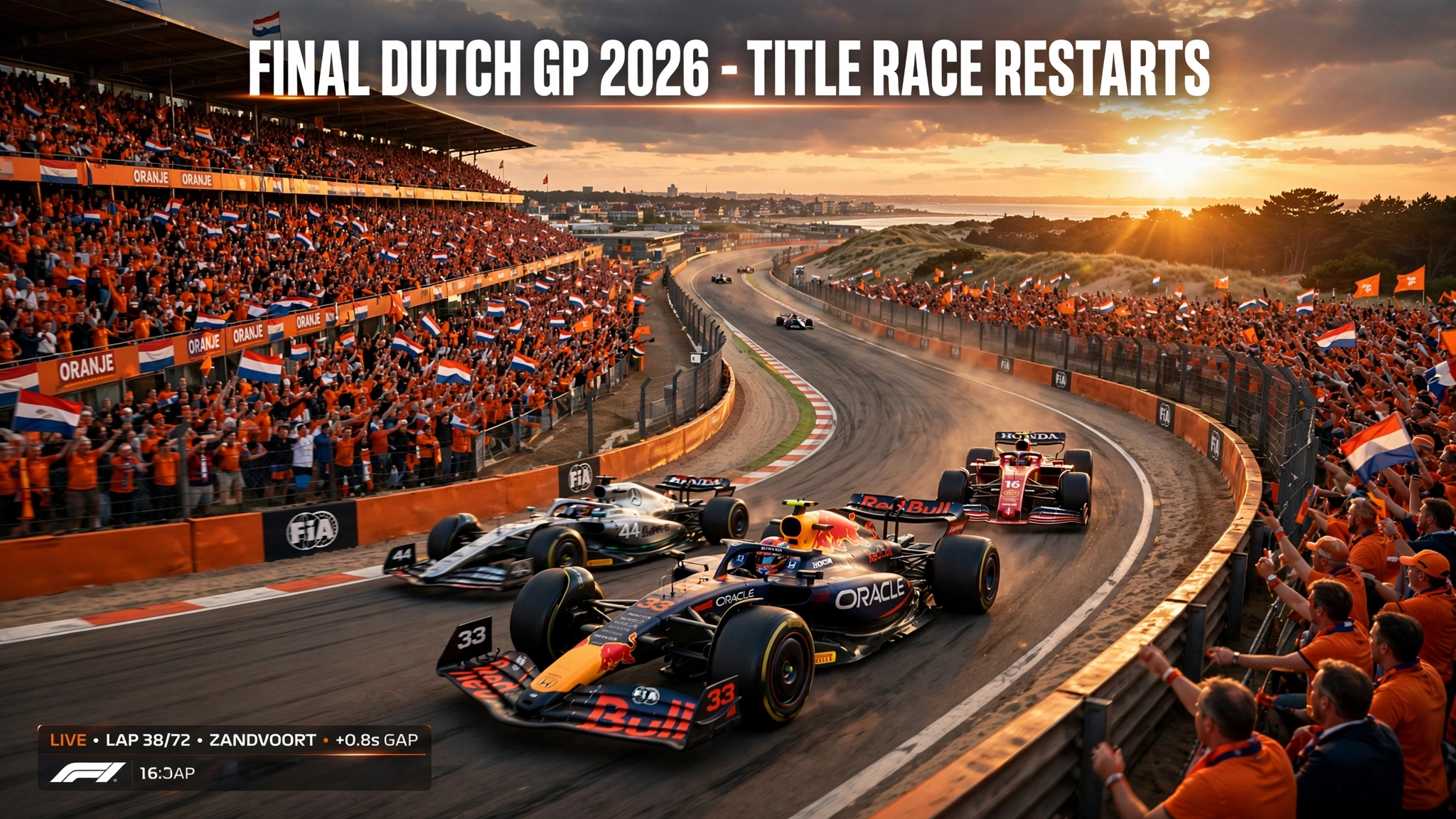

Formula 1 returns from its summer break at Zandvoort from 21 to 23 August, with the 2026 Dutch Grand Prix carrying more significance than a routine restart. This is set to be the last Dutch race under the current agreement, bringing an end to the event’s six-season run since it returned to the calendar in 2021.
There is plenty at stake before the farewell celebrations begin. Kimi Antonelli arrives in the Netherlands leading the drivers’ championship on 219 points, 50 clear of Lewis Hamilton. George Russell is a further nine points behind in third, while Charles Leclerc, Lando Norris and Max Verstappen all need a strong second half of the season to close the gap.
Why the Dutch Grand Prix could change the championship picture
Zandvoort is also hosting a sprint for the first time. Sprint qualifying takes place on Friday afternoon, followed by the 24-lap sprint and Grand Prix qualifying on Saturday. The main 72-lap race starts on Sunday, adding up to a weekend with two competitive starts and more points available than at a conventional round.
That compressed format gives teams little time to settle after the break. There is only one practice session before sprint qualifying, so any mistake with the initial set-up could affect much of the weekend. It also gives followers comparing new betting sites an unusual range of sessions to assess, although the limited practice running makes early form harder to judge than usual.
Antonelli has built a useful advantage, but Zandvoort may test the championship leader in ways that a more forgiving circuit would not. The narrow track leaves little room for error and overtaking can be difficult. Qualifying position, tyre preparation and a clean opening lap are likely to matter throughout both races.
Hamilton and Russell therefore have an opportunity to apply pressure before the calendar moves into its final phase. A poor weekend for Antonelli would reduce the cushion quickly, particularly if one of his closest rivals scores well in both the sprint and Grand Prix. Equally, another strong result from the Italian would make an already demanding pursuit considerably harder.
Max Verstappen returns for Zandvoort’s last Formula 1 weekend
The home attention will again fall on Verstappen, even though his championship position is less commanding than in previous visits. He is sixth on 109 points, 110 behind Antonelli, which changes the context of his return. The immediate target is a home victory rather than control of the title race.
Verstappen won each of the first three Dutch Grands Prix after the event returned, taking victory in 2021, 2022 and 2023. Lando Norris ended that sequence in 2024, while Oscar Piastri won in 2025. The home driver now has one final scheduled chance to add another Zandvoort win in front of the orange grandstands.
Red Bull will need a balanced car through a circuit that places several different demands on the driver. The fast, flowing middle sector rewards commitment, while the banked corners place unusual loads on the tyres. Wind from the nearby North Sea can also alter grip and braking confidence during a session.
A win would not repair Verstappen’s championship deficit on its own, but it could shape the next part of Red Bull’s season. The same applies to McLaren. Norris sits fifth and Piastri seventh, leaving both drivers with ground to regain after a first half in which Mercedes and Ferrari claimed the leading championship positions.
What makes the Zandvoort sprint weekend difficult?
The 4.259-kilometre circuit is one of the shortest on the Formula 1 calendar, yet it offers few straightforward laps. Drivers face rapid direction changes, elevation shifts and gravel traps close to the racing surface. Traffic can become a problem during qualifying because the short lap places cars close together when everyone searches for a clear run.
The banking at Hugenholtz and the final Arie Luyendijk corner is central to the circuit’s character. Drivers can take different lines, but the fastest approach depends on grip, tyre condition and the behaviour of the car under sustained load. A set-up that protects the tyres in the race must still provide enough front-end response for qualifying.
The sprint schedule reduces the chance to correct a poor choice. Teams normally have three practice sessions to work through ride height, wing level and tyre behaviour. At Zandvoort, they must make those decisions after one hour of Friday running before the first competitive session begins.
Weather could further complicate that work. Coastal conditions can change quickly, and even a short spell of rain would increase the risk on a narrow track where cars regularly run close to the gravel. Forecasts nearer the weekend should give a clearer indication, but teams will need plans for more than one set of conditions.
Why the final Dutch Grand Prix matters beyond Sunday’s result
Formula 1 first raced at Zandvoort in 1952. The circuit remained part of the championship, with interruptions, until 1985 before returning after a 36-year absence. Its modern revival followed Verstappen’s rise and turned the event into one of the calendar’s most recognisable home races.
The promoters have described the 2026 edition as the 40th and final Formula 1 race at the circuit. Weekend tickets have sold out, and the programme is being presented as a closing celebration rather than an ordinary annual event. Whatever happens in the race, the scenes after the chequered flag will carry a sense of finality.
That does not mean Zandvoort will disappear as a motor-racing venue. The circuit has a history extending well beyond Formula 1 and remains suited to other categories. What is ending is its current place on the world championship schedule, at a moment when the Dutch crowd still has a leading driver to support.
Before that farewell, the sporting questions come first. Antonelli must defend a 50-point lead, Hamilton and Russell have a chance to cut it, and Verstappen is chasing one more home win. With sprint points available and only a single practice session, the final Dutch Grand Prix should begin the second half of the season at full pace.