
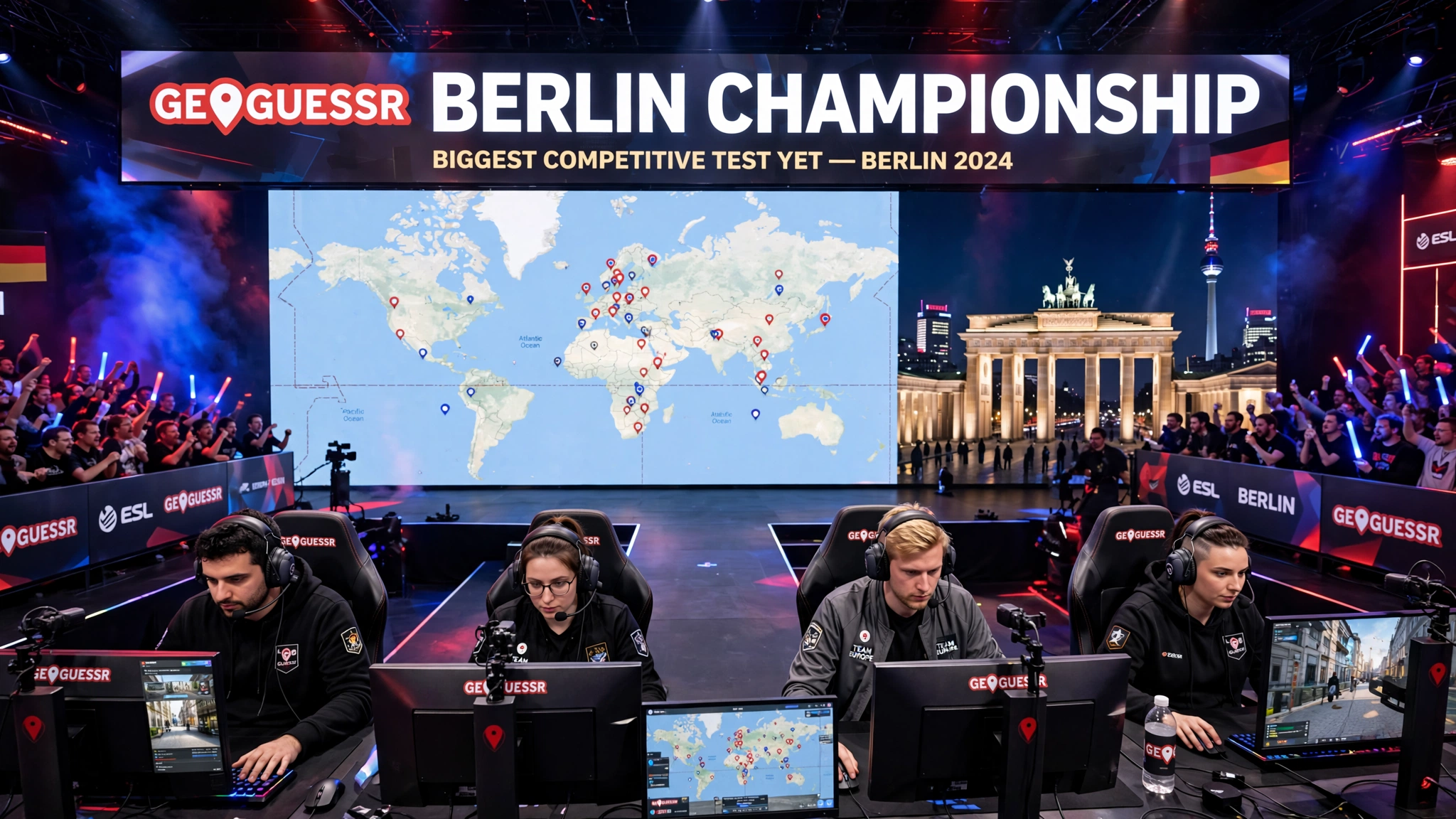

GeoGuessr will bring 24 of the world’s leading players to Berlin from 2 to 5 September 2026 for a four-day World Championship at the Tempodrom. The event will combine two days of group matches with arena playoffs, a grand final and a wider community festival.
It is a considerable step up for a game built around identifying locations through visual clues. Competitors must study road markings, utility poles, vegetation, architecture and camera coverage, often making a precise guess after seeing an otherwise unremarkable stretch of road.
That makes GeoGuessr an unusual part of the wider gaming calendar. Audiences accustomed to major sequels, esports shooters and new online slots are instead watching players distinguish one country from another through the shape of a bollard or the colour of a number plate. Its growth shows that a competitive game does not need combat, a large roster of characters or complex controls to create tension.
What is happening at the GeoGuessr World Championship 2026?
The World Championship Finals will take place at the Tempodrom in Berlin, a venue with capacity for around 3,500 people. The first two days will focus on the group stage, with matches shown on large screens in the surrounding fan zone.
Competition will then move into the main arena for the playoffs and grand final. The organisers have also planned meet-and-greets, workshops, gaming areas, panel discussions, food stalls and partner exhibitions.
This festival format is a notable change in scale. GeoGuessr began its official World Cup programme in 2023, when the competitive scene was still strongly associated with livestreams and online communities. A multi-day event at a recognised Berlin venue treats the final more like an established esports championship.
How did players qualify for Berlin?
The 2026 season introduced a new route to the World Championship. Regional World Leagues ran across EMEA, the Americas and APAC, bringing together 22 returning players and 22 competitors who had progressed through the previous year’s qualifiers.
GeoGuessr replaced its round-robin league with a Swiss system. Under this format, players face opponents with similar records as the competition develops. Someone who wins early is increasingly likely to meet another successful player, while those with weaker records face competitors in a comparable position.
Points earned during the leagues determine who advances. Sixteen players qualify directly for the World Finals, while the Play-Ins give others another opportunity to reach Berlin. The final field contains 24 competitors.
The system places greater weight on form across the season. A player cannot rely on one strong tournament run, and the Play-Ins retain some jeopardy for those who miss direct qualification.
What does a professional GeoGuessr player look for?
A competitive round normally begins with a panoramic street image and very little obvious information. There may be no famous landmark, readable sign or recognisable skyline. Players instead build an answer from several smaller clues.
Road infrastructure is particularly useful. The painted centre lines, roadside posts and warning signs can narrow a location to a country or region. Driving side, road quality and the position of utility cables add further evidence.
Natural details also carry information. Soil colour, mountain shape, tree species and the apparent climate can eliminate large areas of the map. Shadows may offer a rough indication of hemisphere, although the time of day and season can complicate that judgement.
Experienced players also learn how imagery was collected. Different generations of mapping equipment can leave recognisable visual traces. Camera height, image quality and parts of a survey vehicle may therefore help identify where the photograph was taken.
The best competitors process these clues quickly and avoid becoming attached to their first idea. A roadside feature may point towards one country, but the road surface or landscape can contradict it. Strong players keep revising their answer until the clock forces a decision.
How does GeoGuessr create tension without combat?
Scoring depends on distance. A correct country is useful, but a guess placed hundreds of kilometres from the true location can still concede a large advantage. In head-to-head formats, damage multipliers can make later rounds increasingly dangerous.
This gives each map a clear rhythm. Early rounds allow players to gather information and test an opponent’s regional knowledge. As the multiplier rises, a modest geographical error can end the match.
Viewers can follow that pressure because the basic objective is easy to understand. Two markers appear on a map, and the closer one wins the round. The difficult part lies in seeing how each player reached the decision.
Broadcast commentary has an important role here. A commentator can point out a Colombian road cross, explain a distinctive type of Scandinavian bollard or identify why the sun’s position changes the likely hemisphere. Those explanations turn an obscure clue into something the audience can recognise in a later round.
Why has GeoGuessr developed into an esport?
GeoGuessr is accessible at first glance. Most people understand the challenge within seconds, even if they have never played it. The gap between recognising the objective and performing at elite level is enormous.
That gap creates strong competitive viewing. A casual player may search for a language or town name, while an expert can identify a region through road repairs, fencing or a particular style of telegraph pole. A near-perfect guess in an apparently empty location gives the audience an immediate measure of skill.
The game also produces geographical variety without introducing new rules for every setting. A dry track in Botswana, an urban junction in Brazil and a mountain road in Kyrgyzstan all ask the same question, but the evidence changes every time.
Its competitive community has grown alongside that variety. The 2025 World Cup reportedly reached a peak audience of more than 360,000 viewers, setting a record for the title. Berlin will test whether that online interest can support a larger live event with several days of activity around the matches.
What should viewers watch for in Berlin?
Consistency will be as important as spectacular guesses. The group stage gives players time to recover from an error, while the playoffs leave less room for a weak map or a rushed decision.
Regional knowledge could prove decisive. Some competitors are known for identifying countries rapidly, while others are particularly accurate once a round has been narrowed to the right nation. Matches between those styles can turn on whether the locations reward broad recognition or precise regional study.
The live setting adds another variable. Players who are comfortable broadcasting from home must make decisions under stage lighting, crowd noise and tournament pressure. GeoGuessr may be a quiet game to play, but its arena final is unlikely to feel quiet when one misplaced marker can decide the championship.
Berlin will therefore provide more than a winner. It will show whether a geography game built on observation can continue moving beyond its online roots and hold the attention of a full esports venue.
Read also: Universal Credit £325 Payment: Eligibility and Latest Update