
5G home broadband can be a convenient alternative to cable, DSL, or fiber, especially where installing a wired connection is difficult or expensive. Instead of running a physical broadband line into the property, 5G home internet uses a cellular network to connect a gateway or router inside the home. That simplicity is attractive, but wireless broadband has trade-offs. The main risks and disadvantages of 5G home broadband involve variable speeds, network congestion, signal quality, latency, upload performance, and differences between providers. Understanding these limitations can help you decide whether 5G is suitable for everyday browsing, remote work, gaming, streaming, or a heavily connected household.
What Is 5G Home Broadband?
5G home broadband, often called 5G fixed wireless access (FWA), delivers an internet connection over a mobile operator’s radio network rather than through fiber-optic cable, coaxial cable, or copper telephone wiring. A 5G gateway receives the cellular signal and creates a Wi-Fi and, depending on the equipment, Ethernet network for devices inside the property.
The technology can provide fast downloads and straightforward installation, but performance depends heavily on conditions between your home and the cellular network. This makes the experience less predictable than a dedicated wired connection in some locations.
| Factor | 5G Home Broadband | Fiber Broadband | Cable Broadband |
|---|---|---|---|
| Connection to home | Wireless cellular signal | Fiber-optic cable | Coaxial cable |
| Speed consistency | Can vary with signal and congestion | Usually highly consistent | Generally consistent but can vary |
| Upload performance | Often much lower than download | Often strong; some plans are symmetrical | Usually lower than download |
| Latency | Can be good but may fluctuate | Usually low and stable | Usually good |
| Installation | Often simple self-installation | May require technician/cabling | May require existing cable or installation |
| Main limitation | Signal quality and network capacity | Availability | Shared network capacity |
Speed Can Change Throughout the Day
One of the biggest disadvantages of 5G home broadband is that the speed you receive may not remain constant.
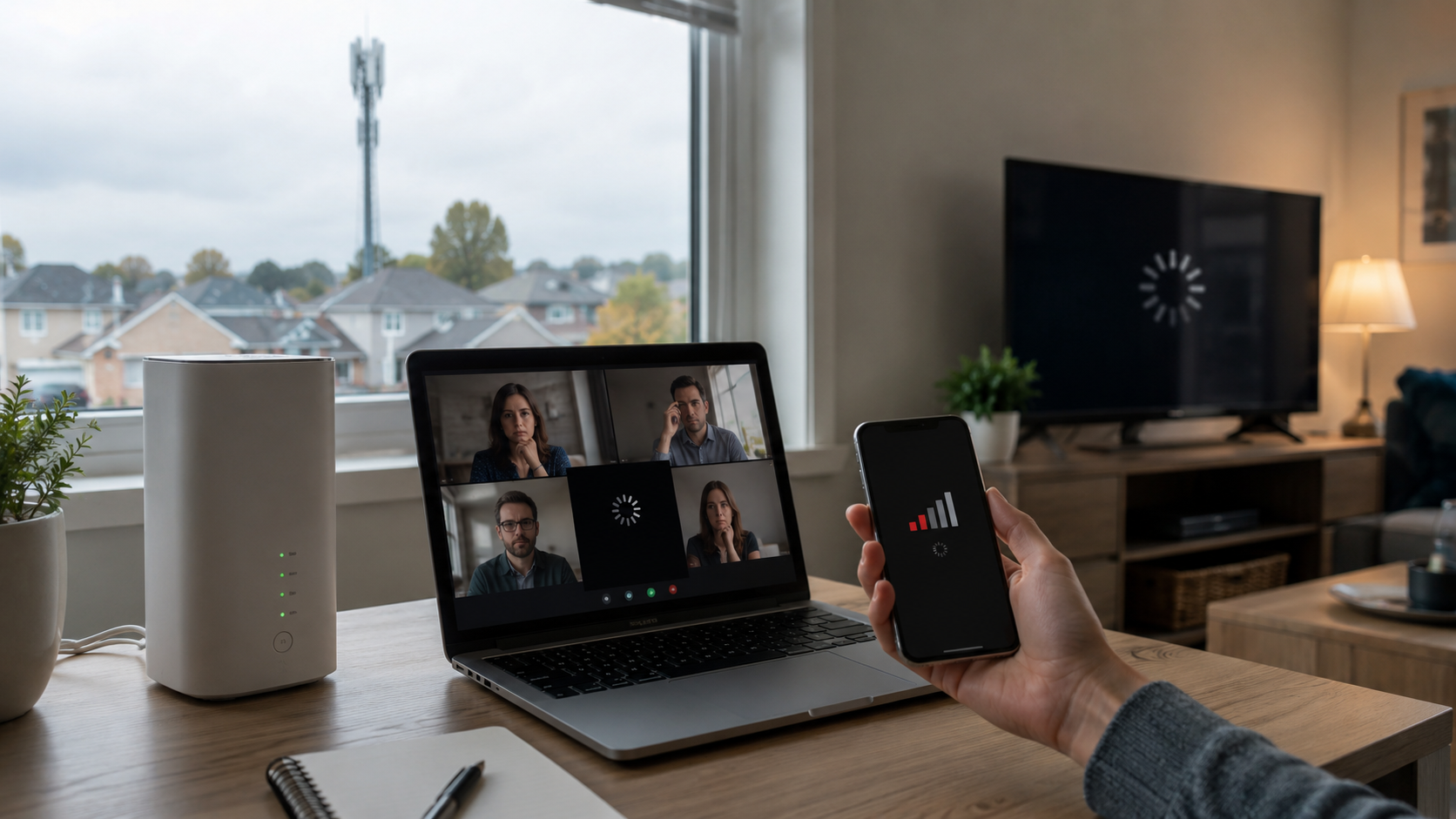
A fixed wireless connection shares radio-network capacity with other users in the surrounding area. When more people are using the network, especially during busy periods, available capacity can decrease. The FCC notes more broadly that network congestion can increase both latency and packet loss, while major 5G home internet providers warn that congestion can affect customer speeds.
Advertised maximum speeds should therefore not be confused with guaranteed performance. Verizon, for example, publishes different typical speed ranges for its 5G Home plans rather than claiming every customer will continuously receive the maximum advertised rate.
For someone mainly browsing websites or watching streaming video, moderate variation may never become a serious problem. It matters more when several people are simultaneously downloading files, streaming high-resolution video, gaming, or joining video meetings.
“During congestion, Home Internet customers may notice speeds lower than other customers due to data prioritization.” — T-Mobile
Signal Quality Depends on Where You Live — and Where the Router Sits
A fiber or cable connection physically enters your property. With 5G broadband, the connection must travel wirelessly between the network and your gateway.
Buildings and other obstructions can reduce wireless signal quality. The FCC’s technical framework for fixed wireless coverage even includes factors such as penetration loss from surrounding obstructions when a receiver is indoors.
This is why gateway placement can make a noticeable difference. T-Mobile advises customers to locate compatible gateways near a window or high on an upper floor or shelf when that provides a stronger signal. Its setup tools include a placement assistant specifically for finding a better gateway position.
The practical disadvantage is that the best location for receiving 5G may not be the best location for distributing Wi-Fi around the house. Large homes may therefore need Ethernet connections, mesh Wi-Fi, or additional access points even when the incoming 5G connection itself is strong.
Network Congestion and Data Prioritization Can Affect Performance
Some 5G home broadband services use network-management policies that can place home internet traffic behind higher-priority traffic during congestion.
T-Mobile states that its Home Internet customers generally receive the same network priority as certain heavy mobile-data users, meaning performance can fall when the network is busy. Verizon also has a heavy-data policy under which qualifying 5G Home or LTE Home customers may have traffic reduced in priority during congestion after exceptionally high monthly usage.
This does not mean every 5G broadband service has a conventional monthly data cap. Some plans advertise unlimited data. The important point is that unlimited data and unlimited full-speed priority are not necessarily the same thing.
Always read the provider’s broadband label, network-management policy, and plan conditions rather than judging a service only by its advertised maximum speed.
Latency and Jitter May Be Less Predictable
Download speed receives most of the marketing attention, but latency can matter just as much for gaming, voice calls, cloud applications, remote desktops, and video conferencing.
Latency measures how long data takes to travel across the network. The FCC defines typical latency as the time required for data to travel between endpoints, measured in milliseconds. During congestion, latency and packet loss can rise.
A strong 5G connection may deliver perfectly acceptable latency, but wireless conditions and shared network capacity can make responsiveness less consistent than a strong fiber connection.
That distinction matters most for competitive online gaming, real-time communications, live broadcasting, and work that depends on highly stable connectivity.
Upload Speeds Can Be Much Lower Than Downloads
Another weakness is asymmetrical performance.
Many 5G home broadband plans prioritize download capacity because typical residential users consume more data than they upload. Verizon’s published 5G Home performance ranges, for example, show download speeds substantially higher than upload speeds across multiple plans.
Lower uploads may be noticeable when:
- backing up large amounts of data to cloud storage;
- uploading high-resolution video;
- sending very large work files;
- livestreaming;
- operating multiple simultaneous video calls;
- transferring files to remote servers.
For households that regularly create and upload large files, a symmetrical fiber connection can be a better fit when available.
5G Coverage Does Not Automatically Mean 5G Home Broadband Is Available
Seeing a 5G symbol on your phone does not guarantee that you can order 5G home broadband.
Providers may restrict fixed wireless availability according to the capacity available around a particular address. Home broadband customers consume much more sustained data than typical smartphone users, so operators cannot necessarily offer fixed wireless service to every home within mobile 5G coverage.
T-Mobile, for example, requires customers moving their Home Internet service to check whether service is available at the new address before transferring it.
This means two houses in the same town — or even nearby streets — can have different service options.
High-Frequency 5G Signals Can Be More Sensitive to Obstructions
5G can operate across several frequency ranges rather than one single type of radio signal.
Higher-frequency spectrum can provide large amounts of capacity, but propagation becomes more challenging. ITU material discussing millimeter-wave systems identifies limited penetration and coverage as technical challenges at high frequencies. Obstacles such as buildings, trees, and terrain can also affect radio propagation.
Providers compensate through technologies such as beamforming, different spectrum bands, and denser network deployment. For the customer, however, the important lesson is simple: impressive 5G performance measured at one property does not guarantee identical results a few blocks away.
Is 5G Home Broadband a Health Risk?
Health concerns are frequently mixed into discussions about the “risks” of 5G broadband, but they should be separated from practical service disadvantages.
5G equipment uses radiofrequency electromagnetic fields. The International Commission on Non-Ionizing Radiation Protection’s RF exposure guidelines cover 5G technologies, Wi-Fi, mobile phones, and base stations. ICNIRP states that 5G exposure meeting its 2020 guidelines is protected against established adverse health effects. The U.S. FDA also states that the weight of scientific evidence has not linked cell-phone radiofrequency radiation with health problems.
For a household choosing between broadband technologies, measurable issues such as speed consistency, coverage, congestion, latency, and provider policies are therefore more relevant decision factors than unsupported claims about 5G-specific illness.
Who Should Think Twice Before Choosing 5G Home Internet?
5G broadband may not be the first choice for households that require exceptionally predictable internet performance.
You may be better served by fiber or another strong wired connection if your household regularly relies on competitive gaming, professional livestreaming, large cloud backups, high-volume uploads, remote production work, or many simultaneous high-bandwidth activities.
On the other hand, 5G home broadband can make considerable sense where wired broadband is slow, expensive, difficult to install, or unavailable. The technology itself is not inherently inferior; its suitability depends heavily on local network quality.
FAQs About the Risks and Disadvantages of 5G Home Broadband
Is 5G home broadband reliable?
It can be reliable when the property has a strong signal and sufficient local network capacity. Performance can still vary more than a wired connection because congestion, radio conditions, and gateway placement influence the connection.
Is 5G home internet slower than fiber?
Not necessarily in every speed test, but fiber generally provides a more predictable physical connection. 5G speeds can vary by spectrum, location, network capacity, and provider plan.
Does bad weather affect 5G home broadband?
Wireless links can be affected by environmental conditions, particularly at higher frequencies, although the real-world impact depends on the spectrum and network design. Signal obstruction and propagation conditions are usually more relevant than simply assuming every rainstorm will interrupt 5G service.
Does 5G home broadband have unlimited data?
Some providers offer plans marketed without conventional data caps, but network-management and prioritization rules can still apply. Customers should check the conditions of the specific plan rather than assuming all 5G home broadband services operate identically.
Is 5G broadband good for gaming?
It can work well when latency is low and stable. Competitive gamers should test latency, jitter, and packet loss during evening peak periods rather than looking only at download speed.
Is 5G home broadband the same as 5 GHz Wi-Fi?
No. 5G refers to fifth-generation cellular networking. 5 GHz Wi-Fi refers to a Wi-Fi frequency band used by devices inside a local wireless network. They are different technologies.
Conclusion
The main risks and disadvantages of 5G home broadband are practical rather than mysterious. Speeds can fluctuate, congestion can reduce performance, gateway placement affects signal quality, uploads may lag behind downloads, and latency can be less predictable than a good fiber connection.
That does not make 5G home broadband a poor choice. For many properties, it can provide fast service with simple installation and fewer physical infrastructure requirements. Before switching, check availability at your exact address, read the provider’s network-management terms, and test the connection during busy hours. The best broadband technology is the one that delivers consistent performance for the way your household actually uses the internet.
Read more: AI Agents vs Traditional Alternatives: Which Approach Is Better?