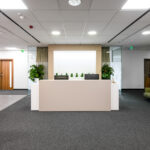


Office design has changed significantly in recent years. Businesses are paying more attention to flexible layouts, collaborative areas, quiet zones, comfortable furniture, and spaces that employees actually want to use. Yet one important part of workplace design is still easy to overlook: lighting.
Lighting affects much more than whether a desk is bright enough to work at. It influences how a room feels, how clearly people can see their screens and documents, how different areas of the office are defined, and how welcoming the workplace appears to employees and visitors.
A well-designed lighting plan does not simply make an office brighter. It provides the right type of light in the right place while helping the workspace feel balanced, comfortable, and visually organised.
Good office lighting should support everyday work while contributing to the overall atmosphere and design of the workplace.
Start With How the Office Is Actually Used
The first step in planning office lighting is understanding how different areas are used throughout the day.
An open-plan workspace has different requirements from a meeting room. A reception area serves a different purpose from a private office, while a breakout space may need a more relaxed atmosphere than a desk-based working zone.
Trying to illuminate every area in exactly the same way can make an office feel flat and overly uniform.
Instead, think of the workplace as a collection of functional zones. Desks need comfortable general and task lighting. Meeting rooms need good visibility around the table without creating distracting glare. Reception areas may benefit from more decorative lighting that helps establish the company’s visual identity.
This approach allows the lighting to support the function of each space rather than treating the entire office as one large room.
Do Not Rely on One Type of Ceiling Light
Many offices are still illuminated almost entirely by rows of identical ceiling fixtures.
While this can provide general brightness, it often creates a very uniform environment with little visual hierarchy. It may also leave certain areas brighter than necessary while providing insufficient focused light elsewhere.
A more flexible approach combines different types of lighting.
General ceiling lighting can provide the foundation, while suspended fixtures, task lights, wall lighting, and decorative elements can support specific areas.
For example, linear pendant lights can visually define a row of desks or a meeting table. Softer lighting can help create a more relaxed breakout area, while focused task lighting may be useful at workstations that require detailed visual work.
Use Lighting to Define Different Work Zones
Modern offices increasingly use fewer permanent walls, which means lighting can help organise open spaces visually.
A long linear fixture above a meeting table immediately signals that the area has a specific purpose. A cluster of decorative pendants can distinguish an informal collaboration zone, while consistent ceiling lighting across desk areas creates visual order.
This can be particularly useful in offices where one large floor area contains several different functions.
Instead of adding physical partitions everywhere, lighting can provide subtle visual boundaries while keeping the space open.
Businesses exploring different approaches to Office Lighting can consider fixtures according to the role of each area rather than selecting one design and repeating it throughout the entire workplace.
Pay Attention to Screen Glare
Computer screens are now central to most office work, which makes glare an important consideration.
A bright fixture positioned directly within someone’s line of sight can become distracting, while light reflected from a screen may make it harder to work comfortably.
Fixture position therefore matters just as much as brightness.
When possible, lighting should be considered together with desk orientation, windows, monitors, and other reflective surfaces. Moving a workstation or changing the position of a fixture can sometimes improve the working environment without requiring more light.
It is also useful to evaluate the office from the seated position employees actually use rather than only standing and looking around the room.
Make the Most of Natural Light
Artificial lighting should work with daylight rather than compete with it.
Workspaces close to large windows may receive plenty of natural light during part of the day, while desks farther inside the building may remain noticeably darker.
This difference should be considered when planning the lighting layout.
It may not make sense for every fixture to operate at the same intensity from morning until evening. Where the system allows it, separate controls or adjustable lighting can help different areas respond more effectively to changing daylight conditions.
The position of blinds, partitions, storage units, and furniture can also affect how daylight travels through the office.
Consider the Atmosphere of Meeting Rooms
Meeting rooms need to support several different activities.
People may be reading documents, having face-to-face discussions, viewing a presentation, or participating in a video call. Lighting that works well for one activity may not be ideal for another.
A very bright room can feel uncomfortable during presentations, while lighting that is too dim may make ordinary meetings feel tiring.
Using several lighting layers or controls can make the space more adaptable.
The fixture itself can also contribute to the room’s design. A pendant or linear fixture positioned above the meeting table can provide illumination while visually anchoring the centre of the room.
Give Reception Areas More Personality
A reception area is often the first part of the workplace that clients, candidates, and visitors see.
It therefore has a different role from a standard desk area.
Lighting can help make the entrance feel more welcoming and reinforce the overall character of the business. Decorative pendants, wall lighting, or focused illumination around a company logo or reception desk can make the area feel more intentional.
This does not mean the reception area needs to be dramatic. Even relatively simple fixtures can create a strong impression when their proportions and placement relate well to the furniture and architecture.
Use Softer Lighting in Breakout Areas
Not every part of an office needs to feel like a workstation.
Breakout spaces, kitchens, lounges, and informal meeting areas can benefit from a different lighting atmosphere.
Softer or lower-level illumination can help distinguish these spaces from focused working areas and make them feel more comfortable for conversation or short breaks.
This variation is useful because it gives employees different environments within the same workplace.
A change in lighting can signal that a person has moved from a concentrated desk area into a more relaxed social or collaborative zone without requiring major architectural changes.
Choose Fixtures That Fit the Scale of the Office
Fixture scale matters in commercial spaces just as much as it does at home.
A small decorative pendant may disappear visually in a large reception area with a high ceiling, while an oversized fixture could make a compact meeting room feel crowded.
Always consider the dimensions of the room, ceiling height, furniture, and viewing distance.
Long tables and rows of desks often work well with elongated or repeated fixtures because the lighting follows the proportions of the furniture below.
Smaller areas may benefit from simpler designs that provide the necessary illumination without dominating the room.
Think About the Office as a Complete Environment
The best workplace lighting plans rarely depend on one impressive fixture.
They create a consistent experience across the entire office.
Employees should be able to move from a desk to a meeting room, reception area, corridor, or breakout space without encountering uncomfortable changes in brightness or lighting quality.
At the same time, individual areas should still have enough visual identity to reflect their purpose.
This balance between consistency and variation is what makes office lighting feel intentional rather than simply installed wherever electrical points happened to be available.
Final Thoughts
Office lighting should be treated as part of workplace design, not just as a technical requirement.
Start by considering how employees and visitors use different parts of the office. Provide practical illumination around desks and work surfaces, pay attention to glare and natural daylight, and use different lighting styles to distinguish meeting, reception, and breakout areas.
There is no need to make every part of the workplace equally bright or to use the same fixture everywhere.
When lighting is planned around real activities, it can make an office easier to navigate, more comfortable to work in, and more visually coherent.
A good workplace is ultimately a collection of spaces designed for different purposes. The lighting should help each of those spaces perform its job.