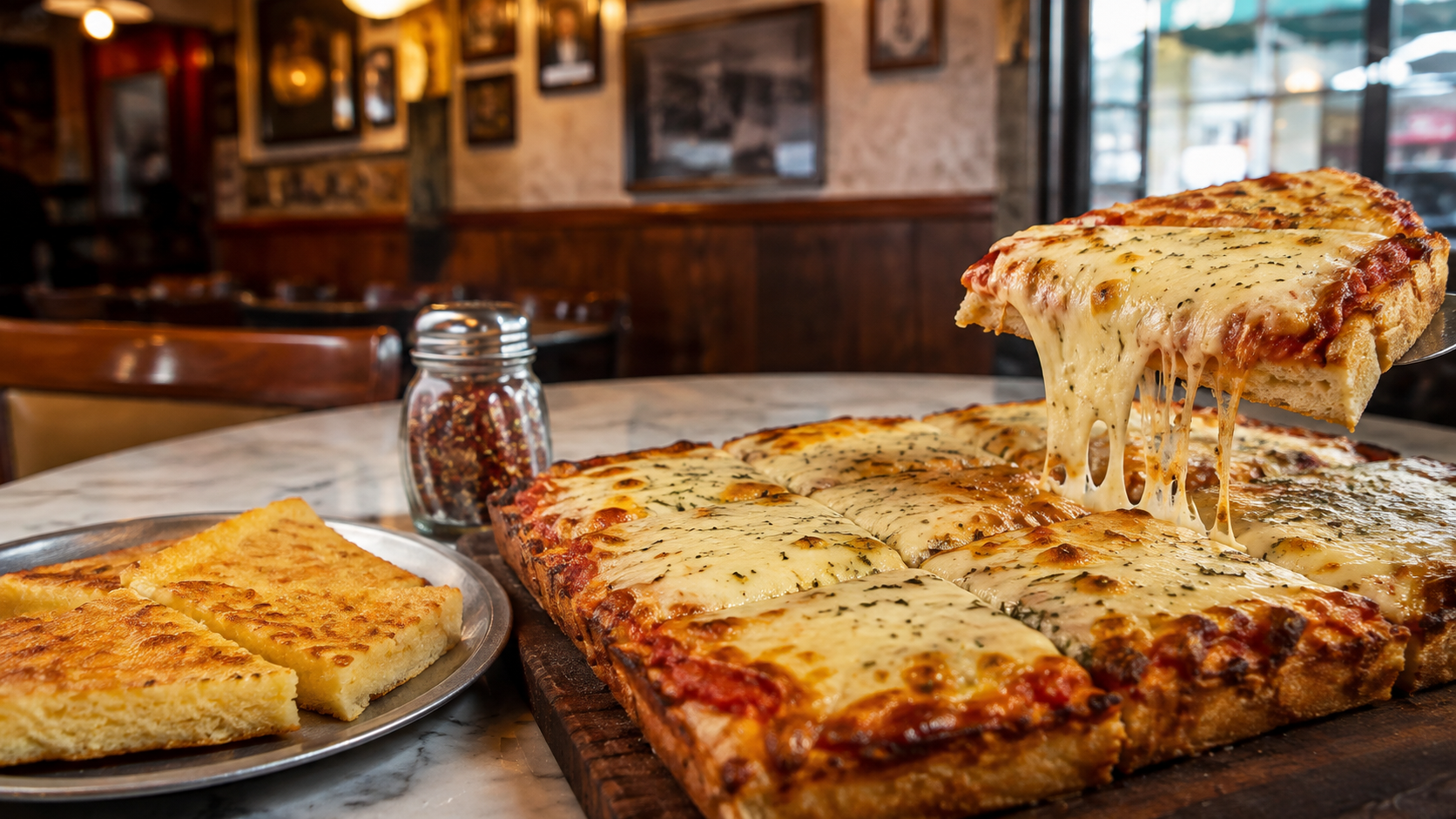

If you are searching for the best pizza porteña near me, look beyond restaurants that simply describe themselves as Argentinian. The strongest signs of genuine Buenos Aires-style pizza are menu terms such as pizza al molde, muzzarella, fugazzeta and fainá, together with a thick, airy base and a conspicuously generous amount of cheese.
Pizza porteña is the pizza culture of Buenos Aires. It developed from Italian immigrant traditions but became something recognizably local: often thicker than Neapolitan pizza, baked in a pan, built for substantial toppings and closely associated with the classic Buenos Aires pizzeria. The city’s official tourism site describes traditional al molde as a deep-pan pizza with a thick, spongy dough and generous cheese, while tracing influences from Naples, Genoa and Sicilian sfincione.
That distinction matters when searching locally. A nearby restaurant may make excellent pizza without making anything close to pizza porteña. The best way to find the real style is to know the vocabulary before choosing a restaurant.
What makes a pizza genuinely porteña?
Buenos Aires has several pizza traditions rather than one rigid recipe. Al molde is the clearest reference point: the pizza is cooked in a pan and develops a comparatively tall, soft crumb. Media masa falls between this substantial style and thinner pizza, while a la piedra has a firmer, thinner base. Buenos Aires’ tourism authority identifies al molde as the city’s most popular traditional form.
Cheese is equally important. The classic muzzarella—the spelling commonly encountered on Argentine menus—is a tomato-and-cheese pizza, often finished with an olive on each slice. The defining visual is abundance rather than restraint. APYCE, Argentina’s national association for pizzerias and empanada shops, described pizza porteña at Madrid Fusión 2026 in terms of a spongy dough, crisp base and generous muzzarella.
These menu words are particularly useful when searching:
| Term | What to expect | Why it helps your search |
|---|---|---|
| Al molde | Thick, pan-baked, spongy pizza | One of the strongest signs of classic porteño style |
| Media masa | A somewhat thinner version with substantial crumb | Useful when you want Buenos Aires character without the full height of al molde |
| Muzzarella | Tomato sauce and abundant cheese | The basic benchmark order in a traditional pizzeria |
| Fugazzeta | Onion-led pizza, commonly associated with a cheese-filled version | One of Buenos Aires’ most distinctive pizza traditions |
| Fainá | Chickpea-flour flatbread served alongside pizza | A major clue that a restaurant understands traditional Buenos Aires pizza culture |
| A la piedra | Thinner, firmer, stone-baked pizza | Still common in Buenos Aires, but texturally different from classic al molde |
Buenos Aires’ tourism site describes fainá as chickpea-flour flatbread that locals commonly buy with pizza and eat together, sometimes literally stacking one piece on the other.
How to find the best pizza porteña near you
A generic search for “pizza near me” will usually favour whatever pizza styles dominate your area. For porteña pizza, specificity works better.
Search map apps, restaurant directories and delivery platforms using “pizza porteña,” “Argentine pizza,” “pizza al molde,” “fugazzeta” and “fainá.” Try both fugazzeta and fugazzetta: even established Argentine sources and pizzerias use variations in spelling. Güerrin, one of Buenos Aires’ best-known historic pizzerias, currently describes its menu as including deep-dish pizza and fugazzeta, while its menu page also uses the spelling fugazzetta.
Then inspect the actual menu rather than relying on a category label. An “Argentinian restaurant” may specialise in steak, empanadas or choripán and offer no porteña-style pizza at all. Conversely, a specialist pizzeria might make the style without using “porteña” prominently in its business name.
Photos can also help. Traditional al molde should look clearly more substantial than a thin Neapolitan base. The crumb should have height, and a classic muzzarella pizza should not look sparsely topped. Fugazzeta should be visibly onion-forward and, in its filled form, substantially cheesier than an ordinary onion pizza. These characteristics align with the definitions used by Buenos Aires tourism authorities and APYCE.
For any restaurant you intend to visit, check its current menu and opening hours on the day. “Near me” results change with location, service area and operating status, so a static guide cannot responsibly name one universal winner.
What should you order first?
For a first encounter with the style, muzzarella with a portion of fainá is the clearest baseline. You get the thick or medium-thick Buenos Aires dough, tomato, abundant cheese and the chickpea flatbread that has accompanied local pizza for generations. The combination is culturally more revealing than starting with an elaborate specialty topping.
If you already know you like onions and rich cheese, order fugazzeta. This is where pizza porteña becomes especially unlike the restrained Italian styles that many international diners know best.
Another classic direction is jamón y morrones—ham and peppers. Buenos Aires’ official gastronomy guide identifies abundant cheese, onion, ham, peppers, oregano and olives among the familiar elements of local pizza culture.
A useful restaurant test is whether the kitchen can do the simplest pizzas well. With muzzarella or fugazzeta there are fewer decorative ingredients available to disguise an indifferent dough, unbalanced cheese or poor baking.
Fugazzeta is a stronger authenticity test than an “Argentine” label
Fugazzeta has become important enough that APYCE lists Fugazzeta Argentina separately from Muzzarella Argentina among the competition categories for its 2026 World Pizza and Empanada Championship.
For international competitions, APYCE has also developed a more specific definition of fugazzeta. Reporting by LA NACION in March 2026 described the competition version as an al molde pizza made with a base and a top layer of dough, filled with cheese and covered with sliced onion. The rules cited in that report require a round 35–36 cm pizza and at least 650 grams of cheese filling.
Those competition measurements should not be treated as a rule every neighbourhood pizzeria must follow. They are useful because they show just how far authentic fugazzeta is from an ordinary thin pizza with a few onions scattered over mozzarella.
This distinction is especially valuable outside Argentina, where restaurants increasingly borrow fugazzeta flavours for Detroit, Neapolitan or other pizza formats. Those hybrids may be excellent, but they are better described as fugazzeta-inspired than as traditional pizza porteña if the dough and structure have been completely changed.
The origin of fugazzeta is less certain than the usual story suggests
Banchero, the historic La Boca pizzeria, is widely associated with the invention of fugazza con queso, and Buenos Aires tourism material has long credited it in the fugazzeta tradition. A 2023 LA NACION interview with a Banchero family descendant recounted the family’s story of cutting an onion fugassa and adding cheese, with the La Boca business dating to 1932.
The history of the stuffed fugazzeta, however, is not as securely documented.
A March 2026 LA NACION investigation cited APYCE and food historian Carina Perticone in noting that documentary evidence does not establish who first created the filled version or precisely when it began to be sold under the name fugazzeta. The article says the oldest identified written use of the word dates to the 1960s, although oral histories place the dish earlier.
That nuance is worth keeping. Banchero is central to the history, but repeating a definitive inventor claim for every form of fugazzeta goes further than the surviving evidence supports.
Fainá is not an optional historical footnote
A restaurant offering fainá deserves extra attention during a search for authentic porteña pizza because fainá’s connection with Buenos Aires predates the well-documented rise of the city’s pizzerias.
Research reported by LA NACION in February 2025 challenged a popular story that pizza was already being made in La Boca in 1882. The publication noted that the tale appears to have originated much later in fiction and that no contemporary documentation has substantiated it. By contrast, fainá and fugazza are documented in Buenos Aires in the late 19th century; the report cites evidence of fainá being sold in La Boca by 1893 and says the first concrete record it found of an establishment specifically intended as a pizzeria dates to 1926.
For the person simply looking for dinner, the practical lesson is easier: do not overlook fainá. A slice of chickpea flatbread may tell you more about a restaurant’s connection to Buenos Aires pizza culture than a menu packed with generic “Argentine-inspired” toppings.
How to judge a good pizza porteña once it arrives
Thickness alone does not make the pizza good. A satisfying al molde needs enough structure underneath its soft crumb to carry the toppings rather than collapsing into a damp layer of bread. APYCE’s own description of the style pairs an airy dough with a crisp base, which is a useful standard to keep in mind.
The cheese should be generous but integrated with the pizza rather than sitting as a detached mass on top. In fugazzeta, richness needs contrast from the onion, whose sweetness and slight bite prevent the filling from becoming monotonous.
Fainá should complement rather than overwhelm the pizza. Try it first on its own, then place part of the slice over the pizza if you want the traditional combined bite described by Buenos Aires’ official tourism guide.
Most importantly, judge the restaurant on the style it says it is making. A thin a la piedra pizza should not be marked down simply because it is not thick al molde. Buenos Aires has room for both traditions. What matters is whether a restaurant describing its food as porteña understands the terminology and executes its chosen version properly.
What Buenos Aires itself uses as a benchmark
There is no official ranking that can settle the argument over the “best” porteña pizza, and local loyalties are part of the culture. There is, however, a useful institutional benchmark.
APYCE and the City of Buenos Aires’ economic-development authorities created the Pizzería Emblemática Porteña distinction for historic businesses considered representative of Argentine pizza tradition. APYCE says qualifying establishments are evaluated for characteristics including at least 50 years of history, artisanal production on the premises and traditional ovens. Its first group of recognised pizzerias includes names such as Güerrin and Banchero.
That does not mean every great pizza needs a half-century of history. For a traveller or anyone trying to understand what “authentic” means, though, those criteria are considerably more informative than simply choosing whichever restaurant has the highest average review score.
The simplest way to make a good choice
When searching for the best pizza porteña near me, start with the menu rather than the rating.
A restaurant that explicitly understands al molde, muzzarella, fugazzeta and fainá is more likely to deliver the experience you are searching for than a conventional pizzeria using “Argentine” as a loose flavour description. For a first order, muzzarella with fainá gives you the clearest reference point; fugazzeta is the more distinctive test of the Buenos Aires tradition.
And if the nearest authentic option is not especially near, that is useful information too. Pizza porteña remains a specific regional style rather than a generic synonym for thick-crust pizza.
Sources
- Buenos Aires City Tourism — “Pizzerias in Buenos Aires.” No publication/update date displayed on the opened page. https://turismo.buenosaires.gob.ar/en/article/pizzerias-buenos-aires
- APYCE — “Pizzerías emblemáticas.” No publication/update date displayed on the opened page. https://apyce.org/pizzerias-emblematicas/
- APYCE — “Campeonato mundial de la pizza y la empanada 2026.” No publication/update date displayed on the opened page. https://apyce.org/campeonato-mundial-de-la-pizza-y-la-empanada-2026/
- APYCE — “APYCE en Argentina Week Madrid.” Page covers Madrid Fusión 2026; no separate publication/update date was displayed on the opened page. https://apyce.org/apyce-en-argentina-week-madrid/
- LA NACION — “Fugazzeta de exportación: la variedad más argentina le compite de igual a igual a las mejores pizzas del mundo.” March 23, 2026. https://www.lanacion.com.ar/sabado/de-la-boca-a-europa-la-variedad-mas-argentina-le-compite-de-igual-a-igual-a-igual-a-las-mejores-nid21032026/
- LA NACION — “Día de la Pizza en Buenos Aires: historia, mitos y las mejores promociones del 9 de febrero.” February 9, 2025. https://www.lanacion.com.ar/que-sale/dia-de-la-pizza-en-buenos-aires-historia-mitos-y-las-mejores-promos-para-celebrar-el-9-de-febrero-nid08022025/
- LA NACION — “Tiene 91 años. La pizzería que inventó la fugazza rellena con queso…” January 11, 2023. https://www.lanacion.com.ar/lifestyle/tiene-91-anos-la-pizzeria-que-invento-la-fugazza-rellena-con-queso-y-llego-a-los-golden-globes-con-nid11012023/
- Pizzería Güerrin — Official website. No publication/update date displayed on the opened page. https://guerrin.com.ar/en/home/
Another Topic To Read: Best Masaco Banana Near Me: How to Find Authentic Masaco de Plátano