
If you are searching for the best masaco banana near me, use the Spanish name masaco de plátano in your search as well. That is the name you are more likely to encounter on Bolivian menus.
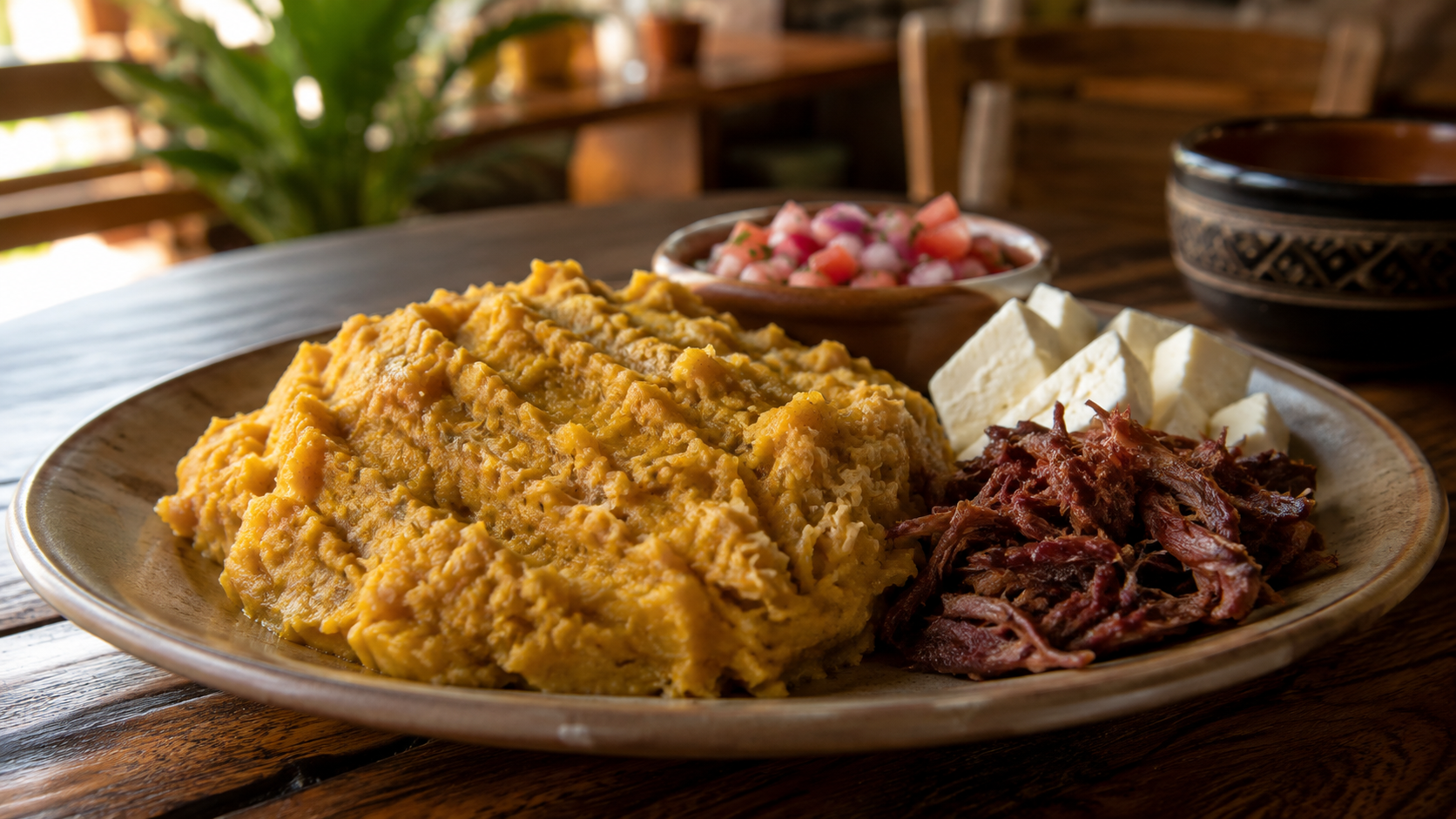
Masaco de plátano is a traditional preparation associated with Bolivia’s eastern lowlands, particularly Santa Cruz and Beni. The basic idea is simple: plantain is cooked until soft and then mashed, traditionally in a tacú. From there, recipes diverge. Some use cheese, others charque, and some combine plantain with meat, cheese, or both. Green, yellow, and ripe plantains all appear in documented preparations, so there is no reason to reject a restaurant simply because its masaco looks different from a version you have seen elsewhere.
That variation matters when you are trying to find a good version nearby. The most useful search is not for a generic banana dish but for a Bolivian restaurant, bakery, market stall, or café that understands the regional food traditions behind masaco.
Search for “masaco de plátano,” not just “masaco banana”
The word banana can send an English-language search in the wrong direction. The Bolivian recipes reviewed for this article consistently use plátano, and the ingredient is treated as a cooking plantain rather than as the soft dessert banana typically eaten raw. Bolivia.com, for example, publishes a version made with plátano amarillo—yellow plantain—fried, mashed and mixed with cheese. BoliviaBella describes the dish as mashed plantain and explains how changing the ripeness changes the balance between starchy and sweet flavors.
Try combinations such as:
- masaco de plátano near me
- masaco de platano near me
- masaco con queso
- masaco con charque
- masaco de plátano verde
- masaco de plátano maduro
- Bolivian restaurant near me
- comida boliviana near me
- comida camba restaurant
- Santa Cruz Bolivian food
The accent in plátano is linguistically correct, but searching both accented and unaccented forms can help when restaurant websites or user reviews omit Spanish diacritics.
Where you are most likely to find it
Masaco is strongly tied to eastern Bolivian cooking. A local report from Santa Cruz’s Mercado Nuevo described vendors serving both plantain and yuca masaco as part of a wider tradition of comida cruceña, alongside foods such as cuñapé and sonso. One third-generation vendor told EL DEBER that her family prepared traditional breakfast foods including masaco de plátano and masaco de yuca.
That makes the type of restaurant more useful than the broad label “Latin American.”
Start with establishments describing themselves as Bolivian, then look more specifically for restaurants or bakeries connected with Santa Cruz, Beni, eastern Bolivia or comida camba. A general South American restaurant could serve masaco, but there is no reason to assume it will: Latin American cuisine covers numerous countries and regional traditions.
Traditional markets, Bolivian bakeries, breakfast cafés and community food events are also worth checking. In Santa Cruz itself, masaco has historically appeared alongside breakfast and snack foods rather than only as a conventional lunch or dinner entrée. EL DEBER’s reporting on Mercado Nuevo places it among traditional breakfast preparations, while BoliviaBella describes masaco as commonly eaten as a snack or with tea or coffee.
Check the menu for these versions
Do not expect every restaurant to make exactly the same masaco.
Masaco de plátano con queso
This is one of the clearest meat-free versions documented in Bolivian recipe sources. Bolivia.com instructs cooks to fry yellow plantain, mash it in a tacú, mix in grated cheese and form the mixture into balls.
If you prefer a milder, cheese-forward preparation, search specifically for masaco con queso.
Masaco de plátano con charque
Charque is dried or dehydrated meat, and it is an important ingredient in numerous Bolivian preparations. In a Santa Cruz recipe published by EL DEBER, chef Nicole Wille uses ripe plantains and charque: the plantains are sautéed and then ground together with the meat.
This version tends to move further toward the savory side of the dish.
Green-plantain masaco
Green plantain gives a starchier and less sweet result. BoliviaBella notes that the flavor becomes sweeter as plantain ripens, while a 2025 EL DEBER article on traditional Santa Cruz cooking described almondrote as a related preparation resembling green-plantain masaco with cheese and egg.
If you specifically want a savory, less sweet masaco, masaco de plátano verde is a useful search term.
Ripe-plantain masaco
Ripe plantain is not automatically a sign that the dish has been turned into a dessert. EL DEBER’s 2022 recipe explicitly calls for ripe plantains and combines them with charque.
A good ripe-plantain version can therefore have both sweetness from the fruit and a strong savory component from cheese or meat.
What should good masaco be like?
There is no single texture or flavor profile that defines every regional or family recipe, but the published preparations have several useful characteristics in common.
The plantain should be cooked until it can be mashed, not simply served as crisp plantain chips. In BoliviaBella’s recipe, the plantain is fried until golden while deliberately being kept soft before it is mashed with the other ingredients. Bolivia.com’s cheese version similarly fries the plantain and then pounds it until it is close to a dough or purée.
The final texture may therefore be dense and rustic rather than completely smooth. Depending on the recipe, you may taste salty cheese, meat, pork fat or charque against the starchiness or sweetness of the plantain.
Ripeness makes a major difference. Green plantain produces a more neutral, starchy base, while increasingly ripe plantain introduces more sweetness. That means two well-prepared masacos can taste noticeably different without either being incorrect.
How to check a restaurant before making the trip
Because “near me” results depend on your location, there is no accurate universal ranking of the best masaco restaurants. Google states that local search results are influenced mainly by relevance, distance and prominence, meaning people in different neighborhoods can receive different results for the same food search.
Once you identify a promising Bolivian restaurant, check the actual listing rather than relying only on its star rating.
Google Business Profiles can contain restaurant menus, prices, photos and dish information. Google also allows restaurants and customers to associate dish names with food photos, which can be particularly useful for a specialty that may appear in photos even when a restaurant’s main website is sparse.
Look for the words masaco, plátano, queso, charque, verde and maduro in menus and recent customer material.
If the dish is important enough to justify a special trip, contact the restaurant before leaving. Ask:
“¿Tienen masaco de plátano hoy?”
Do you have plantain masaco today?
You can follow with:
“¿Es con queso o con charque?”
Is it made with cheese or charque?
And, if the distinction matters to you:
“¿Es de plátano verde o maduro?”
Is it made with green or ripe plantain?
Those three questions will tell you far more than asking whether a restaurant simply has “banana masaco.”
Do not confuse masaco de plátano with masaco de yuca
One of the easiest ordering mistakes is asking for “masaco” without specifying the base.
Masaco is not limited to plantain. Yuca versions are also part of eastern Bolivian cooking, and EL DEBER has documented the two preparations side by side. Its 2022 recipe makes one masaco from cooked yuca and another from ripe plantain, both incorporating charque. Mercado Nuevo vendors in Santa Cruz have likewise been reported making both plantain and yuca versions.
If plantain is what you want, ask specifically for masaco de plátano.
Is masaco banana sweet or savory?
It can be both.
That is one of the reasons descriptions that label masaco simply as a “savory banana dish” or a “sweet banana dish” are incomplete. A green-plantain version can be distinctly starchy and savory. Ripe plantain contributes sweetness, but it may still be mashed with salty cheese or charque.
The better question to ask a restaurant is which plantain and filling it uses.
If you want less sweetness, look for plátano verde and charque or cheese. If you enjoy a sweet-savory contrast, a ripe or yellow plantain preparation may suit you better.
What to order alongside masaco
Masaco does not necessarily need a collection of side dishes. Traditional accounts commonly place it in breakfast, snack or tea-time settings.
BoliviaBella describes it as something eaten warm with tea or coffee, and EL DEBER’s 2022 recipe suggests serving plantain and yuca masaco with hot whipped coffee or mocochinchi.
If you are visiting a Bolivian restaurant for the first time, however, the presence of other regional foods can help you understand the establishment’s cooking. Menus featuring dishes and baked goods associated with Santa Cruz and eastern Bolivia—such as cuñapé, sonso, majao or locro—may indicate a broader commitment to that regional tradition. EL DEBER documented several of those foods alongside masaco at Santa Cruz’s Mercado Nuevo.
That is a better authenticity signal than décor, branding or a generic claim to serve “Latin food.”
The quickest way to find the best masaco banana near you
Start with “masaco de plátano”, then widen the search to Bolivian restaurants if the dish itself produces few results.
Prioritize places whose menus, food photos or recent posts show the actual dish. Check whether the preparation uses green, yellow or ripe plantain and whether it includes cheese, charque or another meat. Finally, confirm availability before traveling if masaco is the main reason for your visit.
Most importantly, do not look for one supposedly definitive recipe. Bolivian sources document real variation. The best masaco near you is the one that is freshly prepared, clearly identified as masaco de plátano, and made in a style you actually want to eat.
Sources
Bolivia.com — “Masaco de plátano con queso (Bolivia)”
Publication/update date not clearly displayed.
https://www.bolivia.com/el-sabor-de-bolivia/asi-sabe-bolivia/masaco-de-platano-con-queso-r1110
EL DEBER — “Masaco de yuca y plátano”
September 7, 2022.
https://eldeber.com.bo/para-ellas/masaco-de-yuca-y-platano_292054/
EL DEBER — “En el Mercado Nuevo conservan el sabor típico de Santa Cruz”
September 13, 2021.
https://eldeber.com.bo/edicion-impresa/en-el-mercado-nuevo-conservan-el-sabor-tipico-de-santa-cruz_247060/
BoliviaBella — “Masaco de Platano – Mashed Plantain”
Publication/update date not clearly displayed.
https://www.boliviabella.com/masaco-de-platano.html
EL DEBER — “Sabores: El llamado a salvar la comida cruceña”
September 24, 2025.
https://eldeber.com.bo/especial/sabores-el-llamado-salvar-la-comida-crucena_531084/
Google Business Profile Help — “Manage your restaurant’s popular dish names”
Publication/update date not clearly displayed.
https://support.google.com/business/answer/9322475?hl=en
Google Business Profile Help — “Tips to improve your local ranking on Google”
Publication/update date not clearly displayed.
https://support.google.com/business/answer/7091?hl=en
Read also: Best Chairo Soup Near Me – Find Authentic Andean Soup Close to You