
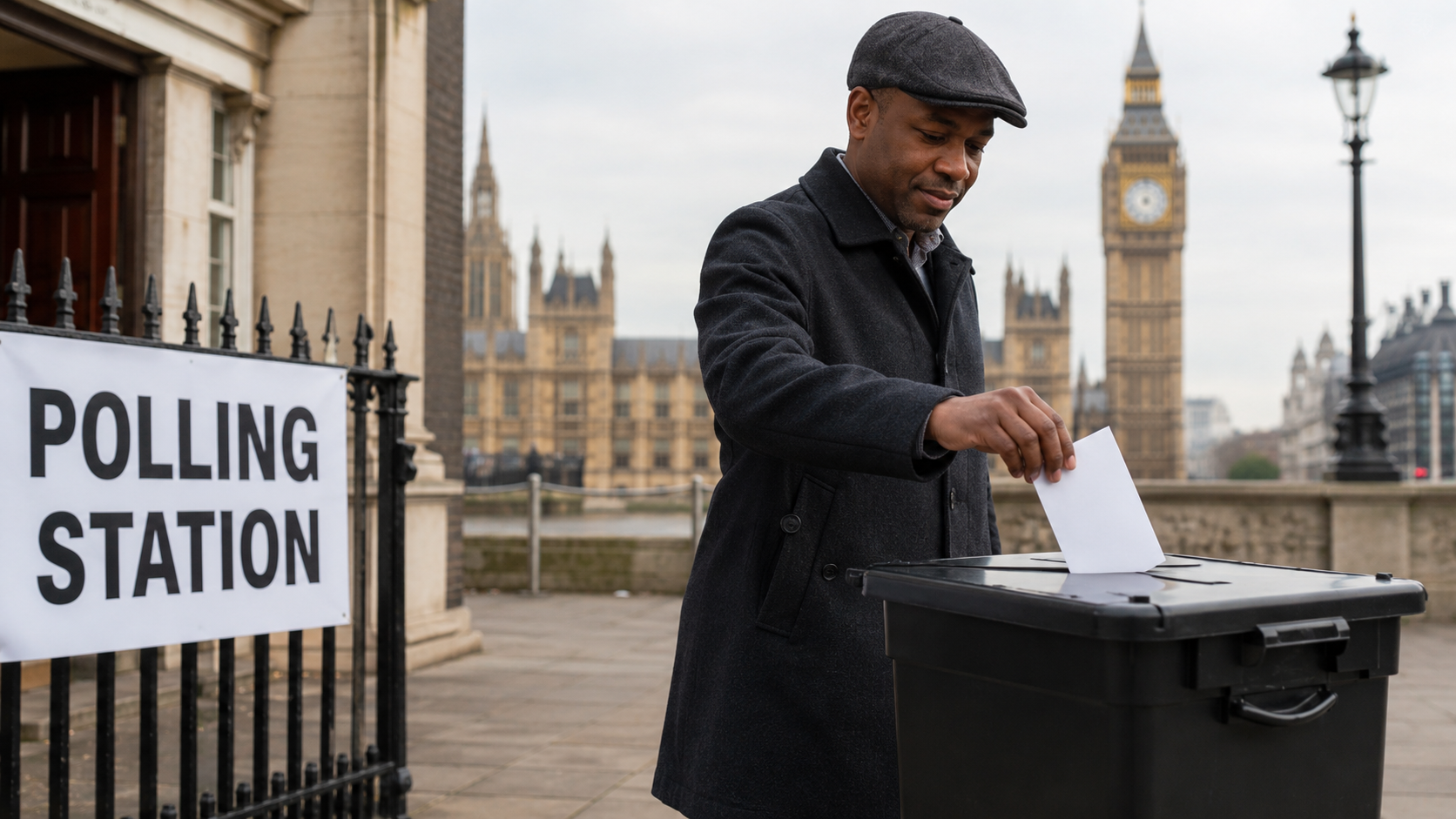

Many people ask, “how does UK general election process work?” A UK general election is a nationwide vote used to choose Members of Parliament, known as MPs, for the House of Commons. The public does not directly elect the Prime Minister. Each voter chooses one local candidate, and the results from all 650 areas help decide which party can form the government.
Why a UK General Election Happens
A general election usually takes place within five years of the previous one. It may also happen earlier. The Prime Minister normally asks the King to dissolve Parliament.
Dissolution ends the existing Parliament and makes every House of Commons seat vacant. MPs lose their seats, although government ministers remain in office during the election period so the country can continue to operate.
Dissolution starts the formal election timetable. Polling day takes place 25 working days later. Saturdays, Sundays and certain public holidays are not counted as part of those 25 working days.
The Role of the 650 Constituencies
To understand how does UK general election process work, people must understand constituencies. The UK is divided into 650 geographical areas called parliamentary constituencies.
Each constituency elects one MP to represent the people living in that area in the House of Commons.
Voters choose only among the candidates standing in the constituency where they are registered. Most candidates represent political parties, but independent candidates can also stand without joining a political party.
Candidates and the Election Campaign
Political parties normally select candidates for the constituencies they want to contest. Independent candidates can enter the election too. Every candidate must follow the official nomination rules before their name can appear on the ballot paper.
During the campaign, candidates and political parties explain their plans and ask people to support them. They may visit local areas, speak at public events, take part in debates and share information about their policies.
However, the ballot paper lists local candidates. A voter chooses one candidate rather than voting separately for a Prime Minister.
Who Can Vote?
Under the current rules, a person voting in a UK general election must be registered to vote, be at least 18 years old on polling day, meet the citizenship rules and not be legally excluded from voting.
British, Irish and qualifying Commonwealth citizens may be eligible. British citizens living outside the UK may also take part if they are correctly registered as overseas voters.
Being old enough does not automatically allow someone to vote. The person must join the electoral register before the official registration deadline.
Eligible voters can vote in person, vote by post or appoint a proxy. A proxy is an approved person who goes to a polling station and votes for someone else.
What Happens on Polling Day?
Polling stations normally open at 7:00am and close at 10:00pm. Anyone who is already waiting in the queue at 10:00pm can still vote.
At the polling station, the voter confirms their details and receives a ballot paper.
People voting in person at a UK general election must show an accepted form of photo identification. Someone who does not have accepted identification can apply for a free Voter Authority Certificate. Northern Ireland has separate identification arrangements.
The voter enters a private voting booth and marks one candidate on the ballot paper. The completed paper is placed inside a sealed ballot box. Voting is private, so nobody has to reveal which candidate they selected.
How First Past the Post Works
UK general elections use a voting system called First Past the Post. Each voter has one vote. The candidate who receives more votes than every other candidate in the constituency wins.
The winning candidate does not need to receive more than half of all the votes. The candidate only needs to have the highest total.
For example, one candidate might receive 15,000 votes, another might receive 13,000 votes and a third might receive 8,000 votes. The candidate with 15,000 votes wins because that is the highest number.
This process happens separately in every one of the UK’s 650 constituencies.
How Votes Are Counted
After polling stations close, the sealed ballot boxes are taken to official count centres. Election staff first check that the number of ballot papers matches the information recorded at polling stations.
Postal ballot papers are also included, and staff count how many valid votes each candidate received.
Some ballot papers may be blank, unclear or marked for more than one candidate. The Returning Officer examines these papers and decides whether they can be counted.
When counting ends, the Returning Officer announces the result and officially declares the winning candidate as the constituency’s new MP.
How a Government Is Formed
The national result depends on the number of seats won by each political party. It is not decided only by the total number of votes a party receives across the whole country.
Each constituency produces one winning MP. Political parties then add up how many constituency seats their candidates have won.
A party normally needs at least 326 of the 650 seats to have an overall majority. When one party wins an overall majority, its leader is normally appointed Prime Minister by the King. That party can then form the government.
Voters therefore influence who becomes Prime Minister by electing MPs, but they do not vote directly for the Prime Minister.
When no party has an overall majority, the result is called a hung Parliament. Political parties may form a coalition, create a minority government or agree to support another party on important votes.
The new government must be able to command the confidence of the House of Commons. This means it must have enough support from MPs to win major votes and continue governing.
Why Each Constituency Result Matters
The answer to how does UK general election process work is based on 650 local contests taking place at the same time.
A political party may receive many votes across the country but still win fewer seats if its candidates do not finish first in enough constituencies. Winning local races is therefore very important.
The elected MPs represent their local areas and also take part in national decisions. They debate proposed laws, vote in Parliament, question government ministers and raise problems affecting the people in their constituencies.
FAQ: Do UK Voters Elect the Prime Minister Directly?
No. UK voters elect local MPs. The leader who can form a government is normally appointed Prime Minister by the King.
FAQ: How Many MPs Are Elected?
The UK elects 650 MPs because it has 650 parliamentary constituencies. Each constituency chooses one MP.
FAQ: Must a Candidate Win More Than Half the Votes?
No. Under First Past the Post, a candidate only needs more votes than every other candidate standing in that constituency.
FAQ: What Happens If No Party Wins 326 Seats?
The result is normally a hung Parliament. Political parties must find a way to form a government that can win the confidence of the House of Commons.
FAQ: Can Someone Vote Without Visiting a Polling Station?
Yes. A registered voter may apply to vote by post or appoint an approved proxy before the relevant official deadline.
Conclusion
So, how does UK general election process work from beginning to end? Parliament is dissolved, candidates complete the nomination process, voters register, campaigns take place and polling stations open on election day.
Each voter chooses one candidate in their local constituency. After voting ends, the ballot papers are checked and counted. The candidate with the most votes in each constituency becomes its MP under the First Past the Post system.
After all 650 constituency results are declared, the number of seats won by each political party decides who can form the government. A party with an overall majority can normally govern alone. Its leader is usually appointed Prime Minister by the King.
When no party has an overall majority, political parties must create a coalition, minority government or another support arrangement. Whatever arrangement is chosen must have enough support in the House of Commons to govern successfully.
The UK general election process therefore turns millions of individual local votes into a new Parliament. Those constituency results decide which MPs will represent the public and which political party, or group of parties, will run the UK government.