
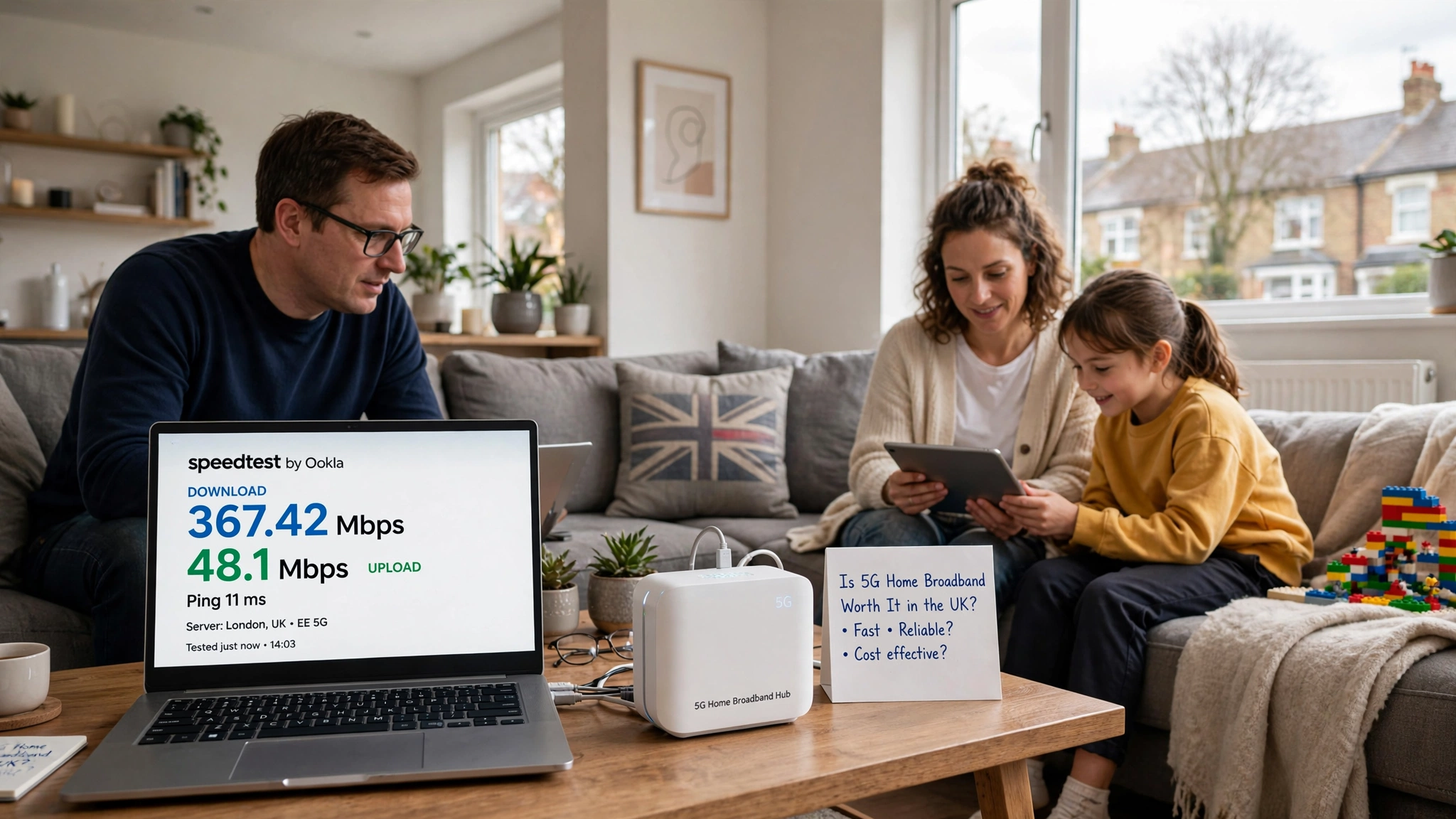

For many UK households, 5G home broadband is now a realistic alternative to a traditional fixed-line connection. It can deliver fast download speeds through a wireless router, requires little or no installation, and is often available on more flexible contracts than fibre broadband.
That does not mean it is automatically the best choice. A 5G connection that performs brilliantly in one street may be noticeably slower a few roads away. Signal strength, indoor coverage, local network demand and even the position of the router can affect the experience.
The practical answer is that 5G home broadband is worth it when you have a strong, stable signal and the package costs less than an equivalent fixed connection. It is particularly attractive for renters, students, people waiting for fibre installation and households still relying on slow copper broadband. Full fibre remains the safer choice when consistent performance, low latency or very fast uploads are essential.
What It Is
5G home broadband, sometimes called 5G fixed wireless access, connects your home to the internet through a mobile network rather than a copper telephone line or fibre-optic cable.
The provider supplies a router containing a SIM or embedded mobile connection. That router receives a 5G signal from a nearby mobile mast and creates a normal Wi-Fi network inside your property. Phones, televisions, computers, consoles and smart-home devices connect to it in much the same way as they would connect to an ordinary broadband router.
Ofcom describes mobile fixed wireless access as a service delivered over licensed 4G and 5G networks, usually through an indoor router. Some providers also use outdoor equipment where indoor signal quality is poor.
The main difference is the final part of the journey. Fixed broadband reaches your property through a physical cable. With 5G broadband, the connection between your home and the local mast travels through the air.
The UK Picture
5G coverage has expanded quickly, although national coverage statistics do not tell you exactly what will happen inside a particular home.
Ofcom’s Spring 2026 update found that individual UK mobile operators provided 5G coverage outside between 76% and 94% of premises, depending on the network. Coverage outside premises from all operators had risen to 64%. Ofcom also reported that 5G standalone coverage ranged from 49% to 85% across the three operators that had launched it.
Outdoor mobile coverage is not the same as usable indoor home broadband. Thick stone walls, modern energy-efficient glazing, nearby buildings, trees and local geography can weaken a signal before it reaches the router.
Ofcom estimated in 2025 that mobile-network fixed wireless services were available to 96% of UK premises, although most of that availability still included 4G services rather than 5G alone. Providers also restrict home broadband sales in areas where a mast may not have enough spare capacity to support large numbers of high-usage households.
This explains why a phone may display a 5G symbol at an address while a provider’s website refuses to sell 5G home broadband there. The provider is considering not only coverage but also expected performance and local capacity.
Realistic Speeds
The appeal of 5G broadband is speed. Under suitable conditions, it can comfortably outperform ADSL and many fibre-to-the-cabinet connections.
Three currently advertises an average 5G home broadband download speed of 150Mbps during the busy 8pm-to-10pm period. EE advertises an average of approximately 146Mbps for its Smart 5G Hub 7 Pro. Vodafone offers address-dependent packages with download speeds of up to 50Mbps or 150Mbps.
Those figures are fast enough for several simultaneous video streams, large downloads, cloud applications and everyday remote working. A stable 100Mbps connection is more than sufficient for the normal needs of many households.
Actual performance can be much higher or considerably lower than the advertised figure. Three states that an individual property’s speed is not guaranteed and may be affected by router position, line of sight to the mast, hills, walls and the number of people using the network locally. Vodafone gives similar warnings about coverage, signal strength, distance from the mast and network demand.
The word average therefore matters. It is not a promise that every customer will receive 150Mbps throughout the day.
Speed Variations
A fixed-line connection has a dedicated physical route into the property. A 5G home broadband customer shares radio capacity with mobile users and other wireless broadband customers connected to the same network infrastructure.
Ofcom notes that mobile fixed wireless services share network capacity with mobile users. In areas of high demand, an operator may decide that it cannot offer a reliable home broadband product, even where the mobile signal itself is available.
Speeds can be excellent early in the morning and slower during the evening when more people are streaming, downloading and using their phones. The difference may be small on a well-provisioned mast, but it can be substantial in a busy area.
Ofcom’s monitoring indicates that congestion remains generally infrequent across UK internet services, although it occurs more often on mobile networks than on fixed networks. That makes full fibre the more predictable option where consistent peak-time performance is important.
A proper test should therefore include several speed checks during the evening, not just one impressive result in the middle of the day.
Latency and Gaming
Download speed is only one part of a broadband connection. Latency, commonly shown as ping, measures how quickly data travels to a server and back.
For browsing and streaming, moderate changes in latency are rarely noticeable. Competitive gaming, live cloud applications, video conferencing and remote desktop software are more sensitive.
Ofcom’s 2025 mobile performance research found that 5G standalone had approximately 15% lower latency than non-standalone 5G. It also found that 70% of standalone 5G download measurements reached at least 100Mbps, compared with 46% for non-standalone 5G. However, standalone 5G represented only a small proportion of measured connections during that research period.
In ordinary use, a good 5G connection can support online gaming without difficulty. The problem is not necessarily the average ping but how much it moves. A connection that changes rapidly from 25 milliseconds to 80 milliseconds may feel less responsive than a fixed connection that remains close to 30 milliseconds.
Vodafone describes its service as suitable for casual and console gaming but advises serious or competitive gamers to consider a more performance-focused fixed broadband product. That is a sensible distinction.
For casual gaming, 5G can be perfectly adequate. For ranked competitive play, professional streaming or cloud gaming, full fibre is normally the lower-risk choice.
Streaming and Downloads
For streaming television, films and online video, 5G home broadband is often more than capable.
A household does not need gigabit broadband simply to watch several programmes at once. What matters is having enough sustained capacity for every active device without frequent drops or buffering.
A stable 100Mbps connection can handle multiple high-definition and 4K streams alongside browsing and ordinary downloads high-definition and 4K streams alongside. Three and Vodafone both market their 5G services for 4K streaming and multi-device households, while EE’s latest hub s917view0turn616836view2turn616836view1
Large game installations and software updates are also much less frustrating than they would be on a slow copper connection. The benefit becomes particularly noticeable for households currently receiving less than 30Mbps.
However, a household with several heavy users should choose an unlimited-data home broadband package, not a portable mobile broadband plan with a relatively small monthly allowance. Three’s 12- and 24-month home broadband plans, for exampleunlimited UK data. citeturn964917view0
Working from Home
5G broadband can support remote working, video meetings, cloud storage and business applications, provided that both download and upload performance are stable.
The upload side deserves attention. Mobile networks often deliver much faster downloads than uploads, and upload performance may vary more widely than fibre. Ofcom’s 2025 measurements showed a broad spread of 5G upload results: some connections remained bes exceeded 20Mbps. citeturn932422view1
A low upload speed can affect cloud backups, large file transfers, high-quality video calls and sending media files. Someone who mainly uses email, web applications and standard video meetings may never encounter a problem. A photographer, video editor or software developer moving large files could find it limiting.
Reliability also matters when a connection is used for paid work. A self-employed person may prefer to keep a second mobile SIM or another backup connection, particularly during the first few weeks of using 5G broadband.
It is also sensible to check whether a workplace VPN functions properly. Most modern VPN services work normally, but specialised business systems can have stricter networking requirements.
Technical Limits
Some mobile broadband services use carrier-grade network address translation, commonly shortened to CGNAT. This allows multiple customers to share public IPv4 address space rather than assigning a unique public IPv4 address to every connection. The method is formally documentedciteturn906794search0turn906794search4
For most households, CGNAT is invisible. Browsing, streaming, messaging, video calls and ordinary gaming generally continue to work.
It can become important when a user needs incoming internet connections. Examples include hosting a game server, operating certain home servers, accessing older CCTV systems remotely or setting up manual port forwarding.
Network arrangements vary by provider, package and access-point configuration. Anyone who needs a public IP address, bridge mode, port forwarding or a static IP should obtain a clear answer from the provider before signing a long contract.
The supplied router also needs checking. Look at the number and speed of Ethernet ports, Wi-Fi standard, external antenna support, bridge or modem mode and whether the router can be used with an existing mesh Wi-Fi system.
Setup and Positioning
The ease of installation is one of the strongest arguments in favour of 5G broadband.
An indoor hub can often be installed by inserting or activating the SIM, plugging in the power and following a short setup process. There is no requirement for a telephone socket, cable installation or engineer appointment.
Vodafone offers indoor and outdoor equipment depending on signal conditions. Three also supplies an outdoor hub with an indoor eero Wi-Fi router in areas where an exten. citeturn616836view2turn579502view5
Router placement can transform performance. The best position is usually elevated, unobstructed and reasonably close to a window facing the serving mast. The nearest window is not always the best one, so testing different sides of the property is worthwhile.
Move the router around before deciding that the service is poor. Test it upstairs and downstairs, rotate it, keep it away from large electronic devices and compare different windows. Once the strongest mobile signal has been found, a mesh system can distribute Wi-Fi to the rest of the property.
An outdoor receiver may be particularly useful in homes with thick walls or coated windows that weaken mobile signals.
Prices and Contracts
5G broadband can be cheaper than fixed broadband, but the full contract cost matters more than the introductory monthly figure.
At the time of writing, Vodafone advertised 24-month 5G broadband from £18 per month, 12-month service from £22 and rolling monthly options from £29 or £30, depending on speed. Three was advertising a promotional 24-month unlimited package with three months free before a stated monthly charge, alongside a £24 12-month option. Availability and the exacs. citeturn616836view2turn616836view3
These promotions can change quickly. Comparing only the first bill can therefore be misleading.
New UK telecoms contracts must show planned mid-contract increases clearly in pounds and pence rather than using an unknown future inflation percentage. Ofcom reported that announced 2026 increases ranged from £2 to £4roadband services. citeturn932422view2
Read the provider’s price schedule and calculate the total cost over the full term. A package beginning at £20 but increasing by £3.50 each April may not remain cheaper than fibre for long.
Flexible contracts are another advantage. Vodafone offers rolling monthly 5G broadband, while Three provides a 30-day money-back guarantee on its home broadband plans. These options reduce the risk of committing to a connection before knowingy. citeturn616836view2turn964917view0
5G or Full Fibre
When both services are available at similar prices, full fibre is usually the stronger long-term connection.
By January 2026, full fibre was available to 82% of UK homes, while gigabit-capable broadband had reached 89%. This means many properties considering 5G mtive fixed option. citeturn468021view0
Full fibre normally offers greater consistency, more capacity and less sensitivity to weather, building materials, mast position or local mobile usage. It is better suited to heavy uploads, competitive gaming, home servers and households that cannot tolerate regular performance changes.
5G wins on convenience. It can be activated quickly, moved more easily and installed without drilling or waiting for an engineer. It may also be considerably faster than an existing part-fibre or copper line.
The best comparison is not simply 5G versus fibre. It is the exact 5G service available at your address versus the exact fixed broadband package available at the same address.
A stable 150Mbps 5G service for £20 can be excellent value compared with a 35Mbps copper-based connection. It is less compelling when reliable 500Mbps full fibre is available for only a few pounds more.
Who Should Choose It
5G home broadband makes the most sense for renters, students, temporary residents and people who need internet quickly. The lack of a fixed installation makes moving simpler, although providers may still require the new address to pass an availability check.
It can also be a valuable upgrade for homes stuck with slow ADSL or distance-limited part-fibre. In those cases, even a moderate 5G result may represent a dramatic improvement.
Small households that mainly browse, stream and work online are likely to be satisfied when the signal is strong. Larger families can also use it successfully, but should test peak-time stability with several devices active.
It is less suitable for competitive gamers, professional content creators, home-server operators and businesses requiring guaranteed performance or specialist network settings. Those users should normally favour full fibre or a business-grade fixed connection.
How to Test It
A postcode checker should be the beginning of the decision, not the end.
Test the actual provider you intend to use. A strong 5G signal from one network says nothing about another network’s performance. Where possible, use a compatible phone or temporary SIM to run tests in several rooms before ordering.
After receiving the router, test download speed, upload speed, ping and stability at different times. Include the busy period between 8pm and 10pm, because UK advertised broadband averages are based on performance during those evening hours. For the most accurate result, Ofcom recommends connecting a computer to the router with an Ethernet cablentirely on Wi-Fi. citeturn932422view3
Try normal household activities at the same time: stream television, join a video call, download a large file and play an online game. A speed-test number is useful, but the real question is whether the connection remains comfortable under ordinary pressure.
Do not cancel an existing broadband service until the 5G connection has been tested properly and any return period is understood.
The Verdict
5G home broadband is worth it in the UK for the right address, but the address matters more than the technology label.
It offers a strong combination of speed, simple installation and flexible contracts. In a property with excellent reception and spare mast capacity, it can provide fibre-like everyday performance at a competitive price. It is especially valuable where fixed broadband is slow, expensive or difficult to install.
Its weaknesses are variability, less predictable upload performance and greater dependence on local network conditions. Headline speeds should never replace real testing inside the home.
Choose 5G when it gives you a clear improvement over your existing connection, the provider offers a useful trial or return period, and evening performance remains stable. Choose full fibre when the prices are close and consistency, low latency, upload capacity or specialist networking features are more important.
For most people, the fairest conclusion is straightforward: 5G home broadband can be excellent value, but it should be tested rather than trusted on coverage claims alone.
Frequently Asked Questions
Is 5G home broadband faster than fibre?
It can be faster than ADSL and many part-fibre connections, particularly where copper line speeds are poor. It is unlikely to beat a high-speed full-fibre package consistently, especially during busy periods.
Does 5G home broadband have unlimited data?
Some dedicated home broadband plans include unlimited data, but portable mobile broadband packages may have monthly allowances. Check whether the plan is genuinely unlimited and whether a fair-use policy applies.
Can I use 5G broadband for gaming?
Yes, particularly for casual and console gaming. Competitive players should test ping, jitter and evening stability because wireless performance can fluctuate more than full fibre.
Where should I put a 5G router?
Place it in an elevated, open position and test windows on different sides of the property. Keep it away from cupboards, televisions and other obstructions. An outdoor receiver may help where walls or glazing weaken the signal.
Can 5G broadband replace my normal home internet?
For many households, yes. It can support streaming, work, study, gaming and smart devices. Before replacing a fixed service, test the 5G connection at peak times and confirm that it supports any specialist needs such as port forwardin, public IP addressing or large uploads.