
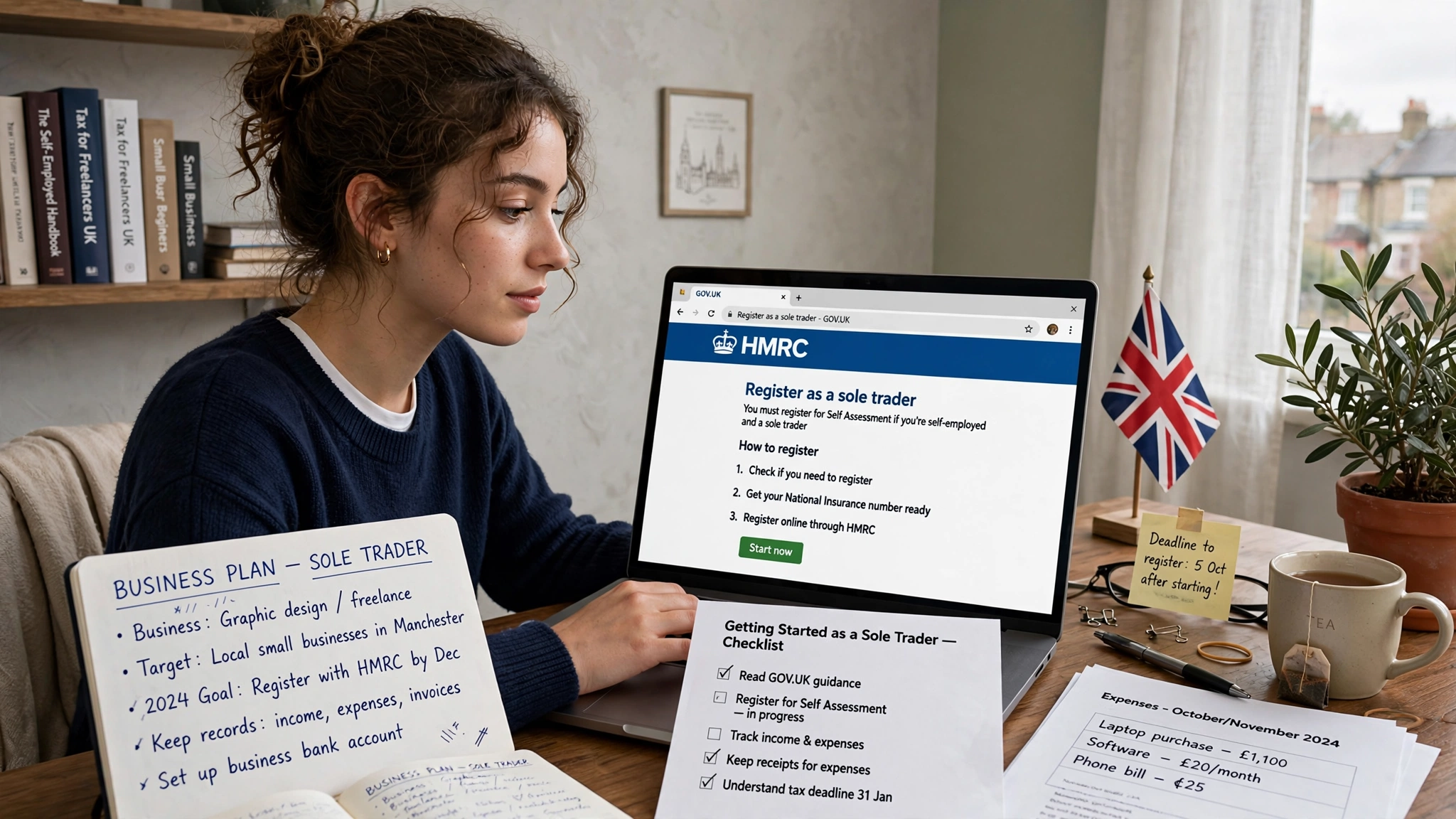

Becoming a sole trader is one of the simplest ways to start a business in the UK. You can begin trading without forming a limited company, appointing directors or registering your business with Companies House.
The simplicity is attractive, but it does not mean that running a sole trader business is informal. You are still responsible for registering with HM Revenue and Customs when required, keeping accurate financial records, reporting your income, paying tax and following any rules that apply to your industry.
This guide explains how to become a sole trader in the UK, what you need to register, how tax works and which practical steps can make your first year easier.
Know the structure
A sole trader is an individual who owns and runs a business personally. You can work alone, hire employees or use subcontractors, but the business itself is not legally separate from you.
You keep the profits after paying tax, but you are also personally responsible for the business’s debts and obligations. This is known as unlimited liability. If the business cannot pay a supplier, customer claim or other debt, your personal finances and assets may be exposed.
This is the main difference between being a sole trader and running a limited company. A limited company is a separate legal entity, while a sole trader and their business are legally the same person.
The sole trader structure is commonly suitable for freelancers, consultants, tradespeople, online sellers, tutors, photographers, designers, cleaners and other small owner-operated businesses. A limited company may be worth considering when financial risk is high, several people will own the business or outside investment is required.
Confirm you are trading
Not every occasional sale or small payment automatically means you are running a business. HMRC is more likely to consider you to be trading when you regularly sell goods or services for profit, advertise your services, buy stock to resell or operate in an organised commercial way.
You can be employed and self-employed at the same time. For example, you might have a full-time job while providing freelance services in the evenings. Income from your employment would normally continue to be taxed through PAYE, while your sole trader income would be reported separately.
Describing yourself as self-employed in a contract does not necessarily make you self-employed for tax purposes. The actual working relationship matters. HMRC’s Check Employment Status for Tax service can help determine whether a particular engagement should be treated as employment or self-employment.
Understand the £1,000 rule
You normally need to register as a sole trader when your gross trading income exceeds £1,000 during a tax year. Gross income means the money received before deducting expenses.
The UK tax year runs from 6 April to 5 April. If your total gross trading income does not exceed £1,000, the trading allowance may mean that you do not need to register for Self Assessment solely because of that income.
There are situations in which you may still want or need to register below the threshold. These include proving that you are self-employed, registering as a Construction Industry Scheme subcontractor, reporting a trading loss or making voluntary Class 2 National Insurance contributions to protect your entitlement to certain benefits or the State Pension.
The £1,000 figure applies to income, not profit. A person who receives £1,500 from customers and spends £900 on business costs has gross income of £1,500, even though the remaining profit is only £600.
Register with HMRC
You become officially registered as a sole trader by registering for Self Assessment with HMRC. Sole traders do not normally register their business with Companies House.
You will usually need your National Insurance number, personal details, contact information and information about when your self-employment began. HMRC will issue or confirm your Unique Taxpayer Reference, commonly called a UTR, after registration.
You must normally tell HMRC by 5 October following the end of the tax year in which you became liable to file a return.
For example, suppose you begin trading on 15 August 2026 and earn more than £1,000 before 5 April 2027. That activity falls within the 2026–27 tax year. You would normally register by 5 October 2027 and submit your online Self Assessment return by 31 January 2028.
There is no advantage in waiting until the October deadline. Registering earlier gives you time to receive your UTR, organise your HMRC account and resolve any problems before your first return is due.
Choose a name
You can trade under your personal name or create a separate business name. A plumber named Daniel Brown could trade as “Daniel Brown” or use a name such as “Brown Home Plumbing.”
A sole trader business name must not include terms such as Limited, Ltd, LLP, public limited company or plc. It must not be offensive or so similar to a protected trademark that it could create a dispute.
Choosing a business name does not create a separate legal organisation. You remain personally responsible for the business.
Before using a name, search online, check domain-name availability, review social media usernames and search the UK trademark register. This reduces the risk of spending money on branding that may later need to be changed.
When using a trading name, your official documents must show both your own name and the business name. Your invoices must also include an address where legal documents can be delivered.
Separate your money
A sole trader is not legally required to open a business bank account. However, using a dedicated account is one of the most useful steps you can take.
Separating business and personal transactions makes it easier to track income, identify expenses, prepare tax figures and answer questions if HMRC reviews your records.
Before opening an account, check the bank’s terms. Some personal current accounts prohibit or restrict business use, even though the law does not require sole traders to hold a formal business account.
Pay customer income into the dedicated account and use it for business purchases wherever possible. When taking money for yourself, transfer it to your personal account and record it as a personal withdrawal rather than a business expense.
Keep good records
Record-keeping begins when you start trading, not when your first tax return becomes due. You must keep enough information to calculate your income, expenses, profit or loss accurately.
Useful records include customer invoices, sales receipts, bank statements, supplier bills, mileage records, equipment purchases, payment-processing statements and evidence of business expenses. You should also record money introduced into the business from your personal funds.
Most sole traders can keep records using a spreadsheet, bookkeeping application or accounting platform. The best system is one you can update consistently and understand without having to reconstruct an entire year from bank statements.
For tax years beginning from 6 April 2024, the cash basis is the standard accounting method for eligible sole traders and qualifying partnerships unless they choose traditional accounting. Under the cash basis, income and expenses are generally recorded when money is actually received or paid.
Self-employed business records must normally be kept for at least five years after the 31 January submission deadline for the relevant tax year. Records may need to be retained longer when a return is late or HMRC has started a compliance check.
Track expenses
Sole traders pay tax on taxable profit rather than total sales. In simple terms, profit is calculated by deducting allowable business costs from business income.
Allowable expenses may include office supplies, website hosting, software subscriptions, advertising, professional fees, relevant insurance, business travel, accountancy charges and the business portion of phone or internet bills.
An expense must generally be incurred for business purposes. Where something is used for both business and personal reasons, only the business portion can normally be claimed. If 40% of a mobile phone bill relates to business calls and data use, only that proportion should usually be treated as a business expense.
Do not assume that every payment from the business account is tax-deductible. Personal withdrawals, ordinary clothing, private travel, loan repayments and personal living costs are not automatically allowable.
The trading allowance can sometimes be claimed instead of actual expenses. You cannot normally use the £1,000 trading allowance and deduct the same business’s actual expenses as well, so compare the two methods before completing your return.
Plan for tax
Sole traders normally pay Income Tax on taxable profits, together with any National Insurance contributions that apply. The amount depends on your total income, available allowances and personal circumstances.
The standard Personal Allowance for the 2026–27 tax year is £12,570, although it can be reduced when adjusted net income exceeds £100,000. Income Tax bands may also differ for Scottish taxpayers.
For 2026–27, self-employed people generally pay Class 4 National Insurance at 6% on profits above £12,570 and up to £50,270, followed by 2% on profits above £50,270.
When annual profits are at least £7,105, Class 2 contributions are treated as paid to protect the individual’s National Insurance record, without an actual Class 2 payment being required. Those with lower profits may be able to make voluntary Class 2 contributions, which cost £3.65 per week for 2026–27.
Tax rates and thresholds can change, so check the figures for the tax year covered by your return rather than relying on an old calculation.
A sensible habit is to move a percentage of each customer payment into a separate tax savings account. The appropriate percentage depends on your profit margin, other income and tax band, but saving as you earn is safer than trying to find the full amount in January.
Expect payments on account
A first Self Assessment bill can be larger than expected because HMRC may ask for both the tax due for the completed year and an advance payment towards the following year.
These advance instalments are known as payments on account. Each payment is usually equal to half of the previous year’s qualifying tax bill. The first is normally due on 31 January and the second on 31 July.
For example, a new sole trader with a £3,000 qualifying bill could be asked to pay the £3,000 balance plus a £1,500 first payment on account by 31 January. A second £1,500 payment could then be due on 31 July.
Payments on account may be reduced when you reasonably expect the following year’s bill to be lower. However, reducing them too far can result in interest if the final liability is higher than estimated.
Check VAT early
VAT registration is separate from sole trader registration. You do not automatically register for VAT simply because you have registered for Self Assessment.
You must normally register when your VAT-taxable turnover for the previous rolling 12 months exceeds £90,000, or when you expect it to exceed the threshold within the next 30 days. Voluntary registration is possible below the threshold.
The VAT test uses taxable turnover rather than profit. It also works on a rolling 12-month basis, not only by tax year or calendar year. A growing business should therefore review turnover every month instead of waiting until the end of its accounts.
Voluntary VAT registration can help a business reclaim VAT on eligible purchases, but it also creates filing, pricing and record-keeping responsibilities. It may make your services appear more expensive when most customers are members of the public who cannot reclaim VAT.
Prepare for digital tax
Making Tax Digital for Income Tax is now being introduced for qualifying sole traders and landlords. It requires digital records and compatible software to provide information to HMRC.
A sole trader whose qualifying self-employment and property income for 2024–25 exceeded £50,000 should have started using Making Tax Digital for Income Tax from 6 April 2026. Those with qualifying income above £30,000 for 2025–26 must begin from 6 April 2027, while those above £20,000 for 2026–27 must begin from 6 April 2028.
These thresholds relate to qualifying gross income, not taxable profit after expenses. HMRC reviews the relevant Self Assessment return and may write to taxpayers who need to join, but checking whether the rules apply remains the taxpayer’s responsibility.
Even when your income is currently below the threshold, digital bookkeeping is worth considering. Starting with suitable software is generally easier than transferring years of spreadsheet and paper records later.
Some people can apply for an exemption, including certain individuals who are digitally excluded. An exemption from Making Tax Digital does not remove the wider responsibility to report taxable income.
Check licences
Registering with HMRC does not automatically give you permission to carry out every business activity. Some trades and professions require licences, registrations, qualifications or local authority approval.
Licensing rules may apply to activities such as food preparation, childcare, street trading, selling alcohol, transporting waste, playing music commercially or operating certain premises. The GOV.UK licence finder can be used as a starting point.
Home-based businesses may need permission from a landlord, mortgage provider, insurer, local council or planning authority. This is particularly relevant when customers will visit, frequent deliveries are expected, staff will work at the property or alterations are required.
Arrange insurance
Business insurance can protect you against risks that are not covered by an ordinary home, vehicle or personal insurance policy.
Public liability insurance may be useful when customers visit your premises or when you work on client sites. Professional indemnity insurance may be appropriate when clients rely on your advice, designs or specialist services. Product liability cover may be relevant when you manufacture or sell physical products.
These policies are not compulsory for every sole trader, but a client, landlord, professional body or contract may require them.
If you employ someone, Employers’ Liability insurance is normally compulsory and must provide cover of at least £5 million through an authorised insurer. Failing to hold the required cover can result in substantial daily fines.
Protect customer data
A sole trader who collects names, email addresses, delivery details, employee records or other personal information must consider UK data-protection responsibilities.
Many businesses and sole traders that process personal data must pay a data-protection fee to the Information Commissioner’s Office unless an exemption applies. Check your position before assuming that a small business is automatically exempt.
Use secure passwords, restrict access to customer information, keep software updated and avoid retaining personal data longer than necessary. A clear privacy notice can also explain what information you collect and why you use it.
Read more: What Is Digital Privacy and How Does It Work?
Create proper invoices
A professional invoice makes it easier to receive payment and maintain reliable records.
An invoice should include a unique number, your contact details, the customer’s name and address, a description of the goods or services, the supply date, invoice date, amounts charged and the total owed. VAT must be shown when applicable.
A sole trader invoice must also show your personal name, any business name you use and an address where legal documents can be delivered when you trade under a business name.
Include clear payment terms, accepted payment methods and a due date. Agreeing these details before beginning work can prevent arguments after the service has been delivered.
Written contracts are equally important. A basic contract should explain the work, price, schedule, payment terms, ownership of work, cancellation arrangements and what happens when the scope changes.
Price for reality
New sole traders often calculate prices using only the hours spent delivering a service. This can produce a rate that looks profitable but fails to cover the full cost of running the business.
Your price may need to cover software, equipment, travel, insurance, marketing, accounting, unpaid administration, cancelled work, holidays, pension saving and periods without customers.
Work out the minimum revenue required each month, estimate realistic billable hours and add a margin for tax and unexpected costs. Review prices regularly rather than keeping an introductory rate long after costs have increased.
Requesting a deposit or staged payments can improve cash flow for longer projects. For products, include packaging, transaction charges, delivery costs, returns and damaged stock when calculating the true margin.
Hiring people
A sole trader can employ staff. The word “sole” refers to business ownership, not the number of people who can work in the business.
Before paying an employee, you may need to register as an employer, operate PAYE, check their right to work, meet workplace pension duties and follow minimum wage and employment law requirements. Employers’ Liability insurance will usually be required.
Calling someone a freelancer does not remove employment responsibilities when the real arrangement resembles employment. Check each worker’s status rather than relying only on the wording of an invoice or contract.
Avoid common mistakes
One common mistake is registering too late because the owner focuses on profit rather than gross trading income. The £1,000 registration test is based on income before expenses.
Another is spending money set aside for tax. Keeping tax savings in a separate account reduces the temptation to treat them as available profit.
Poor records are equally costly. Missing receipts, mixed bank transactions and unnumbered invoices create unnecessary work and may cause allowable costs to be overlooked.
Do not ignore VAT until turnover reaches exactly £90,000. The test is based on rolling taxable turnover and can be triggered during the year.
Finally, do not miss the Self Assessment deadline. A late online return normally attracts an initial £100 penalty, with further penalties possible as the delay continues.
Start with a checklist
During your first few weeks, complete these practical steps:
- Confirm that sole trader status suits the financial risk of the business.
- Record the date on which trading begins.
- Choose and check your business name.
- Register for Self Assessment when required.
- Open a separate account for business transactions.
- Create an invoicing and bookkeeping system.
- Start recording income and expenses immediately.
- Estimate tax and save from each payment.
- Check VAT turnover every month.
- Review licences, insurance and data-protection duties.
- Create written customer terms or contracts.
- Check whether Making Tax Digital will apply.
A simple system followed every week is more valuable than an elaborate system that is only updated once a year.
Final thoughts
Becoming a sole trader in the UK is straightforward, but running the business well requires more than completing an HMRC registration form.
The strongest start comes from treating the business professionally from the first customer: keep accurate records, separate your money, price work properly, understand your deadlines and plan for tax before it becomes due.
As income, risk or staffing grows, review whether remaining a sole trader is still the right structure. An accountant or qualified business adviser can help assess your circumstances, particularly when VAT, employees, property income, overseas customers or significant financial liabilities are involved.
FAQs
Can I become a sole trader while employed?
Yes. You can have an employed job and operate a sole trader business at the same time. Your salary will usually be taxed through PAYE, while qualifying self-employed income and expenses are reported through Self Assessment.
Do I need to register before earning any money?
Not necessarily. You normally need to register when gross trading income exceeds £1,000 during a tax year, although you may register for other reasons, such as proving self-employment or paying voluntary National Insurance contributions.
Does a sole trader need a business bank account?
A separate business account is not generally a legal requirement for a sole trader. However, it can make bookkeeping, tax preparation and cash-flow monitoring considerably easier. Check whether your personal bank allows business transactions.
How much tax does a sole trader pay?
Tax depends on taxable profit, other income and personal allowances. For 2026–27, Class 4 National Insurance is generally charged at 6% on profits between £12,570 and £50,270 and 2% above £50,270. Income Tax may also apply.
Can a sole trader hire employees?
Yes. A sole trader can employ staff, but must follow employer responsibilities such as PAYE, right-to-work checks, employment law and workplace pension requirements. Employers’ Liability insurance will normally be compulsory.
Read more; Best Tools and Resources for Apprenticeships in the UK